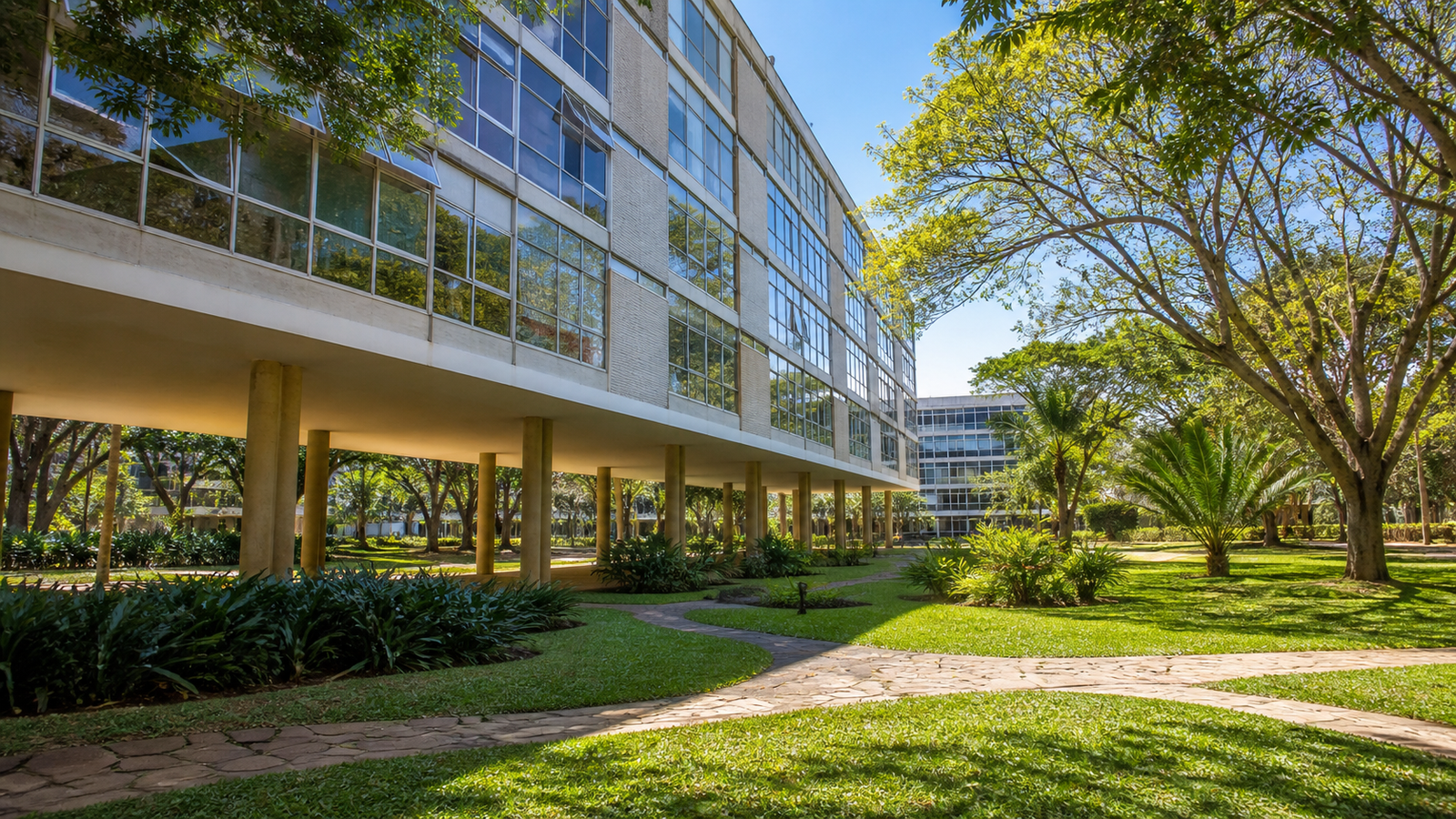
Most travelers arrive in Brasília expecting only the colossal concrete plazas and highway-wide avenues of the civic center. Standing on the vast Esplanade of the Ministries under the blazing central plateau sun, it is easy to assume Brazil’s planned capital was designed exclusively for cars. But a ten-minute ride south on the city’s underground metro reveals an entirely different reality: Asa Sul (the South Wing), a tranquil world of shaded parklands where mid-century apartment buildings float on pillars without a single fence or security wall blocking your path.
Asa Sul is the residential heart of urban planner Lúcio Costa’s airplane-shaped Plano Piloto. While government business dominates the central fuselage, daily life thrives in the South Wing’s leafy residential blocks, known as superquadras. If you are planning a trip using our Brasília 3-day itinerary, taking half a day to explore Asa Sul on foot offers the ultimate human-scale counterweight to the monumental scale of our Monumental Axis guide.
Beyond the Monumental Axis: Understanding Brasília’s South Wing
Asa Sul represents one of the 20th century’s most ambitious experiments in communal urban living. When Lúcio Costa drafted the master plan in 1957, he envisioned residential neighborhoods that eliminated the traditional chaotic city grid in favor of autonomous, self-contained “neighborhood units” (Unidades de Vizinhança).
Each superquadra is a standardized 280-by-280-meter square surrounded by a protective green belt of native trees. Within each block, apartment buildings (known locally as blocos) are strictly capped at six stories high. More importantly, every single residential building is raised on pilotis—slender reinforced concrete pillars—leaving the entire ground level completely open to the public.
Because there are no private perimeter walls, gates, or front yards, the ground beneath the buildings is continuous public parkland. You can stroll freely through gardens, under apartment buildings, past children’s playgrounds, and across lawns beneath mature mango trees and blooming ipês without ever hitting a dead end or gated compound.
Deciphering the Coordinates: How Addresses Work in Brasília
One of the biggest hurdles for first-time visitors is Brasília’s famous alphanumeric address system. Instead of traditional street names named after historic figures or dates, addresses in the South Wing function like a geographic GPS coordinate code.
Understanding this system is remarkably simple once you learn the basic formula:
| Acronym | Portuguese Term | Meaning & What You Will Find | Key Example |
|---|---|---|---|
| SQS | Superquadra Sul | Residential block with apartment buildings on pilotis, open lawns, and trees | SQS 308 (Protected model quadra) |
| CLS | Comércio Local Sul | Commercial street rows with cafes, bakeries, pharmacies, and restaurants | CLS 405 Sul (Top dining strip) |
| EQS | Entrequadra Sul | Shared public space between residential blocks (schools, churches, cinemas) | EQS 307/308 (Igrejinha chapel) |
The numbers follow a clear geographic logic based on their position relative to the central high-speed highway (Eixo Rodoviário, or Eixão). Quadras numbered in the 100s and 300s sit on the western side of the highway, while quadras in the 200s and 400s sit on the eastern side. The double-digit number (from 01 to 16) indicates how far south the block is from the central bus station (Rodoviária do Plano Piloto). A lower number like SQS 102 is close to downtown, while SQS 114 is farther south.
SQS 308: Inside Brasília’s Protected Model Superquadra
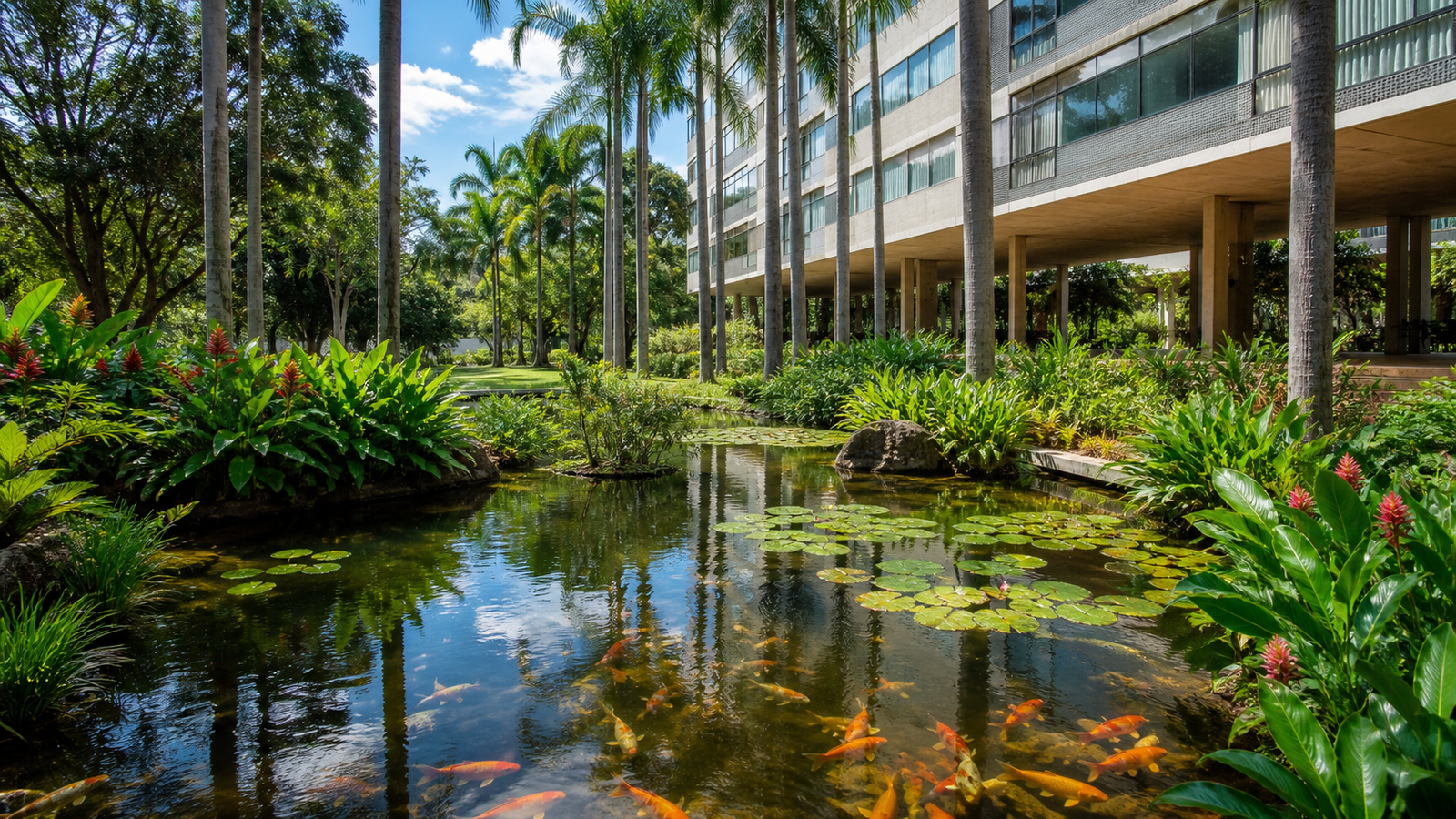
While all superquadras follow Costa’s urban guidelines, SQS 308 (Superquadra Sul 308) is universally celebrated as the crown jewel of the Plano Piloto. Built between 1958 and 1961 originally for employees of Banco do Brasil, SQS 308 was executed exactly as the utopian architects conceived, earning full federal heritage protection from IPHAN (National Institute of Historic and Artistic Heritage).
SQS 308 is the only superquadra in Brasília with a complete communal landscape design signed by legendary landscape architect Roberto Burle Marx. As you walk between the residential blocks, you will discover sinuous stone paths weaving through lush tropical gardens, dense clusters of royal palms, and a tranquil koi pond (espelho d’água) near Bloco F filled with water lilies and swimming carp.
Take time to admire the residential facades: many feature decorative cobogós—hollow perforated ceramic and concrete blocks designed to filter harsh sunlight while allowing the dry savanna breeze to naturally ventilate building stairwells and hallways. The absence of car traffic inside the inner gardens makes SQS 308 a peaceful oasis of mid-century modernist beauty.
Igrejinha Nossa Senhora de Fátima: Niemeyer and Athos Bulcão in Miniature
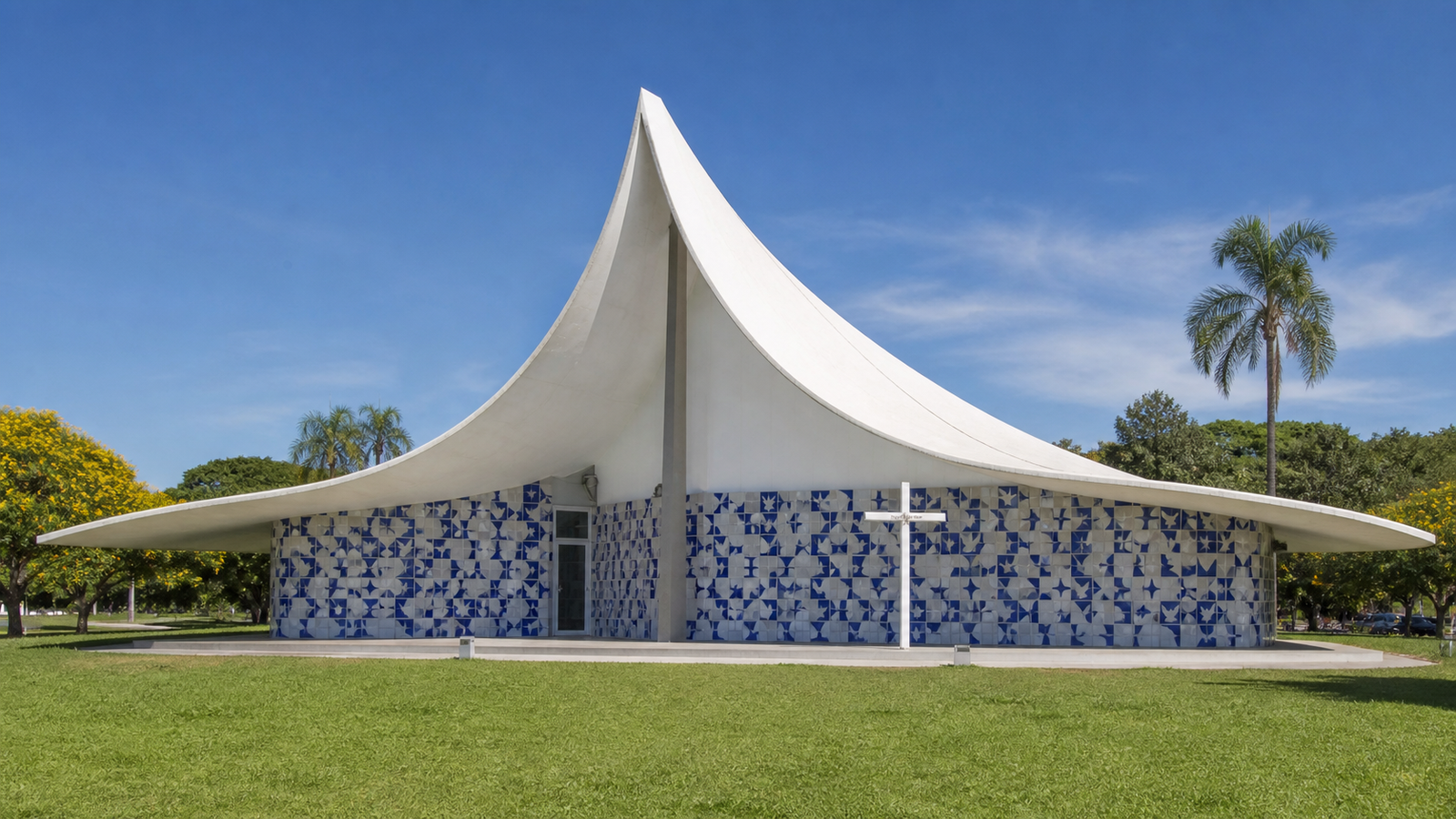
Directly adjacent to SQS 308, in the community space between quadras 307 and 308 (EQS 307/308), stands one of Brasília’s most beloved and photogenic architectural treasures: the Igrejinha Nossa Senhora de Fátima.
Inaugurated on June 28, 1958, the Igrejinha was the very first permanent masonry church built in the new capital. It was constructed in just 100 days as the fulfillment of a personal vow made by First Lady Sarah Kubitschek for the health of her daughter. Designed by Oscar Niemeyer, the chapel’s graceful triangular canopy roof curves gently upward, evoking the shape of a nun’s winged headpiece.
What makes the chapel truly unforgettable is its exterior tilework. The outer walls are clad in exquisite geometric blue-and-white ceramic tiles created by master artist Athos Bulcão, depicting stylized doves of peace and the star of Bethlehem. The chapel is free to view from the outside at all hours, and stepping inside reveals colorful stained glass and sacred murals painted by Francisco Galeno.
Comércio Local and Cine Brasília: Where Daily Life and Culture Meet
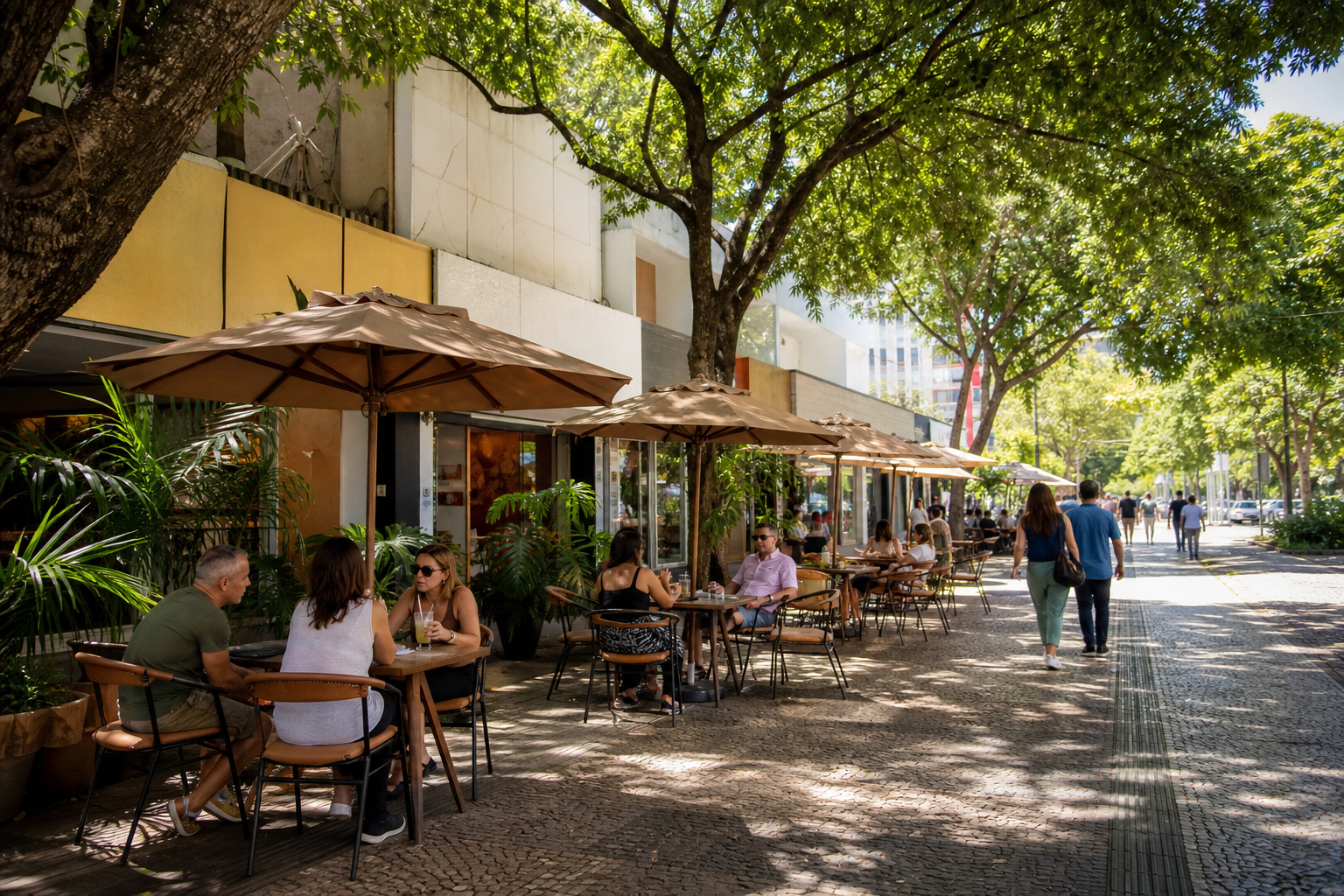
Each residential block in Asa Sul is paired with dedicated commercial strips known as Comércio Local (CLS). Unlike enclosed shopping malls, these open-air, low-rise commercial rows are designed for neighborhood convenience, hosting pharmacies, bookstores, artisan bakeries, and sidewalk cafes.
If you are looking for specialty coffee, gelato, or a leisurely lunch, head to CLS 405 Sul and CLS 404 Sul, often called the gastronomic heart of the South Wing. Here, outdoor tables spill out onto tree-lined sidewalks where local residents gather for espresso and Brazilian craft beer. For classic local flavor, visit the legendary bar Libanus in CLS 206 Sul, famous since the capital’s early days for cold draft beer and Middle Eastern appetizers.
Culture lovers should also walk over to Cine Brasília, located in EQS 106/107 Sul. Designed by Oscar Niemeyer and opened during the capital’s inaugural week in April 1960, this historic 600-seat movie palace serves as the permanent home of the prestigious Festival de Brasília do Cinema Brasileiro. It remains an active public cinema screening Brazilian and international art-house films at affordable ticket prices.
Practical Tips: Metro Access, Shaded Paths, and Crosswalk Etiquette
Exploring Asa Sul on foot is straightforward, safe, and pleasant if you follow a few practical local tips:
- How to Arrive by Metro: Take the Metrô-DF from the central Galeria or Central station to Estação 108 Sul (ideal for SQS 308 and the Igrejinha) or Estação 106 Sul (adjacent to Cine Brasília). A single one-way ticket costs R$ 5.50.
- Pedestrian Crosswalk Etiquette: Brasília has the most famous crosswalk culture in Brazil. When approaching a marked pedestrian crossing (faixa de pedestres), simply stand at the curb and extend your arm outward; vehicle traffic will reliably come to a complete halt to let you cross.
- Weather & Sun Protection: During Brasília’s dry season (May through September), relative humidity frequently drops below 20%. Always carry a refillable water bottle, wear sunscreen, and take advantage of the shaded superquadra tree canopies.
- Best Visiting Hours: Plan your walking loop between 08:30 and 11:30 in the morning or 15:30 and 18:30 in the late afternoon, when the sun is gentler and the residential blocks are bustling with dog walkers, cyclists, and outdoor cafe patrons.
Frequently Asked Questions
Is Asa Sul in Brasília safe and easy to walk around on foot?
Yes, Asa Sul is one of the safest, greenest, and most pedestrian-friendly districts in Brasília during daylight hours. Wide paved paths, tree-shaded lawns, and active residential life make it very pleasant to stroll.
What makes SQS 308 different from other residential superquadras?
SQS 308 is the official model superquadra protected by IPHAN and the only one with complete original landscaping designed by Roberto Burle Marx, including a famous koi pond, lush gardens, and exemplary pilotis and cobogós.
How do I reach Asa Sul from downtown Brasília using the metro?
Take the Metrô-DF from Central or Galeria station directly to Estação 108 Sul or 106 Sul. The ride takes under 10 minutes, and tickets cost R$ 5.50 at the station counters.
What is the famous pedestrian crosswalk rule in Brasília?
Brasília drivers strictly yield to pedestrians at marked crosswalks (faixas de pedestres). Stand at the curb, extend your arm horizontally, and vehicles will immediately come to a complete stop before you step into the street.