

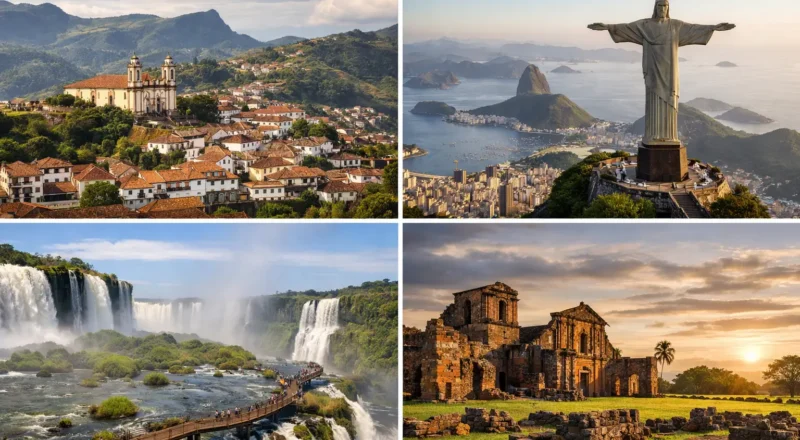
Some countries give you one obvious heritage stop and call it a day. Brazil does not. The UNESCO sites in Brazil range from baroque hill towns and futuristic architecture to Atlantic islands, wetlands, and deep stretches of protected rainforest. For travelers planning a first trip, that variety is the real story – these places are not one type of attraction, but a map of how diverse Brazil feels once you move beyond the postcard images.
If you are deciding where to go, UNESCO recognition can be a useful filter. It helps identify places with outstanding cultural or natural value, but it does not mean every site offers the same travel experience. Some are easy additions to a city itinerary, while others require flights, transfers, permits, or more time on the ground. Knowing that difference matters when you are building a realistic trip.
What UNESCO sites in Brazil actually include
Brazil has both cultural and natural World Heritage Sites, and together they show the country at its broadest. The cultural side includes historic cities, religious architecture, archaeological landscapes, and one of the world’s most famous examples of modern urban planning. The natural side covers ecosystems that are dramatically different from each other, from the Amazon to the Pantanal to offshore Atlantic islands.
For international travelers, this is helpful because it means UNESCO sites can fit very different travel styles. You might want a city break with museums and walkable streets, or a nature-focused itinerary built around wildlife, trails, and boat access. Brazil offers both, but distances are significant, so the best choice usually depends on the region you already plan to visit.
The best-known cultural UNESCO sites
Rio de Janeiro has one of Brazil’s most distinctive UNESCO designations: Rio de Janeiro: Carioca Landscapes between the Mountain and the Sea. This is not a single monument but a cultural landscape, which makes sense once you see how the city is shaped by granite peaks, forest, beaches, and urban life. For many visitors, it is the easiest UNESCO experience to add because Rio is already a major gateway. The value here is less about checking off one site and more about understanding why the city’s setting is globally recognized.
Brasilia is another major landmark, especially for travelers interested in architecture and urban design. Built in the mid-20th century as Brazil’s new capital, it stands apart from older heritage cities because its significance comes from planning, symbolism, and modernism rather than colonial history. Some visitors find it visually fascinating, while others find it less warm and spontaneous than cities like Salvador or Rio. That trade-off is real. Brasilia rewards travelers who enjoy design, civic architecture, and seeing how national identity was expressed through space.
Salvador’s Historic Center, often called Pelourinho, is one of the most atmospheric cultural sites in the country. It brings together colorful colonial buildings, churches, plazas, and deep Afro-Brazilian heritage. It is also one of the clearest places to understand Brazil’s layered history – beautiful, vibrant, and tied to difficult chapters of slavery and colonial power. For visitors, that means Salvador works best when approached as both a visual highlight and a place of cultural depth.
Ouro Preto, in Minas Gerais, is one of Brazil’s classic colonial destinations. Set in a mountainous landscape, it is known for baroque churches, steep streets, and links to the gold cycle. It feels very different from coastal Brazil and gives travelers a stronger sense of inland colonial history. The terrain can be demanding, especially on foot, but that is part of the experience. This is a place to slow down rather than rush through.
Olinda, near Recife, offers a smaller-scale but very appealing historic setting. Its church towers, painted houses, and hillside streets make it one of the most charming urban heritage areas in Brazil. It pairs especially well with a broader Northeast itinerary. Compared with larger heritage cities, Olinda is easier to absorb in a shorter visit, though staying longer helps you experience its cultural rhythm beyond daytime sightseeing.
Sao Luis, in the state of Maranhao, is often less familiar to first-time international visitors, which is exactly why it stands out. Its historic center preserves a large ensemble of colonial buildings, many with distinctive Portuguese tiles. It is not always the first place travelers think of when planning Brazil, but it can work very well if combined with the Lençóis Maranhenses region. That combination creates a strong contrast between urban history and one of Brazil’s most unusual natural landscapes.
Natural UNESCO sites that show Brazil at its wildest
The natural UNESCO sites in Brazil are some of the country’s strongest arguments for planning a longer trip. Iguaçu National Park is usually the most accessible and immediately dramatic. The falls are world-famous for a reason. They are easy to visit, highly photogenic, and supported by solid tourism infrastructure. If you want a UNESCO site with a high reward-to-effort ratio, this is one of the best choices in Brazil.
The Central Amazon Conservation Complex is a very different proposition. It protects an immense area of Amazonian ecosystems and has exceptional biodiversity, but access and logistics are naturally more complex. This is not a place for quick sightseeing. It suits travelers who want a dedicated Amazon experience and understand that distance, weather, and river-based travel are part of the journey.
The Pantanal Conservation Area appeals most to wildlife-focused travelers. While the Pantanal as a whole extends beyond the UNESCO area, this recognition highlights one of the richest wetland systems on the planet. If your goal is seeing jaguars, caimans, capybaras, birds, and seasonal floodplain landscapes, this region can be more rewarding than the rainforest for actual wildlife viewing. The key variable is timing, since water levels affect movement, access, and animal visibility.
Brazil also includes protected Atlantic islands and coastal reserves among its UNESCO natural heritage. The Atlantic Forest Southeast Reserves and the Discovery Coast Atlantic Forest Reserves preserve fragments of one of the world’s most threatened biodiversity hotspots. These sites matter enormously from a conservation perspective, though they may not always translate into a simple, single-stop tourist experience. They are often better understood as part of a wider regional journey rather than a standalone vacation goal.
Fernando de Noronha and Atol das Rocas Reserves are among the country’s most coveted natural areas. Fernando de Noronha is especially appealing to travelers looking for marine life, beaches, and tightly protected island landscapes. It is stunning, but it is also more expensive and regulated than many mainland destinations in Brazil. That usually means a better-preserved experience, but also less flexibility for budget travelers.
Which UNESCO site fits your trip best?
If this is your first time in Brazil and you want iconic, easy-to-plan options, Rio de Janeiro, Iguaçu Falls, Salvador, and Ouro Preto are strong starting points. They combine international recognition with relatively clear access and a defined visitor experience. Rio and Salvador also work well if you want heritage without giving up major-city comfort, dining, and hotel choice.
If you are more interested in architecture and national history, Brasilia makes sense, especially as a short, focused stop. If colonial towns are your priority, Minas Gerais deserves extra attention beyond Ouro Preto. If wildlife is the main goal, the Pantanal is usually more practical than trying to cover multiple natural sites in one trip.
It also depends on how much time you have. Brazil is large enough that trying to combine Rio, the Amazon, Salvador, and the Pantanal in one short vacation can turn into an itinerary built around airports. A better plan is to choose one region and one contrasting highlight. For example, Rio plus Iguaçu works well, as does Salvador plus Olinda, or Sao Luis plus nearby natural attractions in the Northeast.
A practical note before you build your route
UNESCO status is useful, but it should not be the only reason to go somewhere. Some sites are breathtaking on first view. Others become meaningful when you understand their history, culture, or ecological importance. That is especially true in Brazil, where context changes the experience. A colonial center is not just attractive architecture, and a protected forest is not just scenery.
For travelers using Explora Brasil to organize a route, the smartest approach is to treat UNESCO recognition as a starting point, then match it to your available time, budget, interests, and region. Brazil rewards that kind of planning. Pick the places that fit the trip you actually want, and the heritage value will feel less like a label and more like part of the journey.