Arraial do Cabo is a small fishing town in the Região dos Lagos (Lakes Region) of Rio de Janeiro state, about 165 km east of the city of Rio, and it has some of the clearest, most turquoise water anywhere on Brazil’s coast. Praia do Forno, the little Prainhas beaches under the Pontal do Atalaia headland and Praia do Farol on Cabo Frio Island all look as if someone had turned the saturation up. There is a reason for it. Off this cape, a phenomenon called upwelling takes place: when the north-east wind blows, it pushes the warm surface water out to sea and cold, nutrient-rich water rises from the deep to replace it. The result is a sea that is surprisingly cold for south-east Brazil, very clear and full of life, which is why Brazilians call Arraial the country’s “Capital do Mergulho”, its diving capital. Almost the whole of the town’s sea is a federal marine reserve, the RESEX Marinha do Arraial do Cabo, with its own rules for boats and visitors.
This guide is written for international visitors and was checked on 27 October 2026. It covers how to get to Arraial do Cabo from Rio’s airports, from São Paulo and from the regional airport at Cabo Frio, what changed at Pontal do Atalaia in August 2026, what the boat trips, try dives and the harbour boarding fee cost, the opening hours and bans inside the marine reserve, the humpback whale season, itineraries from two to five days, and ten real hotels and pousadas, each linked to its official website, with no affiliate links. Boat-trip prices change from one season to the next, so where there was any doubt we give the range we found and a reminder to check before you go. Prices are in Brazilian reais (R$).
Quick facts: Arraial do Cabo (Rio de Janeiro state, Brazil)
- What it is: a seaside municipality in the Lakes Region with 30,986 residents in the 2022 IBGE census (an estimated 32,822 in 2025) and 152 km² of territory. It split from neighbouring Cabo Frio on 13 May 1985.
- Why the water is so clear and cold: upwelling brings deep water to the surface when the north-east wind blows; on those days the sea can drop below 18 °C, even in the southern summer.
- Distances: about 165 km from Rio de Janeiro via the Rio–Niterói Bridge, the BR-101 and the Via Lagos (RJ-124) toll road, 2.5 to 3 hours without traffic. Cabo Frio airport (CFB) is about 10 km from central Arraial.
- Buses: Viação 1001 runs from Rio’s Novo Rio bus station in about 3h40 to 4 hours. There is no direct bus from São Paulo; you change in Rio or Niterói.
- Via Lagos toll: R$18.40 per axle on weekdays and R$30.60 at weekends and on public holidays (tariff in force since 1 August 2025). A car has two axles.
- Marine reserve (RESEX): boat trips run from 9am to 5pm (until 7pm from November to March); boats may not enter the Blue Grotto; feeding or touching animals and coral is banned; boats may anchor only at Praia dos Anjos and Praia do Forno.
- Pontal do Atalaia: since 21 August 2026 private cars may not drive into or park on the Pontal road. Walk, take a taxi or ride-hail car (drop-off and pick-up only) or a water taxi from Praia dos Anjos.
- Typical costs: boat trip R$70 to R$200 per person depending on the boat and the season; harbour fee at the Marina dos Pescadores R$15 per person, cash only; try dive R$250 to R$350; town bus R$2.00.
- Tourist tax: in October 2026 there was no environmental or tourist fee for independent visitors; only tour buses and vans pay a fee and must register with the town hall.
- How long to stay: 2 days for the boat trip and Pontal do Atalaia; 3 to 4 days to add the Forno trail, a dive and sunset at Praia Grande; 5 days to fit in Monte Alto, the Massambaba sandbar, Búzios or Cabo Frio.
A short history: from Amerigo Vespucci to soda ash
Short answer: Arraial do Cabo is one of the oldest places of European contact in Brazil. In 1503 the fleet carrying the Florentine navigator Amerigo Vespucci anchored in the bay that is now Praia dos Anjos, and 24 men stayed behind to build a trading post for brazilwood. For centuries the place was a fishing village that belonged to Cabo Frio. In the 20th century a state-owned soda ash factory changed the local economy, and in 1985 Arraial became a municipality in its own right.
Long before the Portuguese, groups of fishers and gatherers already lived on the cape: the first inhabitants arrived some five thousand years ago, lived on the hilltops and came down to fish and collect shellfish. When the Europeans arrived, the region was the land of the Tamoio and other Tupinambá peoples. The cape itself is young in geological terms. Wind, currents and tides piled up sand between three former islands, today the Morro do Mirante, the Morro do Forno and the Pontal do Atalaia, and tied them to the mainland. This is the point where the Brazilian coastline turns from running north–south to running east–west, which has always made it a landmark for sailors.
The trading post of 1503
The second Portuguese exploring expedition, which Vespucci sailed with, anchored in 1503 in a bay then called Praia da Rama, today’s Praia dos Anjos. The 24 men left ashore built a small fort and a feitoria, a post for trading brazilwood with the Indigenous people. That is why the town presents itself as the site of one of the first Portuguese trading posts in the country. Historians still debate its exact location, and some argue it stood elsewhere on the Cabo Frio coast. On the trail between Praia do Forno and Prainha there are ruins attributed to Vespucci’s fort. The town also keeps the Casa da Pedra, described as one of the first masonry buildings in Brazil, and a historic marker to Vespucci’s landing with an obelisk, an old well and a plaque.
The church of Nossa Senhora dos Remédios, on the waterfront at Praia dos Anjos, is described by local tradition as one of the oldest in Brazil, linked to the first years of colonisation. There is no firm documentation for its founding date, so treat dates you may see quoted, such as 1506, as tradition rather than established fact. The feast of the patron saint takes place in October.
Fishermen, pirates and the lighthouse
In colonial times the coast between Arraial do Cabo and Cabo Frio attracted privateers and brazilwood smugglers, mostly French, who allied with the Tamoio against the Portuguese. For most of its history, though, Arraial was a small village of artisanal fishermen. Beach seine fishing, with canoes and nets hauled in from the sand, especially during the mullet (tainha) season, is still practised today and is one of the reasons the marine reserve was created.
On Cabo Frio Island, just across the channel, construction of a lighthouse began in 1833 on the island’s highest point. Now known as the Farol Velho (Old Lighthouse), it was inaugurated in 1836. The site turned out to be a mistake: a cloud that often forms over the summit hid the light from passing ships. In 1861 a new, lower lighthouse opened on the southern tip of the island, and it still works today. The island is a Brazilian Navy area, and visits to the Old Lighthouse ruins are only possible with authorisation.
Soda ash and independence
In 1943 the Brazilian government created the Companhia Nacional de Álcalis, a state company that built a soda ash (sodium carbonate) plant in Arraial do Cabo to supply the glass industry. The factory brought in workers from other regions, including technicians from Álcalis’s plant in Rio Grande do Norte, created new neighbourhoods and for decades was the town’s biggest employer. Over time it declined, and tourism and fishing returned to the centre of the economy. Arraial do Cabo separated from Cabo Frio on 13 May 1985, now the town’s anniversary, with the law signed by the then state governor Leonel Brizola. The first mayor, Renato Vianna, was elected in November 1985 and took office in January 1986.
The marine reserve and the diving capital
On 3 January 1997 a federal decree created the Reserva Extrativista Marinha do Arraial do Cabo, the RESEX, to protect artisanal fishing and the marine environment. It is managed today by ICMBio, Brazil’s federal protected-areas agency, with a council of fishers, tour operators and public bodies, and its management plan was approved in 2020. Over the same years, dive schools from all over Brazil moved in, drawn by the visibility, the wrecks and the variety of fish. The Brazilian Navy’s Instituto de Estudos do Mar Almirante Paulo Moreira (IEAPM), which studies the upwelling, is also based in Arraial and runs an oceanographic museum open to the public.
When to go to Arraial do Cabo: weather, wind and sea
Short answer: for sunshine with fewer people, the best time to visit Arraial do Cabo is March to June and August to November, avoiding Brazilian school holidays and long weekends. The southern summer, December to February, has the longest days and boat trips run until 7pm, but the town is packed, prices rise and there are queues at the pier. June to August is humpback whale season, and if you don’t mind colder water the town is much quieter. In any month the sea can be icy on north-east wind days, because of the upwelling.
Arraial do Cabo has a different climate from the rest of the Rio de Janeiro coast: it is dry, windy and sunny. According to INMET, Brazil’s national weather service, average rainfall is around 800 mm a year, less than half of what falls in Paraty, and the cape’s cacti and low coastal scrub show just how dry it is. The constant wind keeps the air temperature in check. The INMET station installed in the town in 2006 recorded an absolute minimum of 12.9 °C on 31 July 2007 and a maximum of 35.1 °C on 4 January 2019.
The table below uses averages from the Weather Atlas service for Arraial do Cabo. These are model estimates, not official INMET climate normals. We left out the service’s average highs, which go above 34 °C in summer and don’t match the official station’s records. The sea temperatures in the table also ignore upwelling, which can drop the water by several degrees overnight.
| Month | Avg. low (°C) | Rain (mm) | Sea, model average (°C) | Daylight |
|---|---|---|---|---|
| January | 22.9 | 78 | 24.8 | 13h24 |
| February | 23.1 | 44 | 25.1 | 12h54 |
| March | 22.8 | 53 | 25.8 | 12h12 |
| April | 21.5 | 78 | 25.3 | 11h36 |
| May | 20.0 | 69 | 24.7 | 11h00 |
| June | 18.2 | 44 | 23.6 | 10h42 |
| July | 17.6 | 45 | 22.4 | 10h54 |
| August | 18.2 | 36 | 22.3 | 11h18 |
| September | 19.0 | 61 | 21.8 | 12h00 |
| October | 19.7 | 81 | 22.8 | 12h36 |
| November | 20.7 | 81 | 23.3 | 13h12 |
| December | 21.8 | 101 | 24.0 | 13h30 |
| Year | 20.5 (average) | 771 | 23.8 (average) | — |
Upwelling: why the sea is so cold
When the north-east wind blows for a few days in a row, it pushes the layer of warm surface water away from the coast. Cold water from the deep, known as South Atlantic Central Water, rises to take its place. University and Navy studies have recorded surface temperatures below 18 °C during these episodes, and readings close to 13 °C have been reported. This water is rich in nutrients, so it feeds plenty of plankton, fish and the marine life divers come for. When the wind swings to the south or south-west, the warm water returns and the sea warms up again. In practice you can find the sea at 24 °C one day and 17 °C two days later, even in January. Bring or rent a wetsuit if you plan to dive, and don’t be put off by cold water: it is exactly what makes the sea so clear.
Summer: December to February
This is high season. Days are long, boats may operate in the reserve until 7pm and there are events every weekend, but the town fills up, especially over New Year, Carnival and January weekends. The Prainhas, Forno and Ilha do Farol get very crowded, and queues at the pier and on the Pontal road are common. December is the wettest month, though rainfall is still low compared with other beaches in south-east Brazil. If you go then, book your room well ahead and do your outings early in the morning.
Autumn: March to May
For many people this is the best time of year. The sea is warmest on average, the holidays are over and the light is beautiful. Easter week and the 1 May holiday fill the town again. The mullet season starts in May, and during it the reserve pushes the start of boat trips back to 10am so as not to disturb artisanal fishing.
Winter: June to August
Winter is dry and sunny, with highs around 25 °C and cool nights. It is humpback whale season, and the whales pass very close to shore on their way north. Between 1 June and 31 August the reserve bans music on boats between Boqueirão and Bufador and bans speedboats and jet skis from the Mar de Fora, the open-ocean side, precisely to protect the whales. It is a good season for diving, hiking and for anyone who wants an emptier town, as long as you accept cold water.
Spring: September to November
September has the coldest average sea of the year, and the north-east wind often blows hard, which is great for kitesurfing and windsurfing but can make the water icy and the open sea rough. October and November warm up, with blue water and a still-quiet town, except on the Brazilian public holidays of 12 October, 2 November, 15 November and 20 November.
Festivals and events in 2026
The town hall’s 2026 Events Calendar, published in December 2025 and subject to change, includes some dates worth planning around:
- Carnival: 13 to 17 February.
- Festival da Lula (squid festival): 2 to 5 April.
- Town anniversary: 13 to 16 May, with concerts at Praia dos Anjos.
- Whale season: official opening on 30 May and start on 1 June; Festival da Baleia (whale festival) from 24 to 26 July.
- São Pedro festival, in Figueira: 26 to 29 June.
- LiterArraial (literary festival): 1 to 4 July.
- Patron saint’s feast, Nossa Senhora dos Remédios: 16 to 18 October.
- Seafood festival: 13 to 15 November.
- Feira do Xaréu: editions through the year, almost every month, celebrating the town’s most traditional fish.
- New Year’s Eve (Réveillon): 30 and 31 December, at Praia dos Anjos and Praia Grande.
How to get to Arraial do Cabo: car, bus and plane
Short answer: from Rio de Janeiro, the simplest options are driving or taking a Viação 1001 bus from the Novo Rio bus station, which takes 3h40 to 4 hours. By car it is about 165 km via the Rio–Niterói Bridge, the BR-101 and the Via Lagos. International travellers usually fly into Rio-Galeão (GIG) and continue by bus, rental car or private transfer. From São Paulo, the quickest option is flying to Rio or, from December 2026, flying direct from Guarulhos to Cabo Frio; there is no direct bus, and the trip with a change in Rio takes more than 13 hours. Cabo Frio airport (CFB) is about 10 km from Arraial.
Driving from Rio de Janeiro
Leaving Rio, cross the Rio–Niterói Bridge, follow the BR-101 to Rio Bonito and turn onto the RJ-124, the Via Lagos, a 57 km toll road to São Pedro da Aldeia. From there, follow the signs for Cabo Frio and Arraial do Cabo until you reach the town gateway (Pórtico). Without traffic the drive takes 2.5 to 3 hours. On Friday afternoons, the day before a public holiday and on Sunday afternoons, allow a lot longer.
There are two main tolls. The Rio–Niterói Bridge charges only in the Niterói direction, about R$6.60 for a car according to route calculators. The Via Lagos, run by the concession company Motiva, has different rates depending on the day: R$18.40 per axle from Monday (from noon) to Friday (until noon) and R$30.60 per axle at weekends and on public holidays, rates in force since 1 August 2025 according to the operator itself. A car has two axles, so a Saturday trip out costs R$61.20 on the Via Lagos alone. In October 2026 the state audit court was proposing a 17% cut and a single flat rate, but the change had not been approved; check the current price before you travel.
Inside Arraial, parking is the big problem in high season. Since 21 August 2026 private cars may not enter or park at Pontal do Atalaia, and the streets near Praia dos Anjos and Prainha fill up early. Many pousadas have their own parking; check before you book. Brazilian roads are generally fine on this route, but avoid driving at night if you don’t know the area and keep to the speed limits, which are enforced by cameras.
Driving from São Paulo
It is about 600 km, usually via the Via Dutra highway to Rio and then the Rio–Niterói Bridge and the Via Lagos. Allow 7 to 8 hours without traffic, plus the Dutra tolls. Many people break the journey with a night in Rio, or take the coastal route with stops in Paraty and Rio; see our Paraty travel guide if you want to include the Costa Verde.
Buses from Rio and São Paulo
Viação 1001 runs the route between Rio’s Rodoviária Novo Rio and Arraial do Cabo’s bus station, with departures through the day, including around 5am, 6:30am, 7:30am, 9am, 12:30pm, 3pm and 11pm, according to ticket sites checked in October 2026. A standard (convencional) ticket cost R$82 to R$87 and an executive one about R$146, with a journey time of 3h40 to 4 hours. Times and prices change with the season; buy on the 1001 website or at the bus station, and bring your passport, because Brazilian bus companies ask for photo ID at boarding.
There is no direct bus from São Paulo to Arraial do Cabo. You go from São Paulo’s Tietê terminal to Rio’s Novo Rio station, or to Niterói, and catch a 1001 bus from there. Adding up the two legs and the wait, ticket sites showed 13 to 15 hours and total fares of R$219 to R$268. If you are coming from São Paulo, flying is usually worth it.
You can also take a bus to Cabo Frio, which has more departures, and continue to Arraial by taxi, ride-hail car or the Salineira intercity bus, which links Cabo Frio, Arraial and Búzios.
Flying: Cabo Frio, Galeão and Santos Dumont
Cabo Frio International Airport (CFB) is the closest, about 10 km from Arraial, 15 to 20 minutes by car. Its runway is 2,550 metres long, and scheduled flights are seasonal. For the 2026–2027 summer, two routes had been announced:
- LATAM, São Paulo-Guarulhos to Cabo Frio: four flights a week from December 2026, on Mondays, Thursdays, Fridays and Sundays, using Embraer E195-E2 jets.
- Azul, Belo Horizonte (Confins) to Cabo Frio: from 12 December 2026 to 27 February 2027, on Tuesdays, Wednesdays, Fridays and Saturdays, and daily between 28 December and 3 January.
The airport also received flights from Argentina in the 2026 summer. International routes and charters change from year to year, so check with the airline. From the airport to Arraial, take a taxi or a ride-hail car; app estimates were around R$35, more with surge pricing in high season.
Outside the summer, and for most visitors arriving from abroad, the gateway is Rio’s Galeão (GIG) or Santos Dumont (SDU) airport. From the airport you can take a bus or taxi to Novo Rio bus station and continue with 1001, rent a car or book a private transfer. To plan your days in the city, see our Rio de Janeiro travel guide.
Tour buses and vans: the town hall rule
Tour coaches, minibuses and vans pay a fee and must register in advance with the town hall to enter Arraial do Cabo, and there are set points for dropping off and picking up passengers. If you go on an organised day trip from Rio, the agency handles this. For independent visitors arriving by car, scheduled bus or plane, there was no individual tourist fee in October 2026. A motion passed by the town council in 2026 asked the town hall to study an environmental preservation fee, but there was no law and no charge, and the amounts circulating on social media have not been confirmed by any official source.
A note on day trips from Rio: many agencies sell a one-day Arraial tour, leaving Rio before dawn and returning late at night, with about 6 hours on the road. It works if you really have only one day, but you spend most of your time on the bus and hit the beaches at the busiest hours. If you can, stay at least two nights.
Getting around Arraial do Cabo
Short answer: Arraial is a small town, and if you stay near Praia dos Anjos, Prainha or Praia Grande you can do a lot on foot. For Praia do Forno and the Prainhas at Pontal do Atalaia, a water taxi from Praia dos Anjos is the most practical option. For everything else there are ride-hail apps, metered taxis and the town bus, which has charged a flat R$2.00 since March 2026.
Town buses
On 2 March 2026 the town hall began running public transport directly, with 12 air-conditioned buses and a single fare of R$2.00. There are five routes, numbered 701 to 705. The one that matters most to visitors is the 703, Centro x Praias, a loop that runs along Praia Grande, Praia dos Anjos, the Prainha lookout, the Vila, Praia do Pontal and the Pontal neighbourhood. The others link the centre with the outlying districts of Figueira, Sabiá, Monte Alto, Parque das Garças, Caiçara and Pernambuca. Transfers between routes are free with the Cartão +Mobilidade, but that card is issued at the town’s urban mobility office with Brazilian ID documents (RG and CPF), so it is really meant for residents.
Taxis and ride-hail apps
Ride-hail apps such as Uber work well in town, and rides between neighbourhoods are short. There are taxi ranks near the bus station and in the centre. Taxis and app cars may enter Pontal do Atalaia, but only to drop off and pick up passengers. In high season the wait for an app car after sunset can be long: arrange your ride back in advance or use the water taxi.
Water taxis
Boats leave the pier at Praia dos Anjos for Praia do Forno and for the Prainhas at Pontal do Atalaia, a ride of a few minutes. The fare is per person and per leg and changes with the season; check the price at the ticket booth before boarding and keep your receipt. There is no water taxi to Ilha do Farol: to get there you have to take a full boat tour with an authorised operator.
Buses to Cabo Frio and Búzios
Salineira runs intercity buses linking Arraial do Cabo with Cabo Frio and Búzios. There are plenty of departures to Cabo Frio and only a few a day to Búzios. In high season the buses are crowded. To visit both neighbouring towns in one day, a car or an agency tour is easier. See our Búzios travel guide.
Tourist information
The town hall runs tourist information points at the Marina dos Pescadores, at the town gateway and on Praça da Independência, open from 8am to 5pm according to local guides. They are good places to ask about water-taxi times and sea conditions. Don’t count on English being spoken everywhere; a translation app helps with taxi drivers, kiosk owners and boat crews.
Marine Extractive Reserve of Arraial do Cabo: the rules every visitor should know
Short answer: almost all of Arraial do Cabo’s sea is a federal marine extractive reserve, created in 1997 and managed by ICMBio. For visitors, the practical rules are these: boat trips only from 9am to 5pm (until 7pm from November to March), boats may not enter the Blue Grotto, feeding, touching or chasing animals and touching coral are banned, and boats may anchor only at Praia dos Anjos and Praia do Forno. In winter, from June to August, extra restrictions protect the whales.
The RESEX Marinha do Arraial do Cabo was created by federal decree on 3 January 1997. ICMBio gives its area as 51,601 hectares, while Brazil’s national register of protected areas and Wikipedia give about 56,769 hectares, a difference that probably comes from different methods of calculation. An extractive reserve is a Brazilian category of protected area that exists to guarantee sustainable use of natural resources by traditional communities, in this case artisanal fishers who have depended on this sea for generations. The management plan was approved by ICMBio Ordinance no. 963 of 25 September 2020, and every season the reserve council publishes operating rules for visitors.
Boat trip hours
- Standard hours: 9am to 5pm.
- November to March: hours are extended until 7pm.
- Mullet season, May to July: trips start at 10am, so as not to interfere with beach seine fishing.
- High season and public holidays: the start may be brought forward to 8am; small boats belonging to local fishermen and dive operators are also allowed to leave at 8am.
What is banned
- Taking a boat into the Blue Grotto (Gruta Azul). Tours only pass in front of it.
- Feeding, touching, chasing or harassing fish, turtles, dolphins and whales.
- Touching, standing on or removing coral and other organisms from the seabed.
- Anchoring outside permitted areas. Tour boats may anchor only at Praia dos Anjos and Praia do Forno; at other spots they stop under controlled conditions or simply pass by.
- Carrying more than 80 passengers per boat.
- On the Mar de Fora, the open-ocean side, tour boats may go only as far as the Bufador and must stay within 500 metres of the shore.
Whale season rules
From 1 June to 31 August, music on boats is banned between Boqueirão and Bufador, and speedboats and jet skis may not use the Mar de Fora. If a whale is sighted from a boat, the skipper must slow down and keep his distance; don’t push for a closer look.
Rules at the Marina dos Pescadores
The Marina dos Pescadores, the fishermen’s harbour at Praia dos Anjos, is the departure point for almost every boat trip. Under Resolution no. 32/2025 of the Fundação Instituto de Pesca de Arraial do Cabo (FIPAC), backed by Municipal Law no. 2,700/2025, each passenger pays a R$15 fee to use the harbour, in cash, at the booth before boarding. Some operators exempt small children and older people, but the rule varies, so ask when you book. A 2021 municipal law bans bringing cool boxes and your own drinks on tour boats, and since 1 January 2026 disposable cups are not allowed on board. Bring a reusable water bottle.
Boat trips in Arraial do Cabo: route, prices and how to choose
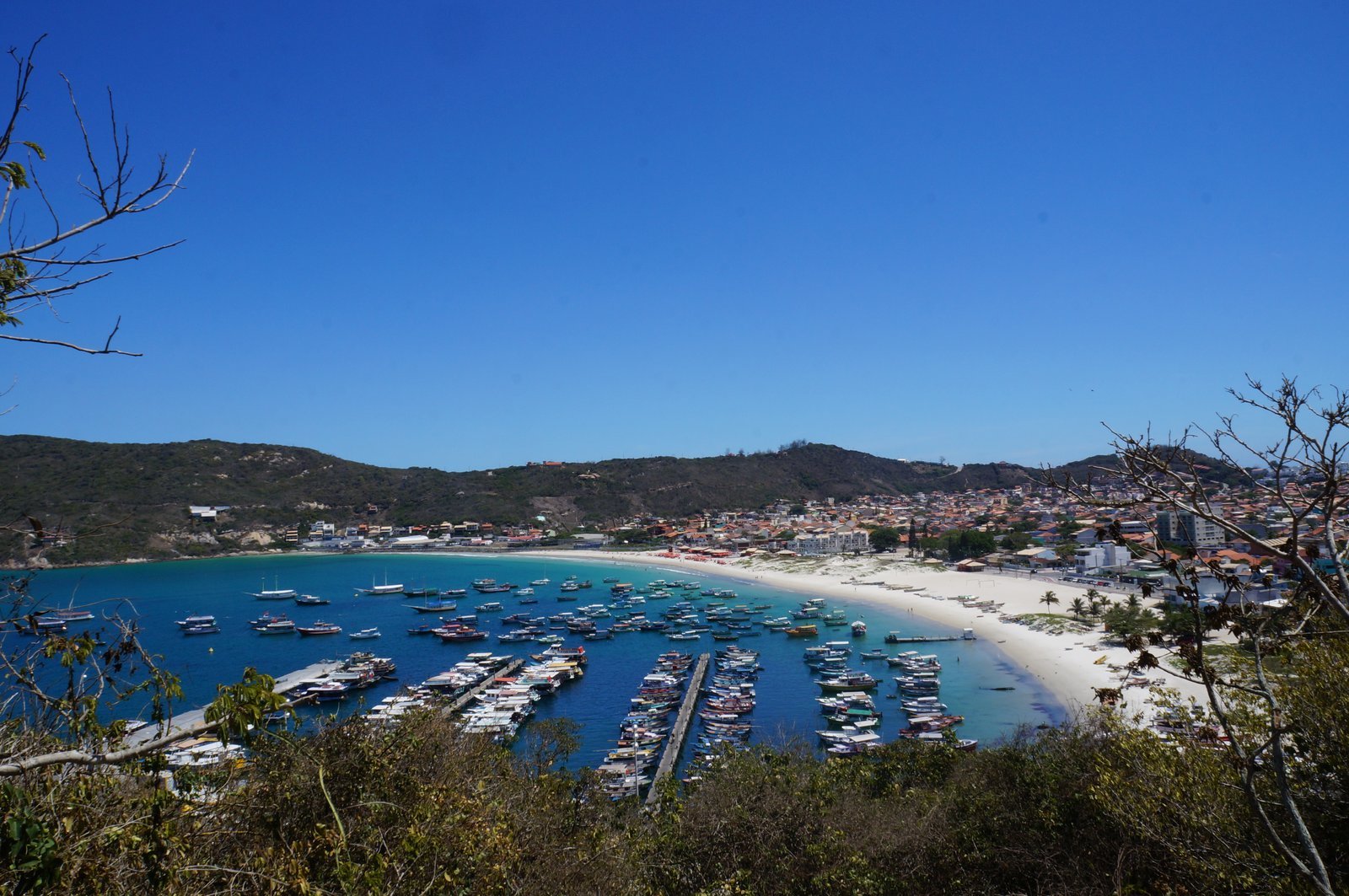
Short answer: the classic boat trip leaves from the Marina dos Pescadores at Praia dos Anjos, lasts on average 3 to 5 hours and stops at Ilha do Farol, the Prainhas at Pontal do Atalaia and Praia do Forno, passing in front of the Blue Grotto, the Fenda de Nossa Senhora, the Pedra do Macaco and the Buraco do Meteoro. In October 2026 the prices we found ranged from R$70 to R$200 per person depending on the boat and the season, plus the R$15 harbour fee.
The route
Operators change the order depending on the wind and the crowds, but the basic route is similar on almost every boat. Swimming stops are usually at Ilha do Farol, the Prainhas at Pontal do Atalaia and Praia do Forno. Sightseeing points where you stay on board include the Fenda de Nossa Senhora, a crack in the rock face with a statue of the Virgin; the Blue Grotto, where the light turns the water an intense blue; the Pedra do Macaco, a rock formation that looks like a monkey’s profile; and the Buraco do Meteoro, a hollow in the rock. Bigger boats, such as the two-deck schooners and saveiros, usually have a slide and music; smaller boats and speedboats do a quicker, quieter trip.
What it costs
| Type of trip | Price per person in 2026 | Notes |
|---|---|---|
| Standard boat, low season | From R$70 to R$100 | Prices from operators such as Efraim Passeios and Arraial Boat |
| Standard boat, high season | About R$200 | Arraial Boat defines high season as 26 December 2026 to 31 March 2027 |
| Larger saveiro | About R$180 | Saveiro Don Juan’s price in October 2026 |
| Private boat or speedboat | From about R$1,100 per boat | Depends on size and duration |
| Marina dos Pescadores fee | R$15 | Cash, charged per passenger |
These prices come from operators’ official websites checked in October 2026 and change often. Be wary of street sellers offering prices far below the market, and choose companies that show a CNPJ (Brazilian company number), Cadastur registration (the national tourism register) and authorisation to operate in the reserve.
How to choose and avoid trouble at the pier
Book ahead in high season or arrive early at the harbour. Ask how long the boat stays at each stop, because in high season time at the Prainhas and Ilha do Farol is limited. Check whether the price includes the harbour fee, whether there are life jackets for everyone and whether the boat has a toilet. Bring sunscreen, a hat, water and cash for the fee and for drinks on board. If you get seasick, choose a bigger boat and a day without strong wind, and avoid sitting at the bow. If you need commentary in English, ask when you book.
Ilha do Farol and Praia do Farol
Short answer: Praia do Farol is on Cabo Frio Island, a Brazilian Navy area facing Arraial, and can only be visited on authorised tour boats. It is often described as one of the most beautiful beaches in Brazil, with very white sand, dunes and transparent water. Time ashore is short, usually 30 to 40 minutes, and the number of people on the sand at any one time is limited.
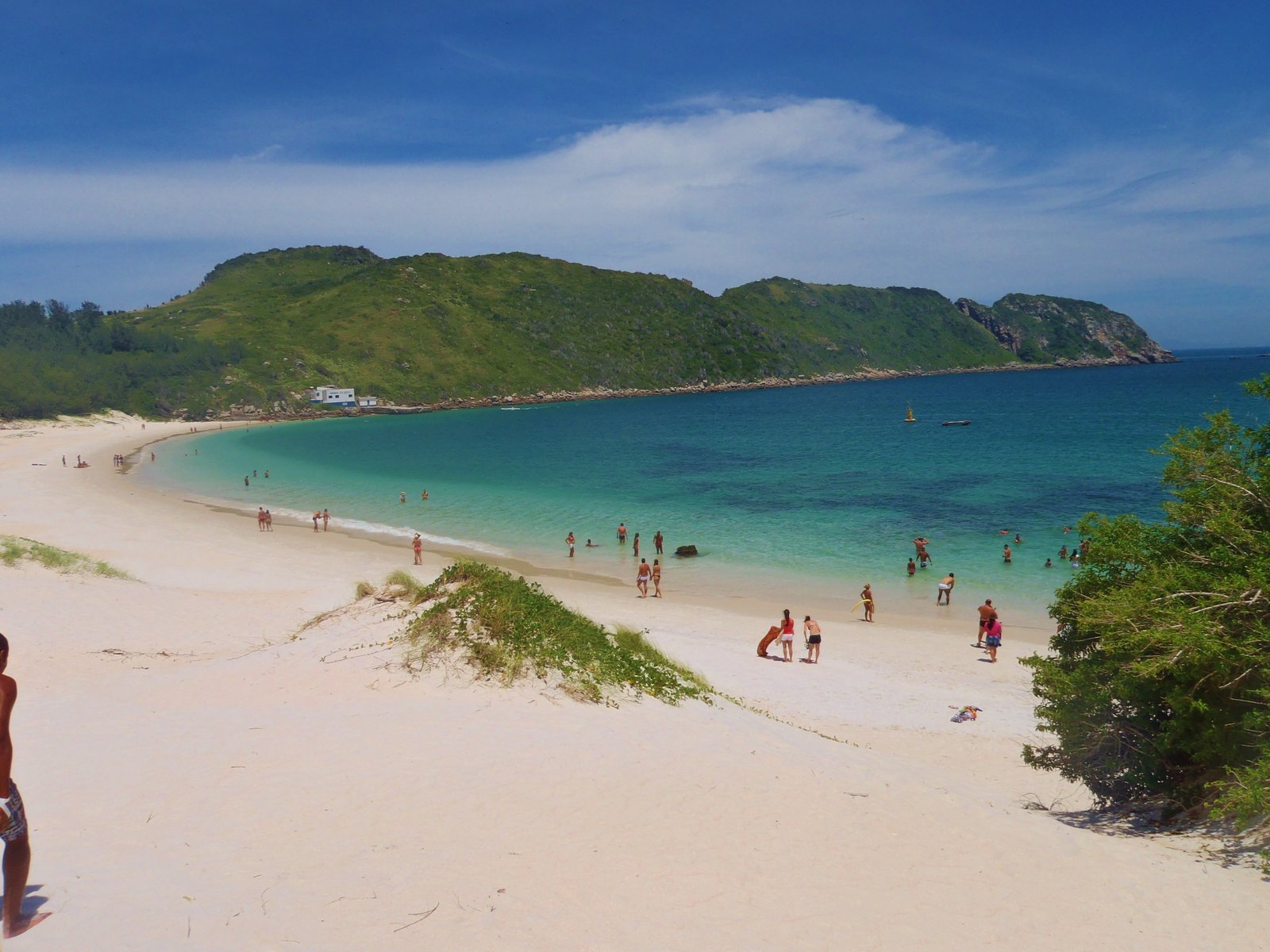
Cabo Frio Island shelters the Praia dos Anjos bay from the open ocean. On the side facing the town lies Praia do Farol, a strip of fine white sand with dunes, where the sea is usually calm and very clear. In 2000 the Brazilian magazine Veja called it the most perfect beach in Brazil, and boat crews still repeat the title. The Navy controls access: there are no facilities on the beach, you may not climb the dunes outside the permitted areas and the stop is brief. Local guides mention a limit of about 40 minutes per boat and about 250 people on the sand at once; we have not found these figures in an official document, so treat them as a guide only.
On top of the island stand the ruins of the Old Lighthouse, built between 1833 and 1836, and on the southern tip is the working lighthouse of 1861. Neither is part of the normal boat trip. Visiting the Old Lighthouse requires Navy authorisation and is done only by organised groups.
Pontal do Atalaia and the Prainhas: the stairway, the lookout and the new rules
Short answer: the Prainhas do Pontal do Atalaia are two small beaches of transparent water at the foot of a headland, reached by a wooden stairway of more than 200 steps. Since 21 August 2026 private cars may not drive into or park on the Pontal road: walk, take a taxi or ride-hail car (drop-off and pick-up only) or a water taxi from Praia dos Anjos. The lookout at the top of the hill is where the town watches the sun set over the sea, one of Arraial’s classic views.
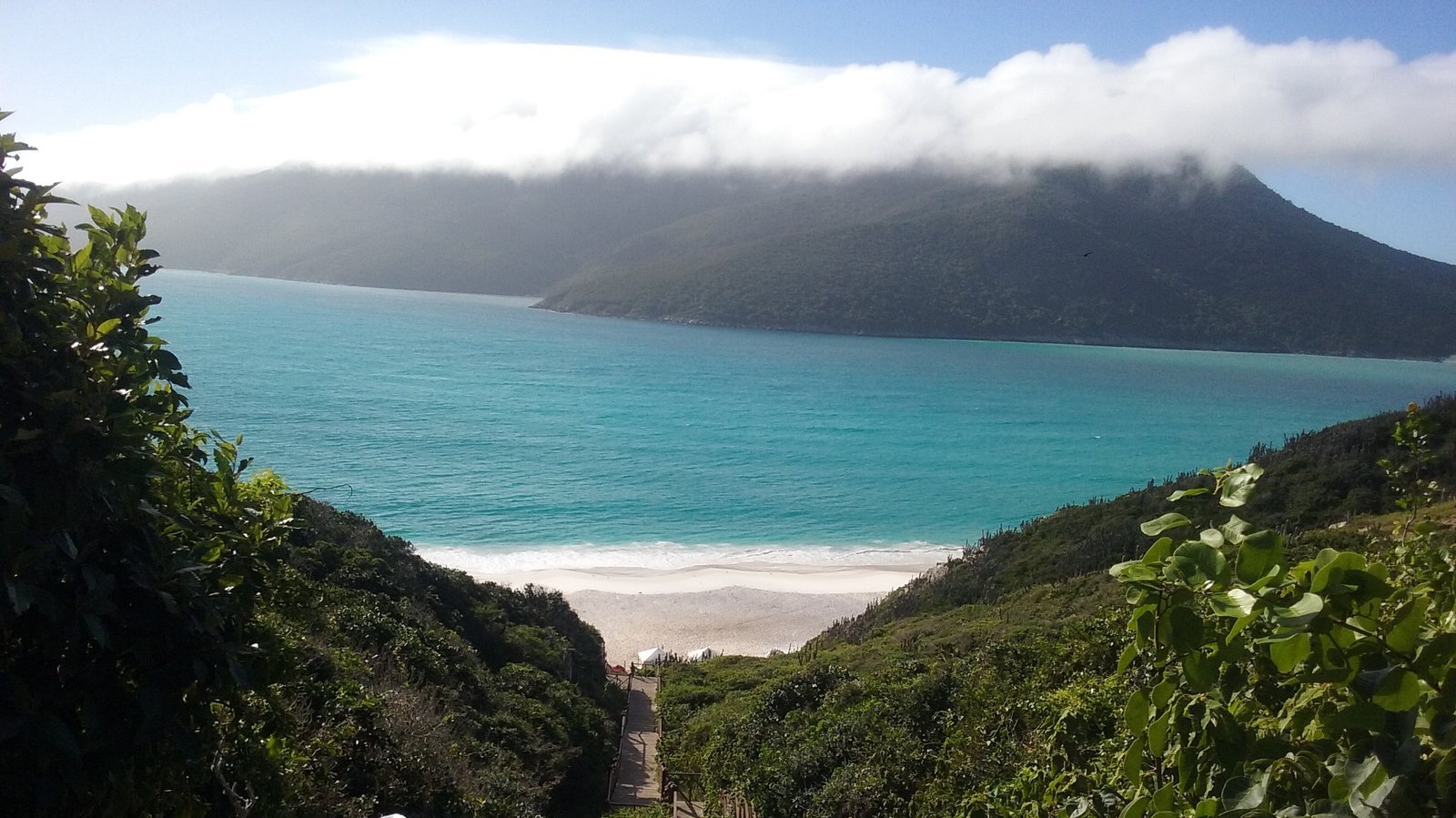
Pontal do Atalaia is one of the three former island-hills that formed the cape, and its rocky slopes rise to about 180 metres. On the side facing Cabo Frio Island lie the Prainhas (“little beaches”), two short strips of sand separated by rocks, with shallow, very clear water when the sea is calm. The wooden stairway, built in 2014 to replace a steep path, has between 225 and 255 steps depending on the source: counts vary, but the climb back up in the sun is the real workout of the day. Take water.
What changed in 2026
Access to the Pontal was the subject of a conduct adjustment agreement (a TAC, a formal legal settlement), and the town hall changed the rules on two fronts. On land, since 21 August 2026 the Pontal do Atalaia road has been closed to private cars and paid parking has ended. Taxis and ride-hail cars may enter only to drop off and pick up passengers; residents of the gated community and customers of businesses with authorised parking are exceptions. At sea, since January 2026 boats stopping at the Prainhas follow a lane system: one lane for boats up to 10 metres and another, on a rota, for bigger ones, with about 30 minutes on the beach per boat and a maximum of five schooners at the same time. In practice this means less chaos on the sand, but you must respect your boat’s return time.
Pontal do Atalaia lookout and the sunset
The lookout at the top of the hill looks over the Prainhas, Praia Brava, the open ocean and Cabo Frio Island. Because of the way the cape points, the sun sets over the sea in Arraial, something rare on Brazil’s south-east coast. Arrive before sunset to get a spot, and plan your ride back: with parking gone, the queue for app cars in the late afternoon can be long. The same lookout is the town’s main whale-watching point in winter.
Praia do Forno: trail, boat and what to expect
Short answer: Praia do Forno sits in a cove next to Praia dos Anjos and can be reached on a trail of about 1 km, a 15 to 20 minute walk, or by water taxi from the pier. The water is calm, blue-green and usually cold. There are simple kiosks on the sand, and it is one of the two beaches in the reserve where tour boats may anchor.
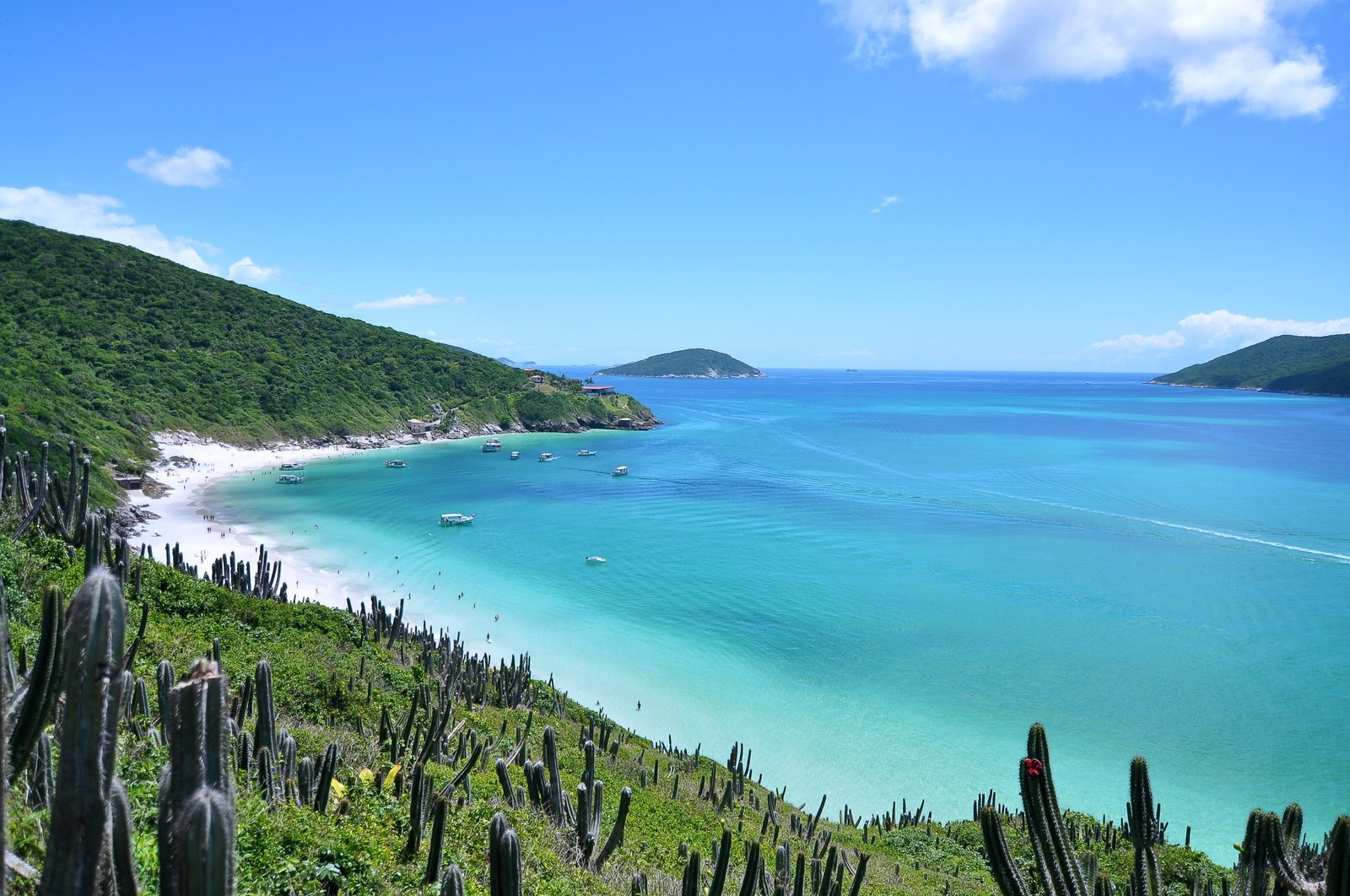
The trail starts at the end of Praia dos Anjos, near the Porto do Forno. It climbs a hill covered in dry vegetation, with cacti and coastal scrub, and then drops down to the beach. It is short but has stretches of loose earth and rocks; wear trainers or sturdy sandals, avoid the hottest hours and bring water. Near the top there is a lovely view of the cove, the one in the photo at the start of this guide. The distances and times we give come from guides and travel reports and are approximate. On the trail between Forno and Prainha are the ruins attributed to Amerigo Vespucci’s fort.
If you’d rather not walk, take the water taxi, which does the trip in a few minutes. In high season the beach also receives tour boats throughout the day, so go early if you want it quiet.
Other beaches in Arraial do Cabo
Short answer: besides Forno, the Prainhas and Ilha do Farol, the beaches most worth visiting are Praia Grande, an open-ocean beach famous for its sunsets; Prainha, calm and good for children; Praia dos Anjos, home to the harbour; Praia do Pontal, quiet and shaded by casuarina trees; and, in the second district, Arubinha, a sandbar in the Araruama Lagoon.
Praia Grande
Praia Grande is an open-ocean beach of fine white sand and cold water that stretches west of the centre along a long strip of dunes and coastal scrub. The state tourism department speaks of 40 km of sand, counting the stretch along the Massambaba sandbar. The sea usually has waves and currents, so it is not the best beach for small children. The seafront near the centre has kiosks and is the most popular spot to watch the sun set over the sea.
Prainha
Right at the entrance to town, Prainha is a cove with calm water and kiosks and restaurants, good for families. It is one of the easiest beaches to walk to from pousadas in the centre and around Praia dos Anjos.
Praia dos Anjos
This is the beach of the harbour and the Porto do Forno, in the heart of town. The sea is calm, but the boat traffic makes it more of a departure point than a swimming beach. Along the seafront are the church of Nossa Senhora dos Remédios, the Oceanographic Museum and many of the restaurants.
Praia Brava
Praia Brava lies on the open-ocean side of Pontal do Atalaia and can be seen from the lookout. As the name (“wild beach”) suggests, the sea is rough, and it is mostly visited by surfers. It has no facilities; if you don’t know the place, go with someone who does and stay out of the water when there is a big swell.
Praia do Pontal
Tucked away at the end of a short dirt road just past the town gateway, Praia do Pontal has few visitors and natural shade from casuarina trees, which makes it good for a family outing, according to the state tourism department.
Arubinha, Monte Alto and Massambaba
Ponta da Acaíra, nicknamed Arubinha (“little Aruba”), is in the Figueira district on the shores of the Araruama Lagoon. It is a sandbar of about 1.5 km with shallow, hypersaline water of mild temperature, very popular for kitesurfing and windsurfing. Access is on dirt and sand tracks, so most people go on a dune-buggy tour. On the way you pass Praia de Monte Alto and the Restinga de Massambaba, the sand strip between the lagoon and the sea, which is a protected area and home to the restinga antwren (com-com-da-restinga), a small bird found only in the coastal scrub of the Lakes Region and threatened with extinction. Quad-bike tours usually follow a different route, via Praia do Pontal, Praia Grande and lagoons in the area.
Diving in Arraial do Cabo: try dives, certified dives and sites
Short answer: Arraial do Cabo is known as Brazil’s diving capital because it has around 30 dive sites, very clear water and a great variety of fish, turtles and other animals brought by the upwelling. A try dive (batismo, a first scuba dive for beginners) requires no swimming skills or course and cost R$250 to R$350 in October 2026, including equipment and instructor, plus the R$15 harbour fee.
The try dive
On a try dive you get a briefing on land, put on the equipment and dive alongside an instructor who controls everything, at a shallow, sheltered site. In the official price list of Arraial Sub checked in October 2026, a try dive cost R$350, with the boat leaving between 9am and 1pm, about 30 minutes underwater, full equipment and eight photos, and no need to be able to swim. Don Juan charged R$250 in low season and R$350 in high season, plus the harbour fee. Children above a certain age can do a try dive; the limits vary by operator, so ask.
For certified divers
Certified divers do what operators call “turismo subaquático”, two dives per outing. At Arraial Sub, an outing cost R$300 without equipment and R$450 with equipment. Bring your certification card and logbook. Because of the upwelling, the water can be quite cold even in summer; operators provide wetsuits, and you will be glad of one.
Snorkelling
If you don’t want tanks, you can snorkel with mask and snorkel on operators’ own snorkelling outings or at the boat-tour stops. At Arraial Sub, a snorkelling outing cost R$180. At Praia do Forno and the Prainhas you can see fish close to the sand on calm days.
Dive sites
The most often mentioned sites are Ilha dos Porcos, Ilha do Farol, Cardeiro, Saco do Cherne, Ponta d’Água, Praia do Forno and the Blue Grotto area. Divers see turtles, groupers, squid, lobsters, rays and, with luck, dolphins. Choose a registered operator that shows its authorisation to work in the reserve, and never touch coral or animals.
The Blue Grotto
The Gruta Azul is a chamber about 30 metres long and 15 metres high in the rock of Cabo Frio Island. Its inner walls have golden and silver tones that turn blue depending on the light, hence the name. Under the reserve rules, tour boats may not enter the grotto; they pass in front of it, and the view from outside already shows the blue of the water.
Whale watching in Arraial do Cabo
Short answer: from June to August, humpback whales pass very close to Arraial do Cabo’s coast, and you can see them from land. Projeto Mar de Baleias, which monitors sightings from the Pontal do Atalaia lookout, counted 960 whales from June to August 2026. The best spots are the Pontal do Atalaia lookout, the Mirante da Boa Vista and the Mirante da Flávia Alessandra.
Monitoring is done by Projeto Mar de Baleias, run by the environmental group Funtec Ambiental with support from the town hall, on Tuesdays, Thursdays and Saturdays. In 2026 the count was 284 whales in June, 518 in July and 158 in August, from the Pontal lookout alone, which means the real number of animals passing was higher. In 2026, July had the most sightings. Bring binoculars and be patient: the most common sign is the blow, the spout of breath seen from far away. Between 1 June and 31 August the reserve bans music on boats between Boqueirão and Bufador and bans speedboats and jet skis from the Mar de Fora, to protect the animals. The whale festival in July is part of the town’s calendar.
Oceanographic Museum and other things to do on land
Short answer: the Navy’s IEAPM Oceanographic Museum is on Praça Daniel Barreto, at Praia dos Anjos, and opens Tuesday to Sunday from 2pm to 5pm, with tickets at R$10 (R$5 concession). It explains the upwelling and displays marine organisms and research equipment. The church of Nossa Senhora dos Remédios and the ruins of the Bateria and Telégrafo on Morro da Fortaleza are also worth a visit.
IEAPM Oceanographic Museum
The Instituto de Estudos do Mar Almirante Paulo Moreira is a Brazilian Navy research centre that studies Arraial’s sea, the upwelling and marine life. Its public museum has a collection of marine organisms and oceanographic equipment. According to Brazil’s museums institute, Ibram, it opens Tuesday to Sunday from 2pm to 5pm, until 6pm at weekends in July and from December to February. A full ticket costs R$10 and a half-price ticket R$5; over-60s and under-5s go free. It is a good option on cloudy days and with children.
Church of Nossa Senhora dos Remédios
On the Praia dos Anjos seafront, the patron saint’s church is presented by the state tourism department as the first in Brazil to hold Mass indoors. Tradition dates its founding to the early 16th century, without documents to confirm it. The patron saint’s feast takes place in October.
Ruins, lookouts and the cultural centre
On Morro da Fortaleza are the ruins of the Bateria and the Telégrafo, old defence and signalling structures. The Mirante da Boa Vista and Mirante da Flávia Alessandra lookouts look over the beaches of the centre. The Centro Cultural Manoel Camargo hosts exhibitions and cultural activities.
Dune buggies, quad bikes and agency tours
Buggy tours run along Praia Grande, Massambaba, Monte Alto and Arubinha, which is hard to reach in an ordinary car. Quad-bike tours usually go to Praia do Pontal, lagoons and Praia Grande. Agencies also sell day trips to Cabo Frio and Búzios.
What to eat in Arraial do Cabo
Short answer: in Arraial the thing to eat is fresh fish from the artisanal catch, especially xaréu (a jack fish), which gives its name to the Feira do Xaréu, and squid, celebrated with its own festival in April. Restaurants are concentrated around Praia dos Anjos, Prainha and Praia Grande, and beach kiosks serve portions of fried fish and squid.
Artisanal fishing is the basis of local culture, and the food reflects it. Xaréu, one of the most traditional fish in the local catch, is the star of the Feira do Xaréu, held several times a year. Squid has its Festival da Lula in April, and the seafood festival closes the food calendar in November. The Rota do Petisco, in June, brings together bars around town with snacks at special prices.
Among the places recommended by the Rio de Janeiro state tourism department is Sol na Cozinha, the restaurant linked to Pousada Caminho do Sol at Praia Grande. At the kiosks, order the peixe do dia (catch of the day), ask the price first and choose places full of locals. A “porção” is a sharing plate, usually enough for two or three people. Since the town is small, it is worth strolling along the Praia dos Anjos seafront in the evening and choosing on the spot.
Safety and practical tips for Arraial do Cabo
Short answer: Arraial is a relaxed town for visitors, and the main precautions concern the sea, the sun and the crowds. Respect the lifeguards’ flags and warnings, especially at Praia Grande and Praia Brava, which face the open ocean; wear sunscreen, because the wind hides how strong the sun is; and in high season keep an eye on your belongings on crowded beaches and boats.
Sea and boats
The cold, transparent water is deceptive. Praia Grande and Praia Brava have waves and currents; swim near the lifeguard posts and don’t go in after drinking. On boats, wear a life jacket if you are not a strong swimmer, follow the crew’s instructions and respect the return time at each stop. On windy days the channel between the town and the island gets rough, and trips may be cancelled or rerouted. In an emergency, dial 193 for the fire brigade, which runs the lifeguard service, and 192 for an ambulance (SAMU).
Sun and wind
The constant breeze keeps the temperature pleasant, but UV radiation is high. Use sunscreen, a hat and a sun-protection shirt on boat trips, which spend hours without shade. Drink water, especially on the climb up the Prainhas stairway and on the Forno trail.
Crowds and belongings
On public holidays and in summer, the Prainhas, Forno and Ilha do Farol get very busy. Don’t leave things alone on the sand, take only what you need on tours and use a dry bag for your phone. Pay for boat trips and dives with operators that have a fixed office and issue receipts.
Money
Bring cash for the Marina dos Pescadores fee, which is charged in cash, and for kiosks and water taxis. Most restaurants and pousadas take cards; Pix, Brazil’s instant payment system, is everywhere but usually requires a Brazilian bank account.
Respect the reserve and the community
Arraial do Cabo is an extractive reserve because artisanal fishing supports many families. Don’t bring cool boxes or your own drinks on tour boats, as municipal law requires, don’t leave rubbish on the sand, don’t touch coral and give way to fishing canoes, especially in mullet season.
How much does a trip to Arraial do Cabo cost in 2026?
Short answer: the biggest costs are accommodation, which varies hugely between low and high season, and the trips at sea. With the prices checked for this guide, a boat trip costs R$70 to R$200 per person, a try dive R$250 to R$350, the Marina dos Pescadores fee is R$15 and the town bus R$2.00. We have not listed nightly room rates because they change with every date: check directly on the hotels’ official websites.
| Item | Price in 2026 | Notes |
|---|---|---|
| Bus Rio (Novo Rio)–Arraial, Viação 1001 | R$82 to R$87 standard; about R$146 executive | 3h40 to 4 hours; ticket sites, October 2026 |
| Bus São Paulo–Arraial, changing in Rio | R$219 to R$268 in total | 13 to 15 hours; no direct route |
| Via Lagos toll, car | R$36.80 on weekdays; R$61.20 at weekends | R$18.40 or R$30.60 per axle, Motiva tariff since August 2025 |
| Rio–Niterói Bridge toll | About R$6.60 | Niterói direction only |
| Ride-hail car, Cabo Frio airport–Arraial | About R$35 | Estimate; higher with surge pricing |
| Town bus | R$2.00 | Flat fare since March 2026 |
| Marina dos Pescadores fee | R$15 per person | Cash, before boarding |
| Standard boat trip | R$70 to R$200 per person | Depends on the boat and the season |
| Private boat or speedboat | From about R$1,100 per boat | Depends on size and duration |
| Try dive | R$250 to R$350 | Arraial Sub R$350; Don Juan R$250 to R$350 |
| Certified dive outing | R$300 to R$450 | Without or with equipment, Arraial Sub |
| Snorkelling with an operator | About R$180 | Arraial Sub |
| IEAPM Oceanographic Museum | R$10; concession R$5 | Free for over-60s and under-5s |
| Tourist fee for visitors | Not charged | Only tour buses and vans pay a fee |
As a rough guide, a couple driving from Rio, staying in a mid-range pousada near Praia dos Anjos and doing one boat trip and one try dive will usually spend more on accommodation and food than on activities. That is our own estimate, not a surveyed price. To save money, travel midweek and outside the holidays, take the bus, and use water taxis and the town bus instead of a car.
Itineraries: 2, 3, 4 and 5 days in Arraial do Cabo
Short answer: two days are enough for the boat trip and sunset at Pontal do Atalaia; three days let you add the Forno trail and a try dive; four days take in Praia Grande, the museum and a buggy tour to Arubinha; five days end with a day trip to Búzios or Cabo Frio. Save the boat trip for the least windy day and head out early in high season.
Arraial do Cabo in 2 days
- Day 1: arrive in the morning; lunch near Praia dos Anjos; in the afternoon, Prainha or Praia do Forno via the trail; late afternoon at the Pontal do Atalaia lookout for sunset, going by taxi, ride-hail car or on foot.
- Day 2: early boat trip from the Marina dos Pescadores, with Ilha do Farol, the Prainhas and Forno and a pass by the Blue Grotto; late lunch at Praia dos Anjos; head back in the afternoon, leaving before the worst traffic.
Arraial do Cabo in 3 days
- Day 1: arrival, Prainha and Praia dos Anjos, the church of Nossa Senhora dos Remédios and dinner on the seafront.
- Day 2: boat trip in the morning; rest in the afternoon; sunset at Praia Grande.
- Day 3: try dive or snorkelling with an operator in the morning; in the afternoon, the trail to Praia do Forno and back by water taxi.
Arraial do Cabo in 4 days
- Days 1 to 3: as in the three-day itinerary.
- Day 4: buggy tour along Praia Grande, Massambaba, Monte Alto and Arubinha on the Araruama Lagoon; late afternoon at the IEAPM Oceanographic Museum, open Tuesday to Sunday from 2pm to 5pm. In winter, swap part of the morning for whale watching from the Pontal do Atalaia lookout.
Arraial do Cabo in 5 days
- Days 1 to 4: as in the four-day itinerary.
- Day 5: day trip to Búzios, about an hour away by car, or to neighbouring Cabo Frio, with Praia do Forte and Ilha do Japonês. To plan it, see our Búzios travel guide.
Where to stay in Arraial do Cabo
Short answer: on a first visit, stay near Praia dos Anjos or Prainha so you can walk to the harbour, the restaurants and the Forno trail. Praia Grande suits travellers who want sunset on the doorstep and pousadas with pools. Pontal do Atalaia has the places with the best views, but it is more isolated and, since August 2026, has access rules for cars. Every link below goes to the property’s official website and was checked on 27 October 2026.
A few things to know before booking. At Pontal do Atalaia, ask the pousada whether it has authorised parking for your car, because parking on the road has been banned. Around Praia dos Anjos and Prainha, many pousadas are on residential streets with little spare parking in high season. At Praia Grande, the seafront avenue is busy at night, and some rooms facing it can be noisy. A pousada is a small, usually family-run guesthouse, and breakfast is normally included. For New Year, Carnival and long weekends, book months ahead and read the cancellation policy carefully.
Pousada Atalaia Boutique FR (upscale, Pontal do Atalaia)
Pousada Atalaia Boutique FR is at Rua Albatroz 48 on Pontal do Atalaia and presents itself as a pousada built on comfort and good food. The highlight, according to its website, is an infinity pool facing the sea, plus a restaurant, bar, garden and a deck with access to the water. Stay here to wake up looking at Cabo Frio Island, close to the Prainhas.
Ioda Guest House (studios, Pontal do Atalaia)
Ioda Guest House has nine studios on Pontal do Atalaia, all with a full kitchen and some with a private pool, according to its website. The house has direct access to the sea and is a few minutes from the Prainhas. A good choice for couples who want independence and like to cook some of their own meals.
Pousada Vista Turquesa (spa and views, Pontal do Atalaia)
Pousada Vista Turquesa is in the Pontal do Atalaia area, and every suite has a hot tub, air conditioning and a minibar, according to its website. There is a restaurant, a spa and day-use passes, and the name gives away the main attraction: the view of the turquoise sea. One for a romantic stay.
Pousada Caminho do Sol (charming, Praia Grande)
Pousada Caminho do Sol sits on top of a small hill at Rua Miguel Ângelo 55, 80 metres from the sand at Praia Grande, with gardens and views over the town and the sea. It has Standard Plus suites and 45 m² penthouses with balconies. Its restaurant, Sol na Cozinha, appears on the Rio de Janeiro state tourism department’s list of places to eat. Good for Praia Grande sunsets.
Pousada do Timoneiro (families, Praia Grande)
Pousada do Timoneiro is at Avenida Getúlio Vargas 103, at Praia Grande, and is family-run: the name comes from the patriarch’s nickname, “the helmsman”, its website explains. It has a common area with pools and a breakfast with tapiocas made to order. As it is on the main avenue, ask for a quieter room if you are a light sleeper.
Pousada da Prainha (mid-range, Prainha)
Pousada da Prainha is a short walk from Prainha, the calmest beach at the entrance to town. Its website lists an outdoor pool, Wi-Fi, air conditioning and service in Portuguese, Spanish and English, and it accepts pets on request, possibly for an extra charge. The phone number is +55 22 2622-2512. A good option if you travel with your dog.
Pousada Fernandes (family-run boutique, town centre)
Pousada Fernandes is at Praça da Independência 25, in the centre of Arraial, and describes itself as a boutique pousada with the warmth of a family home. It is a few steps from Prainha, Praia Grande and Pontal, according to its website, which also takes direct bookings. A good base if you want to stay central without a car.
Pousada Hotel Praia dos Anjos (beach house, Praia dos Anjos)
Pousada Hotel Praia dos Anjos occupies a large beach house 50 metres from Praia dos Anjos, on a quiet street at Avenida Roberto Silveira 10. From here you can walk to the harbour where the boat trips leave, to the Praia do Forno trail, to the Oceanographic Museum and to the bus station, less than 1 km away, its website says. The best location if you arrive by bus and don’t want a car.
Pousada Canto da Baleia (beach and families, Praia dos Anjos)
Pousada Canto da Baleia is at Rua Kioto 30, near Praia dos Anjos, and appears on the state tourism department’s official accommodation list. According to its website, it has rooms for couples and families of up to four, some with a balcony and sea view, breakfast included, free parking and Wi-Fi throughout.
Pousada Arraial Inn (budget with facilities, Praia dos Anjos)
Pousada Arraial Inn is at Avenida da Liberdade 481, in the Praia dos Anjos area. Its website describes an inner garden with a pool and sauna, a living room with a reading corner and a film room, and it suggests diving, boat, hiking, buggy and quad-bike tours. Pets are not allowed.
Video: Arraial do Cabo by Visit Brasil
This short film from Visit Brasil, the official international promotion channel of Brazil’s tourism board Embratur, invites you to recharge in the blue water of Arraial do Cabo.
Frequently asked questions about Arraial do Cabo
How many days do you need in Arraial do Cabo?
Three days is a good minimum: one for the boat trip to Ilha do Farol, the Prainhas and Praia do Forno, one for a try dive or snorkelling, and one for the Forno trail and sunset at Pontal do Atalaia or Praia Grande. With four or five days you can add a buggy tour to Arubinha and a day trip to Búzios or Cabo Frio.
When is the best time to visit Arraial do Cabo?
March to June and August to November, outside Brazilian holidays, are quieter and cheaper. Summer, December to February, has longer days and boat trips until 7pm, but it is very crowded. June to August is humpback whale season. In any month the water can be cold on north-east wind days because of the upwelling.
How do I get from Rio de Janeiro to Arraial do Cabo?
By car it is about 165 km via the Rio–Niterói Bridge, the BR-101 and the Via Lagos, 2.5 to 3 hours without traffic, with a Via Lagos toll of R$18.40 per axle on weekdays and R$30.60 at weekends. Viação 1001 buses leave Rio’s Novo Rio station, take 3h40 to 4 hours and cost R$82 to R$87 for a standard seat (October 2026).
What is the nearest airport to Arraial do Cabo?
Cabo Frio International Airport (CFB), about 10 km away, but its scheduled flights are seasonal; for summer 2026–2027, LATAM announced flights from São Paulo-Guarulhos and Azul from Belo Horizonte. Most international visitors fly into Rio-Galeão (GIG) and continue by bus, rental car or transfer, about three hours.
How much is a boat trip in Arraial do Cabo?
In October 2026, prices on operators’ official websites ranged from R$70 to R$200 per person depending on the boat and the season, plus the R$15 Marina dos Pescadores fee, paid in cash. Private boats and speedboats started at about R$1,100 per boat.
Is there an entry fee for Arraial do Cabo?
Not for independent visitors: in October 2026 there was no tourist fee for cars or pedestrians. Tour buses and vans pay a fee and must register in advance. Everyone who takes a boat trip pays the R$15 per person fee for using the Marina dos Pescadores.
How do I get to the Prainhas do Pontal do Atalaia?
Since 21 August 2026, private cars may not enter or park on the Pontal do Atalaia road. Walk, take a taxi or ride-hail car, which may enter only to drop off and pick up, or a water taxi from Praia dos Anjos. The final stretch down to the Prainhas is a wooden stairway of more than 200 steps.
How do I get to Praia do Forno?
On the trail that starts at the end of Praia dos Anjos, about 1 km and a 15 to 20 minute walk, or by water taxi from the Praia dos Anjos pier in a few minutes. On the trail, wear sturdy shoes and bring water.
Do I need to know how to swim for a try dive in Arraial do Cabo?
No. On a try dive an instructor stays with you the whole time, and operators such as Arraial Sub state that you don’t need to know how to swim. In October 2026 a try dive cost R$250 to R$350 with equipment, plus the R$15 harbour fee.
Where is the best area to stay in Arraial do Cabo?
On a first visit, stay near Praia dos Anjos or Prainha so you can walk to the harbour, the Forno trail and the restaurants. Praia Grande suits travellers who want sunsets and pousadas with pools, and Pontal do Atalaia those after views and peace, bearing in mind that car access has been restricted since August 2026.
Is Arraial do Cabo worth it?
Yes, very much so, as long as you know what to expect. Arraial’s water is among the clearest in Brazil, and the mix of postcard beaches, diving and whales, all less than three hours from Rio, is hard to find anywhere else. The other side of the coin is the crowds in summer and on holidays, water that is often cold and the rules of a reserve that exists to protect the sea and the people who make a living from it. Go outside high season if you can, take the boat trip early and give it at least three days.
If you are planning a longer trip around the state, start with our Rio de Janeiro travel guide, add the Búzios travel guide for the next stop along the Lakes Region coast, and see the Paraty travel guide for the Costa Verde on the other side of Rio. If you are flying into São Paulo, our São Paulo travel guide helps you plan the first leg.
Sources
- IBGE Cidades: Arraial do Cabo (RJ) overview (2022 census population, 2025 estimate and area)
- ICMBio: Arraial do Cabo Marine Extractive Reserve (founding decree, area, management plan and visitor operating rules)
- Arraial do Cabo town hall: official website (town buses, whale season, events calendar, rules for tour buses)
- Rio de Janeiro State Tourism Department: Arraial do Cabo (beaches, dive sites, church of Nossa Senhora dos Remédios, accommodation and restaurants)
- Ibram: IEAPM Oceanographic Museum (address, opening hours and tickets)
- Motiva: Via Lagos toll tariff announcement, in force since 1 August 2025
- g1 Região dos Lagos: new access rules at Pontal do Atalaia, R$2 town bus and Cabo Frio flights for summer 2026–2027
- O Dia: FIPAC resolution on the Marina dos Pescadores and LATAM flights between Guarulhos and Cabo Frio
- RC 88.7 FM: Arraial do Cabo 2026 Events Calendar
- Arraial Sub: official price list for try dives, certified dives and snorkelling, checked in October 2026
- Weather Atlas: Arraial do Cabo climate (monthly averages for rain, low temperatures, sea and daylight; not INMET normals)
- Faróis Brasileiros: Cabo Frio Lighthouse (Old Lighthouse and the 1861 lighthouse)
- Wikipedia: Arraial do Cabo, plus the Portuguese-language articles on the Marine Extractive Reserve and Cabo Frio International Airport (history, INMET climate data and general facts, checked against official sources)