Armação dos Búzios, usually just called Búzios, is a peninsula about 8 km long that juts into the Atlantic roughly 170 km east of Rio de Janeiro. Packed into it are 23 beaches, spread across coves, rocky headlands and offshore islands. The old fishing village that Brigitte Bardot made famous in 1964 had 40,006 residents in Brazil’s 2022 census, up 45% from 2010, and it now lives on tourism all year. What sets Búzios apart from other Brazilian beach towns is its shape: because the peninsula points out to sea, its beaches face in different directions. Some have warm, glassy water; others are cold and open to the swell, perfect for surfing. They are all a few minutes apart.
This Búzios Brazil travel guide brings together everything you need to plan the trip, checked in October 2026: entry rules for foreign visitors, the weather month by month using official INMET climate data, how to get there by bus, car or plane (including the summer flights into Cabo Frio), what the schooner cruise, beach buggies, water taxis and the Arraial do Cabo day trip cost, what each of the main beaches is like according to the town’s own tourism office, the story behind the Orla Bardot, the official events calendar, safety tips, itineraries for 2 to 5 days and ten real hotels and guesthouses, each linked to its official website.
Quick facts: Búzios, Brazil
- What it is: a beach town in the Região dos Lagos (Lakes Region) of Rio de Janeiro state, with 40,006 residents in the 2022 IBGE census and an area of 70.977 km². Búzios split from neighboring Cabo Frio in 1995 and celebrates its anniversary on November 12.
- Best time to visit: December to March for heat and warmer water; April, May, September and October for fewer crowds and lower rates. It is one of the driest parts of the state: the nearest INMET station averages 893 mm of rain a year.
- Temperature: average highs of 26–32.2 °C (79–90 °F) and lows of 17.8–23.7 °C (64–75 °F) (INMET 1991-2020 normals, Iguaba Grande station, the closest to Búzios).
- Getting there: Auto Viação 1001 buses from Rio’s Novo Rio bus terminal (about 3h10 to 3h50) or straight from Galeão airport (about 4 hours); by car over the Rio-Niterói Bridge and the Via Lagos highway; in summer, seasonal flights into Cabo Frio airport (CFB).
- Getting around: there is no metro and no bus network designed for visitors. Use taxis, a rented buggy, a car, water taxis between the beaches at the tip of the peninsula, or your own feet downtown.
- Daily budget: roughly R$ 250–450 per person on a budget trip, excluding accommodation and paid tours (our estimate). Búzios is pricier than the rest of the Lakes Region.
- How many days: 2 days for downtown, the Orla Bardot and a schooner trip; 3 to 4 to see the main beaches at an easy pace; 5 to add a day trip to Arraial do Cabo.
- Where to stay: Centro and the Orla Bardot to walk everywhere at night; Ossos, Azeda and João Fernandes for calm beaches and sunsets; Ferradura and Geribá for beach hotels; Tucuns and Manguinhos for resorts and lower prices.
Entry requirements, money and practical basics
Direct answer: US, Canadian and Australian citizens need a Brazilian eVisa, applied for online before the trip; citizens of many countries, including most of the EU, the UK and South America, can enter as tourists without a visa. Brazil’s currency is the real (R$), cards are widely accepted in Búzios, and many businesses are used to Argentine and Chilean visitors, so Spanish is often understood.
- eVisa: since April 10, 2025, Brazil requires a visa from citizens of the United States, Canada and Australia. The application is online through the official provider linked from the Brazilian Ministry of Foreign Affairs site, costs US$ 80.90 and allows stays of up to 90 days. Apply well ahead of the trip and only through official channels.
- Other passports: rules vary by nationality, so check the Ministry of Foreign Affairs visa table before booking.
- Money: withdraw reais from bank ATMs at the airport or inside shopping areas rather than from isolated street machines. The town’s tourism office lists a 24-hour ATM on Praça Santos Dumont, downtown. Credit and debit cards work in hotels, restaurants and most shops. Pix, the instant transfer system Brazilians use for almost everything, usually needs a Brazilian bank account; as a visitor, plan on cards plus some cash for beach kiosks and water taxis.
- Language: Portuguese. English is spoken at larger hotels and tour desks; Spanish is common thanks to the large Argentine community. The municipal tourism office has bilingual staff who speak English and Spanish.
- Power: most of Rio de Janeiro state runs on 127 V, but voltage can vary between buildings in Brazil. Check the socket or ask at the hotel before plugging in hair dryers, and bring a plug adapter.
- Tipping: restaurants usually add a 10% service charge to the bill. It is technically optional.
- Time zone: Búzios is on UTC-3 all year, with no daylight saving time.
- Emergency numbers: Military Police 190, ambulance (SAMU) 192 and fire department 193.
A short history: from a whaling station to Bardot’s hideaway
Direct answer: the name Armação dos Búzios combines two things. An armação was a whaling station, where boats were fitted out and whales caught off the coast were processed, an industry that operated here in the 18th century; búzios are the sea shells that once covered the sand. The fishing village stayed almost cut off until the 1960s, when people from Rio and abroad began spending long holidays here. French actress Brigitte Bardot’s visit in 1964 put Búzios on the international map. The municipality was created in 1995, when it split from Cabo Frio.
Long before the holiday homes, the peninsula was Tupinambá land. In the 16th century, French ships anchored along this coast to load brazilwood, and it took the Portuguese decades to drive them out. Local tradition says Praia das Caravelas got its name because caravels used it as a harbor, and that same area is now part of the Pau-Brasil (Brazilwood) Environmental Protection Area, which protects patches of the vegetation that drew the first Europeans.
In the 18th century, the peninsula’s economy revolved around whales. The town’s tourism office says the whaling station on Praia da Armação operated from 1729; other historical sources link it to Brás de Pina around 1740, which is why you will see different dates on plaques and in books. The origin of the name is not in dispute: on the beach that is now the Orla Bardot, whaling boats were prepared and the animals processed. On neighboring Praia dos Ossos (Bones Beach), according to the most common version, the skeletons were buried. The Church of Sant’Anna, on the small hill at the left end of Ossos, was built in 1743 and honors the town’s patron saint.
After whaling ended, Búzios went back to being a fishing village. Black communities settled in Rasa after slavery was abolished in 1888, and the area keeps its quilombola (maroon community) heritage. In the 1920s, the family of German-born Eugênio Honold bought land on the peninsula and planted bananas; the family’s old colonial-style house on Praia da Azeda is still one of the best-known images of the town. Getting here by land was hard: the road to Cabo Frio was only paved in 1973, and the Rio-Niterói Bridge, opened in 1974, cut the journey from Rio.
Brigitte Bardot and the Búzios of the 1960s
Brigitte Bardot arrived in Búzios in January 1964 with her Brazilian boyfriend, Bob Zagury, to escape the photographers in Rio. She stayed for months, came back at the end of that year and talked about the village in interviews. The international press did the rest. From then on, Búzios drew artists, wealthy cariocas and, over time, a large Argentine community that still has a strong presence among visitors and the owners of guesthouses and restaurants.
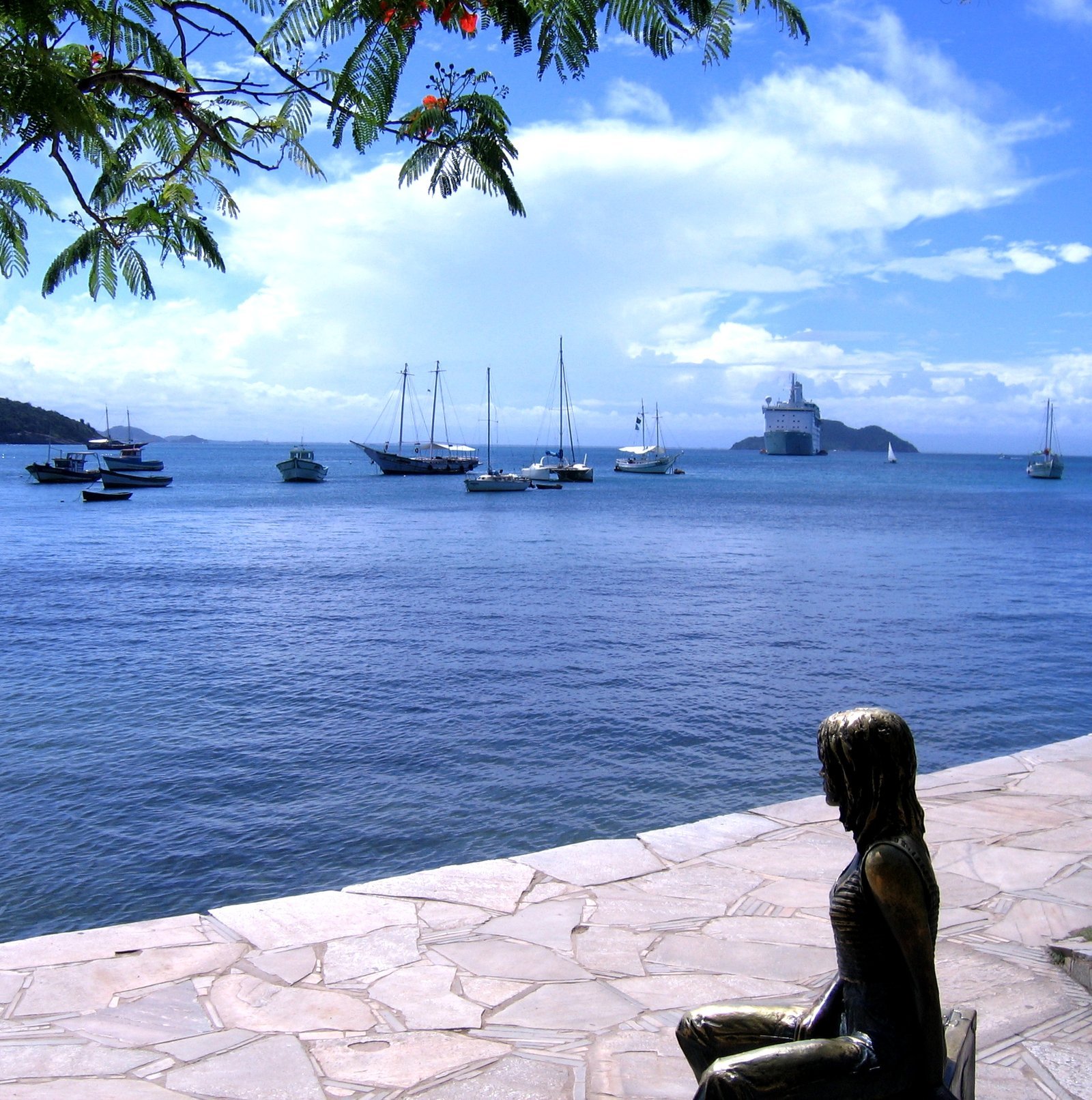
The bronze statue of Bardot, seated on a suitcase and gazing out to sea, was made by artist Christina Motta and unveiled in 1999 on the Praia da Armação waterfront, which was then renamed Orla Bardot. It was based on a photograph by Denis Albanese. Christina Motta also made Os Três Pescadores (The Three Fishermen), the bronze group nearby. Bardot died on December 28, 2025, at 91, and the town paid tribute on the waterfront that same day.
Búzios today
Today Búzios is the most upscale destination in the Lakes Region, with boutique hotels, acclaimed restaurants, marinas and a steady stream of cruise ships in the summer season. At the same time, fishermen still work from Praia da Armação and Ossos, and the town keeps popular festivals and a calendar of sea sports events. Much of the peninsula is protected: Costa do Sol State Park, created in 2011, covers areas around Forno, Tucuns and Tartaruga, and there is also the Pau-Brasil Environmental Protection Area and municipal reserves such as Lagoinha Park and the João Fernandes and Brava Rocky Shores Natural Monument.
When to visit Búzios: weather month by month
Direct answer: for beach weather and heat, the best time to visit Búzios is December to March, with average highs above 30 °C (86 °F). April, May, September and October bring pleasant days, little rain and lower prices than summer. Winter is the driest season, but lows drop to around 18 °C (64 °F) and the water gets cold on the open-sea beaches. November, December and March are the wettest months, at around 110 mm each, which is not much by the standards of southeastern Brazil.
The table below uses the 1991-2020 climate normals from Brazil’s National Institute of Meteorology (INMET) for the Iguaba Grande station, the closest official station to Búzios, about 40 km away. The peninsula is usually a little breezier than the inland Lakes Region, so treat the numbers as a guide, not a forecast.
| Month | Average low and high | Average rainfall (mm) |
|---|---|---|
| January | 23.3 °C to 31.5 °C (74–89 °F) | 103.6 |
| February | 23.7 °C to 32.2 °C (75–90 °F) | 61.0 |
| March | 23.1 °C to 30.9 °C (74–88 °F) | 109.4 |
| April | 21.7 °C to 29.4 °C (71–85 °F) | 65.3 |
| May | 19.3 °C to 27.0 °C (67–81 °F) | 74.8 |
| June | 18.3 °C to 26.4 °C (65–80 °F) | 40.6 |
| July | 17.8 °C to 26.0 °C (64–79 °F) | 52.8 |
| August | 18.3 °C to 26.5 °C (65–80 °F) | 35.5 |
| September | 19.2 °C to 26.8 °C (67–80 °F) | 62.0 |
| October | 20.5 °C to 27.9 °C (69–82 °F) | 64.6 |
| November | 21.2 °C to 28.5 °C (70–83 °F) | 112.1 |
| December | 22.6 °C to 30.3 °C (73–87 °F) | 111.6 |
| Year | 20.8 °C to 28.6 °C (69–83 °F) | 893.3 |
The Lakes Region is known as one of the driest parts of Rio de Janeiro state. Some sources put Búzios at around 750 mm of rain a year; the INMET station at Iguaba Grande records 893 mm. The figures do not match exactly, but they tell the same story: it rains far less than in Rio de Janeiro, and sunny days are the rule. An easterly wind blows often, which makes the peninsula one of Brazil’s best spots for sailing, windsurfing and kitesurfing, especially at Manguinhos and Rasa.
Why are some beaches so cold?
It is upwelling. The tourism office explains that when the east wind pushes warm surface water offshore, cold, deep water rises along the coast, a phenomenon centered on Arraial do Cabo that directly affects beaches such as Tucuns and Forno. So even in January you may find chilly water on the southern and open-sea side of the peninsula and warm water in the north-facing coves such as Azeda, Ossos and Tartaruga. If cold water bothers you, choose your beach according to the day’s wind.
High season, holidays and prices
December, January, Carnival and long holiday weekends are the busiest and most expensive times. Ahead of New Year’s Eve 2025/2026, the Búzios hotel and guesthouse association reported occupancy of almost 95%, according to the town hall. July brings school holidays and plenty of Argentine and Brazilian visitors, but the water is cold. March, April, May, September, October and the first half of November tend to combine settled weather, emptier beaches and lower rates.
New Year’s Eve in Búzios
For New Year’s Eve 2025/2026, the town hall did not put on fireworks or free public concerts, in line with a municipal law banning loud fireworks. Parties were run by hotels, clubs and venues, under Municipal Decree 2,951/2025. As of this guide’s last update, the town hall had not announced an official program for New Year’s Eve 2026/2027. Hotels and guesthouses are already selling year-end packages, so book early and check before you go whether any public event is planned.
How to get to Búzios: by bus, car and plane
Direct answer: the easiest way to reach Búzios without a car is the Auto Viação 1001 bus from Rio’s Novo Rio bus terminal, which runs several times a day and takes 3h10 to 3h50. There is also a direct bus from Galeão airport (about 4 hours). By car, it is about 170 km from Rio over the Rio-Niterói Bridge and the Via Lagos highway. In summer, there are flights into Cabo Frio airport, 30 to 45 minutes’ drive from Búzios.
Bus from Novo Rio terminal
Auto Viação 1001 runs the Rio de Janeiro to Búzios route with about nine departures a day, the first just after 6 a.m., in conventional and executive classes. In October 2026, a conventional ticket cost around R$ 92, conventional with air conditioning R$ 130–137 and executive about R$ 156, with advance-purchase deals from R$ 77.54. The Búzios bus station is at Estrada da Usina Velha 444, in the Triângulo de Búzios neighborhood, close to downtown. The Buser platform also sells trips from around R$ 71. Fares change with the date and how far ahead you book, so check when buying.
Direct bus from Galeão airport
If you fly into Rio, you can go straight from Galeão. 1001 runs a Galeão to Búzios service that boards at Terminal 2 arrivals, according to RIOgaleão. In October 2026, listed departures were 9:20 a.m., 11:20 a.m. and 3:20 p.m., with a trip of about 4 hours and fares of around R$ 105–121 depending on the source. With so few departures, check the 1001 website before your flight and leave a buffer for delays.
By car
From Rio, cross the Rio-Niterói Bridge, take BR-101 to Rio Bonito and join the Via Lagos (RJ-124), a toll highway into the Lakes Region. From there, RJ-106 and RJ-102 lead to the entrance to Búzios. It is about 170 km. Without traffic, the drive takes around 2h30 to 3 hours (our estimate); on summer Fridays and before holidays it can take much longer. In town, the main road is Avenida José Bento Ribeiro Dantas, which runs the length of the peninsula from Praia Rasa, with speed cameras limiting you to 40 km/h on several stretches.
Parking near the beaches and downtown is pay-and-display under the Summer Parking system: spaces are marked by curbs painted blue, and attendants in blue uniforms collect the fee. Rua das Pedras is pedestrian-only.
Vehicle fees
Many people ask whether Búzios charges an entry fee for cars. In October 2026, we found no entry fee in force for tourists’ cars. A proposed Sustainable Tourism Fee was shelved in November 2025. Tour buses and vans still need prior authorization from the town hall, and a fee on those vehicles was struck down by the state court in March 2026. The rules change often, so check before traveling, especially with a group.
By plane: Cabo Frio airport
Cabo Frio International Airport (CFB) is 30 to 45 minutes’ drive from Búzios, depending on traffic (our estimate), and handles seasonal flights. For summer 2026/2027, Cabo Frio’s town hall announced 233 round-trip rotations between December 3, 2026 and March 29, 2027, including LATAM flights from São Paulo-Guarulhos (from December 3, on Mondays, Thursdays, Fridays and Sundays), Azul flights from Belo Horizonte-Confins from December 12 and Aerolíneas Argentinas flights from Buenos Aires, Rosario and Córdoba from December 26. Sources give different end dates for the Azul service, so check with the airline. Outside summer, the usual route is to fly into Rio (Galeão or Santos Dumont) and continue by road. See our Rio de Janeiro travel guide if you plan to stay a few days in the city first.
Getting around Búzios: taxis, buggies, water taxis and walking
Direct answer: Búzios is small but spread out. Downtown, the Orla Bardot, Praia do Canto and Praia da Armação are walkable. For beaches farther out, such as Geribá, Ferradura, Tartaruga or Tucuns, use a taxi, a car, a rented buggy or a guided buggy tour. Between Ossos, Azeda and João Fernandes, water taxis run when the sea allows.
- On foot: from downtown you can walk to the Orla Bardot, Armação, Ossos and, after a short climb, Azeda. The town hall also maintains signposted trails under the Búzios Eco Trail name, such as Brava–Forno and Canto–Amores–Tartaruga.
- Taxis: the tourism office lists three official taxi ranks: on Praça Santos Dumont, downtown, phone +55 22 2623-2160; in front of McDonald’s, +55 22 2623-2703; and in front of the Santa Rita church in Manguinhos, at the main turnoff for Geribá, +55 22 2623-5794.
- Ride-hailing apps: they usually work in town, but supply varies a lot with season and time of day. Check the app before relying on it to get back from a remote beach.
- Buggies: the classic way to explore the peninsula. In October 2026, Buggy Búzios charged R$ 300 for a 24-hour rental (with a R$ 500 deposit) and R$ 100 per person for a 1h30 guided tour of eight beaches and three viewpoints.
- Water taxis: small boats link Ossos and the downtown pier with Azeda and João Fernandes. A local agency listed fares of R$ 90–105 per person per leg in October 2026; prices at the pier may differ, so agree on the fare before boarding. Service stops when the sea is rough.
- Local buses: they exist but are designed for residents. For visitors, a taxi or buggy usually saves a lot of time.
Búzios neighborhoods: where each one fits
Direct answer: Centro, with Rua das Pedras and the Orla Bardot, is the heart of the nightlife and restaurant scene. Ossos, Azeda and João Fernandes are at the tip of the peninsula, with calm beaches and many guesthouses. Ferradura and Geribá are on the south side, with long beaches and beach hotels. Manguinhos, Tucuns and Rasa sit closer to the town entrance, with resorts, gated communities and windy beaches.
Centro, Rua das Pedras and Orla Bardot
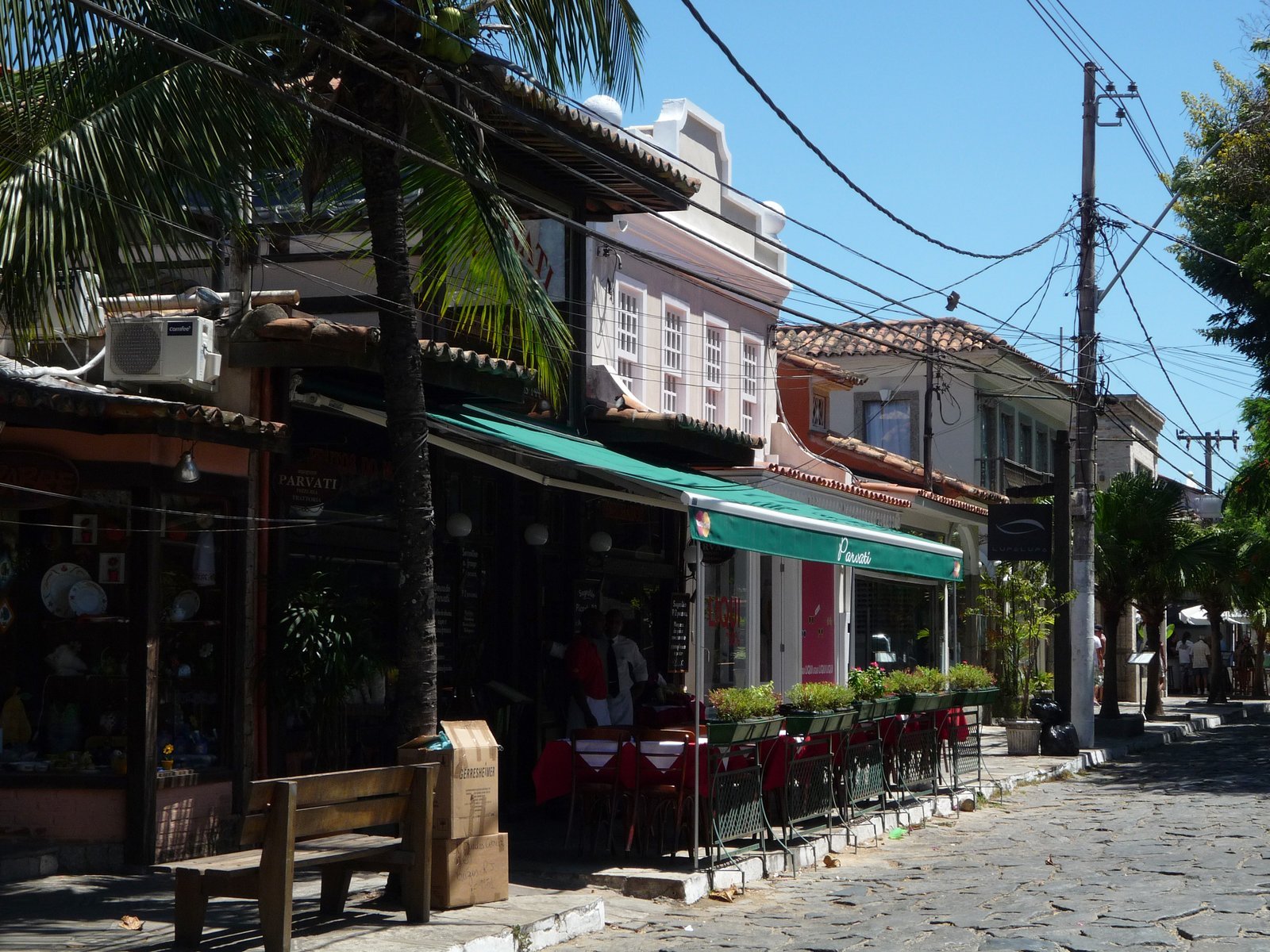
This is where everything happens at night. Rua das Pedras, paved with uneven stones and closed to cars, is lined with shops, bars, restaurants and galleries, and the action continues on parallel Rua Manuel Turíbio de Farias. The Orla Bardot follows Praia da Armação, with wooden decks, benches and the Bardot statue. Praia do Canto is right next door. Staying here lets you walk to dinner, but the streets are lively on high-season nights.
Ossos, Azeda and João Fernandes
The tip of the peninsula has the most photogenic beaches and the calmest water. Ossos has colorful boats, the Church of Sant’Anna and the path to Azeda and Azedinha. João Fernandes and João Fernandinho, facing Ilha Branca, are the favorite beaches of South American visitors. It is a good base if you want the beach in the morning and dinner downtown, a few minutes away by taxi.
Ferradura, Ferradurinha and Geribá
On the south side, Geribá is the trendiest beach, with surfing, beach clubs and plenty of restaurants. Horseshoe-shaped Ferradura has sheltered water and is one of the best for families. Tiny Ferradurinha is a postcard. Hotels here are farther from Rua das Pedras, so plan on a taxi or car at night.
Manguinhos, Tucuns and Rasa
Closer to the town entrance, Manguinhos is the sailors’ and kitesurfers’ beach, with the Manguinhos pier and good sunsets. Tucuns is wild, with dunes and resorts. Praia Rasa, about 9 km long, has shallow, warm water and quilombola heritage. Prices tend to be lower than at the tip of the peninsula, in exchange for more driving.
Things to do in Búzios: beaches, Rua das Pedras and tours
Direct answer: the Búzios essentials are a schooner cruise around the beaches and islands, a day between Ossos, Azeda and João Fernandes, a look at Geribá and Ferradura on the south side, a late-afternoon walk along the Orla Bardot and dinner on Rua das Pedras. With more time, add the Búzios Eco Trail hikes, the beaches of Forno and Brava, snorkeling at Tartaruga and a day trip to Arraial do Cabo.
The town hall lists 23 beaches. You can’t see them all on a short trip, and you don’t need to. Below are the main ones, with details on size, access and sea conditions from the town’s official tourism portal. A simple rule helps you choose: beaches at the northern tip of the peninsula (Azeda, Ossos, João Fernandes, Tartaruga) usually have calm, warmer water, while those on the south and open-sea side (Geribá, Brava, Tucuns, Forno) are colder, and some have strong waves.
Rua das Pedras and the Orla Bardot
Rua das Pedras is Búzios’s main attraction, by day and by night. It is a pedestrian street with an uneven surface of irregular stones that, according to the town hall, came from an old quarry at Ponta do Marisco, at the end of Geribá. Along it and on parallel Rua Manuel Turíbio de Farias you’ll find shops, bars, restaurants, ice cream parlors and galleries. Things pick up after sunset and go on late on weekends and in high season. Wear flat shoes: the cobbles are uneven on purpose.
The Orla Bardot starts where Rua das Pedras ends and follows Praia da Armação. It is a waterfront promenade with wooden decks over the sea, benches, fishing boats at anchor, Ilha do Caboclo just offshore and three bronze sculptures: Brigitte Bardot, Os Três Pescadores (The Three Fishermen) and former president Juscelino Kubitschek. The town hall highlights the row of old colonial-style houses and the bars for watching the sunset. This is also where the Píer do Centro (downtown pier) is, where the schooners leave and cruise ship passengers come ashore, along with the Píer dos Pescadores, still used by fishing families.
Praia dos Ossos
Praia dos Ossos is a 400 m cove with colorful fishing boats, a tree-lined waterfront and restored fishermen’s houses. At the left end stands the Church of Sant’Anna, from 1743, with the yacht club just below. From the right side of the beach, a paved street leads to Azeda and Azedinha. There are two stories behind the name, which means Bones Beach. The best known says the bones of whales processed at Armação were buried here; another refers to the remains of Indigenous people killed during colonization. Cars can reach the start of Rua da Praia dos Ossos, and water taxis stop here.
Azeda and Azedinha
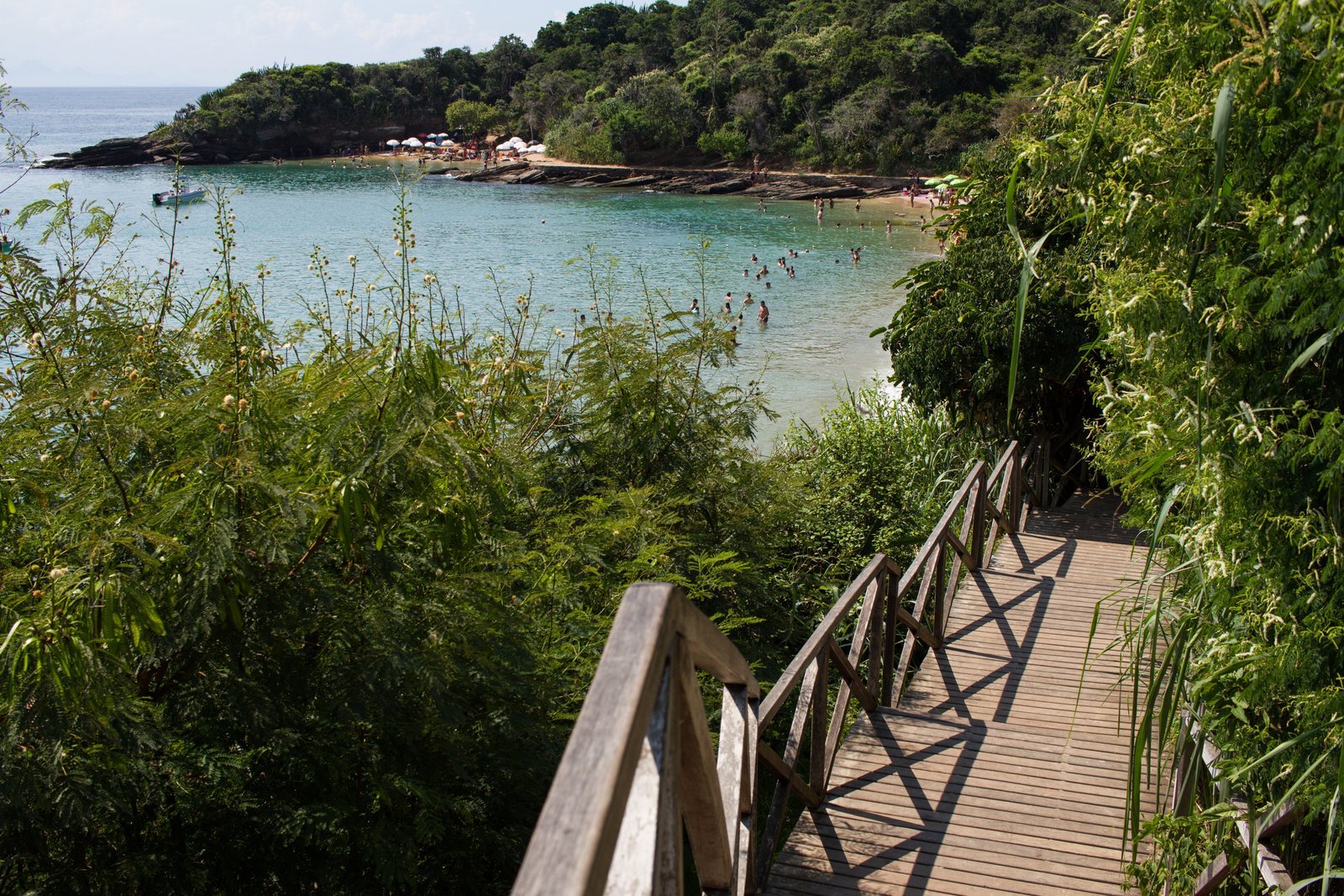
The town hall considers Azeda (200 m) and Azedinha (50 m) two of the most beautiful beaches in Brazil. They sit between Ossos and João Fernandes, and you reach them on foot: from the street on the right side of Ossos, a short uphill walk leads to a wooden staircase down to Azeda; from Azeda, a path over the rocks at the right end takes you to Azedinha. You can also arrive by private boat or water taxi. The water is calm, clear and lime green, and both beaches have kiosks. The old colonial house of the Honold family, one of the best-known images of the town, is here too. Go early on summer weekends, because the strip of sand is small and fills up.
João Fernandes and João Fernandinho
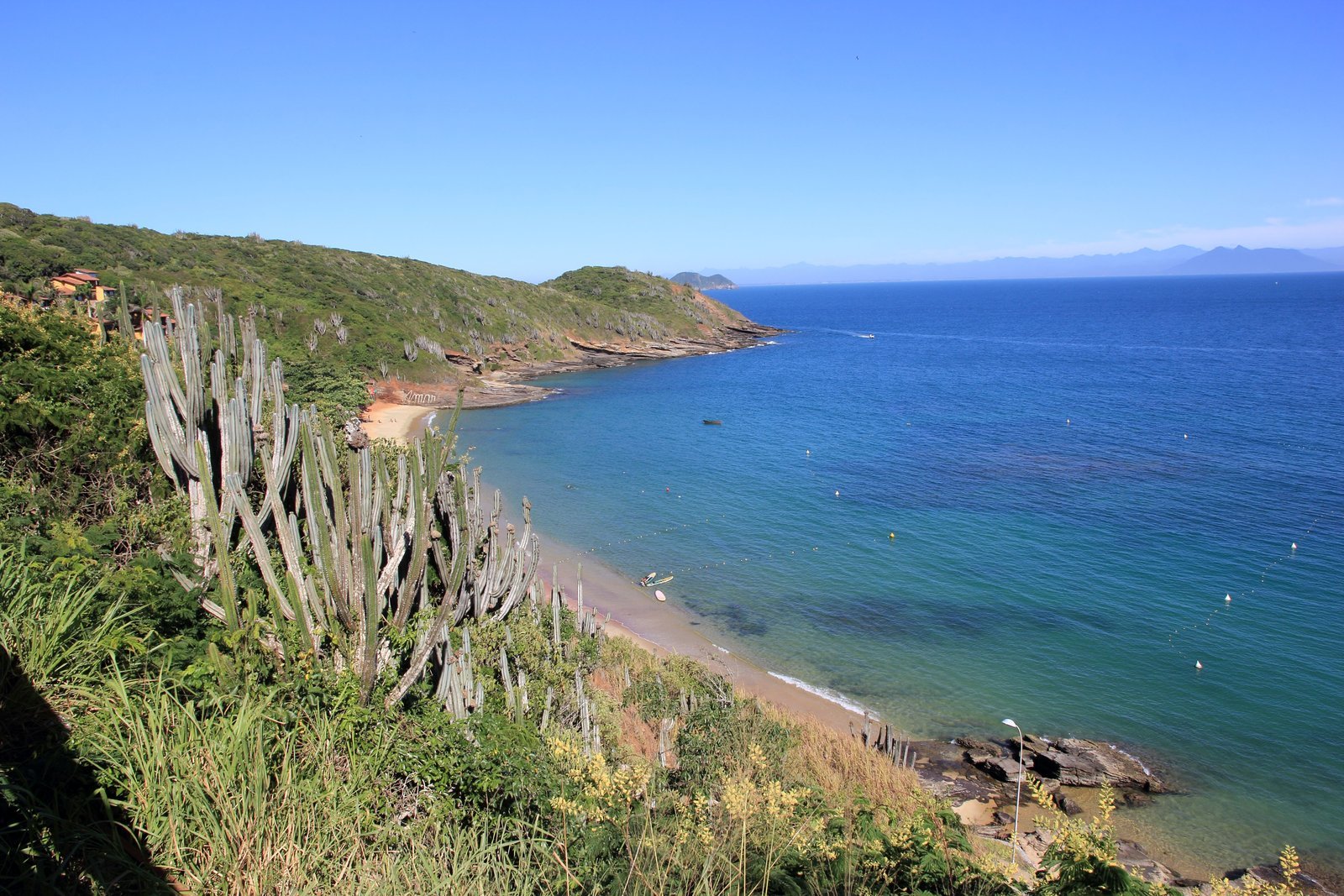
At the northeastern tip of the peninsula, facing Ilha Branca, these two beaches add up to about 800 m of fine, pale sand and calm blue water, good for snorkeling, kayaking and stand-up paddleboarding. They are the most popular beaches with South American visitors and stay busy all year, with plenty of restaurants and kiosks. João Fernandes can be reached from several streets in the neighborhood; for smaller, slightly quieter João Fernandinho, an unpaved path starts at the top of the hill on the right. The João Fernandes viewpoint offers one of the classic views of Búzios.
Geribá
With almost 2 km of fine white sand, Geribá is the trendiest beach in Búzios and the top choice for surfing, with cold water and rough seas. The left end has a marked area for beach sports, and the waterfront is full of restaurants and beach clubs. At the right end is Ponta do Marisco, whose rocks, more than two billion years old, preserve evidence of the separation of South America and Africa, according to the town hall. The main access is via Rua dos Gravatás and Avenida Geribá, from the Trevo do Ceceu roundabout. There are public restrooms at the left end.
Ferradura and Ferradurinha
Ferradura (Horseshoe) has 1.5 km of pale sand in a horseshoe shape, sheltered from wind and currents, which makes it one of the best beaches for children. The water is calm and cool, good for swimming, wakeboarding, kayaking and pedal boats, and the shore is lined with hotels and large houses, with restaurants and public restrooms at the right end. Neighboring Ferradurinha is just 100 m long and one of the prettiest in town. You reach it on foot from a street on the left side of Geribá, and the water trapped between two rocky points stays calm for paddleboarding and kayaking. From Ferradurinha, a trail leads to Praia dos Amores and the Ferradurinha tide pools.
Forno, Foca and Brava
Forno is a small, 100 m beach surrounded by rocks, with clear, cold water and natural pools near the rocky shore, great for snorkeling. The sand looks pink in the sun because of garnet, a mineral from the surrounding rocks. The beach lies inside Costa do Sol State Park, has kiosks and a paved road, plus the Forno viewpoint. Next door, Praia da Foca, in the Saco do Forno, is only 50 m long, with water as still as a swimming pool. Praia Brava, 660 m long, faces the open sea with strong waves, and surfers prefer its left side; the right side is more secluded. Brava and Forno are linked by a 1.5 km signposted trail of moderate difficulty that crosses Lagoinha Municipal Park and the João Fernandes and Brava Rocky Shores Natural Monument.
Tartaruga
Praia da Tartaruga (Turtle Beach) runs 2 km between Ponta da Sapata and Ponta da Cruz, with calm, green, warm water that is good for swimming and watching fish. It is one of the best for a family day, with kiosks, restaurants and a stand-up paddle school. According to the town hall, the cove is a nesting site for three species of sea turtle, which gave the beach its name. Access is via a paved road of about 1.5 km off Avenida José Bento Ribeiro Dantas, or by water taxi. The right side belongs to Costa do Sol State Park.
Canto, Amores and Virgens
Praia do Canto is downtown, parallel to Rua das Pedras, about 1.5 km long, with fishing boats, houses right on the water and few kiosks. It is good for a quiet swim close to everything. Along the rocky shore to the left, on foot, you reach tiny Praia dos Amores, 30 m long, and Praia das Virgens, with no facilities at all. The second phase of the Búzios Eco Trail links Canto, Amores, Virgens and Tartaruga in about 2 km, with the Tartaruga viewpoint, 52 m above sea level, as its highest point.
Manguinhos, Rasa and the Mangue de Pedra
Manguinhos is about 8 km long and is the sailors’ beach, home to most of the town’s regattas and a kitesurfing hotspot. The Manguinhos pier is a good place to watch the sunset. Praia Rasa, about 9 km long, has shallow, warm water, steady wind for windsurfing and kitesurfing, and a marina. Farther on, between Vila dos Pescadores and Ponta do Pai Vitório, Praia da Gorda is home to the Mangue de Pedra, a rare mangrove ecosystem growing over rocks. There is nowhere to buy food, so bring water and snacks.
Tucuns, Caravelas, José Gonçalves and Olho de Boi
To escape the crowds, Tucuns has 2.7 km of wild beach with dunes, coastal scrub, cold water and good waves, and it is also the landing spot for hang gliders and paragliders. Caravelas (141 m) and José Gonçalves (100 m) lie inside the Pau-Brasil Environmental Protection Area, on the road to Cabo Frio, reached by a dirt road in good condition and a short walk down. Taking pebbles from José Gonçalves is forbidden. Olho de Boi, 100 m long, can only be reached by trail, has no facilities and is used as a naturist beach.
Schooner cruise around the beaches and islands
The schooner cruise is the most popular activity in Búzios. Boats leave from the downtown pier, round the tip of the peninsula and stop at some beaches and islands for swimming and snorkeling, over about 2h30 to 3 hours. The town hall mentions Praia das Moças, on Ilha Feia, as one of the stops, with clear green water where rays and turtles are often seen. These are the prices we checked in October 2026:
- Nautitour: from R$ 60 per person, with standard boarding at the Rua das Pedras pier at no extra charge; boarding at Porto Veleiro or the fishermen’s pier costs R$ 10 more. Private speedboats from R$ 1,200.
- MDS Mergulho: R$ 80, daily departures from 11:30 a.m., stops of about 20 minutes at João Fernandes, Ilha Feia and Tartaruga, plus a R$ 10 port fee; children up to 5 ride free.
- Buggy Búzios: R$ 60 on promotion until November 20, 2026 (full price from R$ 100), departing at 11:30 a.m.; children up to 5 ride free and ages 6 to 10 pay half.
The larger schooners carry a lot of people: Nautitour mentions boats for up to 120 passengers. If you want a calmer trip, ask about the boat size before buying or share a private speedboat with another couple. Bring sunscreen, a hat and cash for drinks, and check whether the boarding fee is included.
Buggy tours and viewpoints
A buggy tour with a driver covers beaches and viewpoints far from downtown, such as the Forno and João Fernandes lookouts. In Buggy Búzios’s 2026 price list, the 1h30 private tour of eight beaches and three viewpoints cost R$ 100 per person, and the buggy-plus-schooner combo R$ 160. If you want to drive yourself, a 24-hour rental cost R$ 300, with a R$ 500 deposit. Check whether insurance is included and drive slowly: the streets are narrow and the hills are steep.
Snorkeling, stand-up paddle, sailing and kitesurfing
The calm coves of Tartaruga, Forno, João Fernandes and Ferradura are good for snorkeling and stand-up paddleboarding, and Tartaruga even has a paddleboard school, according to the town hall. For scuba diving around the islands, look for accredited dive operators. Manguinhos and Rasa are the windy spots, with sailing, windsurfing and kitesurfing schools. For any instructor-led activity, choose registered companies with proper safety gear, and ask about sea conditions on the day.
Búzios Eco Trail hikes
The town hall has signposted trails linking beaches and viewpoints: Brava–Forno (1.5 km, moderate), Canto–Amores–Virgens–Tartaruga (2 km, moderate) and Ponta do Pai Vitório, between the Mangue de Pedra and Praia Rasa, about 13 km from downtown. Wear sneakers, carry water and sunscreen, avoid the hottest hours and, if you don’t know the way, hire an accredited guide.
Events and festivals in Búzios
Direct answer: Búzios has events all year, mostly tied to the sea, music and food. The official 2026 calendar lists more than 50 events, including the Búzios Jazz Festival in May, Wine in Búzios in June, the Sardine and Seafood Festival and Búzios Coffee and Chocolate in September, and the town’s anniversary festival in November. The 2027 calendar had not been released when this guide was last updated.
These are some highlights from the 2026 calendar released by the town hall in March. Dates can change, so check before you go:
| Dates in 2026 | Event |
|---|---|
| April 2–5 | Búzios Sailing Week Oceano |
| May 1–3 | Búzios Jazz Festival |
| May 13–17 | Beach Tennis World Tour |
| May 29–30 | MI Búzios El Plan, aimed at Argentine and Chilean visitors |
| June 2–7 | Wine in Búzios |
| September 18–19 | Sardine and Seafood Festival |
| September 25–27 | Búzios Coffee and Chocolate |
| October 9–11 | MPBúzios (Brazilian popular music) |
| November 9–11 | Literary Festival |
| November 12–14 | Festa da Cidade, the town’s anniversary |
| November 27–28 | Classic car meet |
| December 1–31 | Natal de Luz (Christmas lights) |
| December 6 | Búzios Half Marathon |
| December 11–12 | Christmas Cantata |
Day trips from Búzios: Arraial do Cabo and Cabo Frio
Direct answer: the most popular day trip is Arraial do Cabo, about 40 km away (36 to 46 km depending on the route), roughly an hour’s drive. The boat tour there, covering Ilha do Farol, the Prainhas do Pontal and the Gruta Azul (Blue Grotto), cost from R$ 100 per person until December 25, 2026. Cabo Frio, with Praia do Forte, is about 25 km away. You can also see both towns on a buggy tour from Búzios.
| Destination | Distance from Búzios | Driving time | Notes |
|---|---|---|---|
| Cabo Frio | about 25 km | 40 to 45 min | Praia do Forte and a large shopping area |
| Arraial do Cabo | 36 to 46 km, depending on the route | about 1 hour | Boat tour from R$ 100 until 12/25/2026 |
| Rio de Janeiro | about 170 km | 2h30 to 3 hours without traffic (our estimate) | 1001 bus, 3h10 to 3h50 |
Arraial do Cabo
Arraial do Cabo is the neighbor with crystal-clear, very cold water, caused by the same upwelling that chills the southern beaches of Búzios. The classic outing is the boat tour. With Arraial Boat, for example, the tour lasts about 4 hours, leaves at 11 a.m. from the floating pier at Praia dos Anjos and visits Ilha do Farol, the Prainhas do Pontal do Atalaia and the Gruta Azul. In October 2026, adults paid R$ 100 until December 25, 2026 and R$ 200 from December 26 to March 31, 2027, plus a R$ 15 per person marina boarding fee. Read our guide on how to find tours in Arraial do Cabo for more tips.
If you’d rather not drive, Buggy Búzios sells a full-day buggy trip to Arraial for R$ 190 on its 2026 promotion, not including Arraial’s environmental fee, which is charged separately. Go early: in high season, traffic at the entrance to Arraial and lines at the pier build up quickly through the morning.
Cabo Frio
Cabo Frio is Búzios’s parent town, from which it split in 1995. It has Praia do Forte, a long, wide beach, a big shopping area and the region’s airport. From Búzios it is a half-day trip, or a stop on the way if you fly into CFB. Combine it with Arraial on the same day if you have a car.
Rio de Janeiro and the rest of the state
Many travelers pair Búzios with a few days in Rio. See our Rio de Janeiro travel guide and our pick of Búzios, Jericoacoara and Pipa, Brazil’s under-the-radar beaches if you are planning a longer beach trip around Brazil.
What to eat in Búzios
Direct answer: in Búzios, eat fish and seafood brought in by the boats at Armação and Ossos. The town also has a strong Argentine influence, with parrillas (grills) and empanadas, and a restaurant scene of French, Italian and contemporary cooking concentrated on Rua das Pedras and the Orla Bardot. Eating well here costs more than in Cabo Frio or Arraial.
The town’s history explains the menu. Búzios was a fishing village for centuries, and fresh grilled fish, moqueca (a Brazilian seafood stew) and squid, shrimp and octopus dishes are still the backbone of the beach restaurants. The arrival of French, Argentine and Rio visitors from the 1960s on brought bistros, chef-driven cooking and charcoal-grilled meats. Today you can find everything from Japanese food to fresh pasta.
- Catch of the day and seafood: order locally caught fish grilled or as moqueca. Ask what the catch of the day is before ordering; not everything on the menu came off the local boats.
- Sardines: the humble sardine has its own festival on the official calendar, the Sardine and Seafood Festival, in September.
- Argentine cooking: parrillas serving cuts such as bife de chorizo and ojo de bife, empanadas and dulce de leche appear on many menus, a reflection of the Argentine community.
- Beach food: the kiosks at Geribá, Ferradura, João Fernandes and Tartaruga serve platters of fish, shrimp and squid, plus grilled queijo coalho cheese and caipirinhas. Check prices before ordering; on fashionable beaches, the bill adds up fast.
- Coffee and chocolate: since 2026, the calendar has included the Búzios Coffee and Chocolate festival in September, with regional producers and cafés.
- Hotel restaurants open to the public: some hotels welcome non-guests. Le Relais La Borie, in Geribá, says on its official website that its Franco-Brazilian restaurant, Chez Françoise, is open to the public by reservation.
To save money, have lunch at a prato feito (set plate) spot or a pay-by-weight buffet downtown or along Avenida José Bento Ribeiro Dantas, keep the expensive dinner for a special night and always check whether the 10% service charge has been added to the bill.
Nightlife in Búzios
Direct answer: Búzios nightlife is concentrated on Rua das Pedras, Rua Manuel Turíbio de Farias and the Orla Bardot, with bars, restaurants, shops open late and nightclubs. It begins with sunset on the Orla Bardot decks and at the Manguinhos pier and heats up after 10 p.m. on weekends and in high season.
The simplest plan is to walk. Car-free Rua das Pedras fills up after dinner, and many shops stay open at night in season. On summer weekends and holidays, there are parties at clubs, Geribá beach clubs and hotels. On New Year’s Eve, parties are private and ticketed, under town hall rules for events with more than 100 people. Out of season, the town is much calmer and some places shorten their hours, which can be a plus if you want dinner without a line.
If you’re drinking, leave the car or buggy at the hotel. The streets of Búzios are narrow, dark in places and full of hills. The taxi ranks downtown and on Praça Santos Dumont are the easiest way back.
Is Búzios safe? Safety tips
Direct answer: as in any busy tourist destination, the basic precautions apply in Búzios: don’t leave belongings unattended on the sand, avoid flashing phones and jewelry on empty streets at night and take a taxi back from remote beaches. In the sea, follow the lifeguards’ flags at Geribá, Brava and Tucuns, which have waves and currents, and check water quality reports before swimming.
- Police: there is a police post on Praça Santos Dumont, downtown, and the 127th Police Precinct is at the entrance to the Ferradura neighborhood, phone +55 22 2623-9237. In an emergency, call 190.
- Health: the Hospital Municipal Dr. Rodolpho Perissé is on the Cabo Frio–Búzios road, between the Cem Braças and São José neighborhoods, phone +55 22 2623-7622. Ambulance (SAMU): 192.
- Fire department: the station is on Rua das Flores, in Manguinhos, phone +55 22 3399-9335, or call 193.
- The sea: open-sea beaches such as Brava, Geribá and Tucuns have strong waves and rip currents. Swim near lifeguard posts and away from the rocks.
- Water quality: after heavy rain, some beaches may be unfit for swimming. The Rio de Janeiro State Environmental Institute (INEA) publishes water quality bulletins for the state’s beaches; check before you go.
- Sun: the constant breeze hides the heat, and sunburn comes fast. Use high-factor sunscreen and a hat, and reapply after swimming.
- Trails: hike in a group, in daylight, with water and closed shoes. On poorly marked trails, hire an accredited guide.
- Buggies and traffic: steep hills, narrow streets and drivers distracted by the view are a dangerous mix. Wear a seat belt, respect the 40 km/h speed cameras and never drink and drive.
- Environment: many beaches are in protected areas. Don’t take pebbles, shells or plants, don’t feed animals and take your trash with you.
How much does a trip to Búzios cost in 2026?
Direct answer: Búzios is expensive by Lakes Region standards. The bus from Rio costs about R$ 92 in conventional class, schooner cruises run from R$ 60 to R$ 80 per person, a guided buggy tour costs about R$ 100 per person and water taxis cost R$ 90 to R$ 105 per leg through a local agency. For accommodation, check each hotel’s official website, because rates vary a lot with the season. Check the current exchange rate before you travel.
The table brings together the prices we checked on official and operator websites in October 2026. Tours and transport can change price without notice, especially from late December.
| Item | 2026 price | Notes |
|---|---|---|
| Rio to Búzios bus, conventional | about R$ 92 | 1001, from Novo Rio terminal; deals from R$ 77.54 |
| Rio to Búzios bus, conventional with A/C | R$ 130 to R$ 137 | 1001; executive about R$ 156 |
| Galeão to Búzios bus | R$ 105 to R$ 121 | 1001, Terminal 2; figures vary between sources, check |
| Schooner cruise | R$ 60 to R$ 80 | Plus a R$ 10 boarding fee at some piers |
| Private speedboat | from R$ 1,200 | Nautitour, per boat |
| Guided buggy tour (1h30) | R$ 100 per person | Buggy Búzios, eight beaches and three viewpoints |
| Buggy rental (24 hours) | R$ 300 | R$ 500 deposit |
| Buggy and schooner combo | R$ 160 | Buggy Búzios |
| Water taxi | R$ 90 to R$ 105 per leg | Agency price; may differ at the pier |
| Buggy day trip to Arraial do Cabo | R$ 190 | 2026 promotion; Arraial environmental fee extra |
| Arraial do Cabo boat tour | R$ 100 | Until 12/25/2026; R$ 200 in high season, plus R$ 15 marina fee |
| Daily budget, budget traveler | R$ 250 to R$ 450 | Per person, excluding accommodation and paid tours (our estimate) |
Ways to save: travel between March and November, avoiding holidays; buy your 1001 ticket early to get the promotional fare; board the schooner at the Rua das Pedras pier, where some companies charge no boarding fee; pick a guesthouse in Manguinhos or near the bus station and use taxis only at night; and have lunch downtown rather than at the kiosks on the most famous beaches.
Búzios itineraries: 2, 3, 4 and 5 days
Direct answer: with 2 days, do the schooner cruise, Ossos, Azeda and the Orla Bardot. With 3, add Geribá and Ferradura. With 4, add Forno, Brava, Tartaruga and a hike. With 5, set aside a day for Arraial do Cabo. Match the beaches to the day’s wind and sea, and ask at your hotel or the boatmen which ones are most sheltered.
Búzios in 2 days
- Day 1: in the morning, walk along the Orla Bardot to Ossos and climb over to Azeda and Azedinha. Have lunch at João Fernandes or back downtown. Then take the schooner cruise (several companies depart at 11:30 a.m.; check times). In the evening, have dinner on Rua das Pedras.
- Day 2: spend the morning at Geribá or Ferradura, have lunch there and, in the late afternoon, watch the sunset from the Orla Bardot or the Manguinhos pier before hitting the road.
Búzios in 3 days
- Day 1: downtown, the Orla Bardot, Ossos, Azeda and Azedinha.
- Day 2: schooner cruise in the morning and an afternoon at João Fernandes and João Fernandinho, with the viewpoint.
- Day 3: buggy tour of the southern beaches (Geribá, Ferradurinha, Ferradura, Forno) and a special dinner.
Búzios in 4 days
- Days 1 to 3: as in the 3-day itinerary.
- Day 4: the Brava–Forno trail in the morning, snorkeling at Forno and an afternoon at Tartaruga, with stand-up paddle. In the evening, head back to Rua das Pedras.
Búzios in 5 days
- Days 1 to 4: as in the 4-day itinerary.
- Day 5: day trip to Arraial do Cabo for the 11 a.m. boat tour, leaving Búzios early. If you still have energy, stop in Cabo Frio on the way back.
Traveling as a couple? Búzios also features in our list of romantic destinations in Brazil and our Brazil honeymoon guide. If you’re coming for the holidays, see our best Brazil destinations in December.
Where to stay in Búzios
Direct answer: on a first trip, stay in Centro or near the Orla Bardot so you can walk to dinner on Rua das Pedras. Ossos and the João Fernandes area suit travelers who want calm beaches and sunsets on the doorstep. Ferradura and Geribá are for beach hotels on the south side, while Tucuns and Manguinhos have resorts and better-value options. Every link below goes to the hotel’s official website and was checked on October 26, 2026; we don’t use agency or booking site links.
Rates vary a lot with the season. December, January, Carnival and holidays are the most expensive periods, and over New Year’s many guesthouses only sell multi-night packages. Check prices directly on each hotel’s official website and book well ahead for those dates.
Casas Brancas Boutique Hotel & Spa (boutique, Centro)
Casas Brancas Boutique Hotel & Spa is at Rua Alto do Humaitá 10, in Centro, on the hill above the Orla Bardot. It is a boutique hotel with a spa and views over Armação bay, a few minutes’ walk from Rua das Pedras. A good pick for couples who want to be close to the nightlife without being in the middle of it.
Abracadabra Boutique Hotel (boutique, Centro)
Abracadabra Boutique Hotel is at Rua Alto do Humaitá 13, also on the hill above the Orla Bardot. According to its official website, it is aimed at couples and has panoramic views of Armação bay, a heated infinity pool, a dry sauna, the Mediterranean restaurant Místico and a 24-hour front desk. It is about 1 km from Rua das Pedras and 550 m from the Bardot statue.
Vila da Santa Hotel Boutique & SPA (boutique, Praia dos Ossos)
Vila da Santa is at Praça Eugênio Honold 173, on Praia dos Ossos. Its website explains that Bettina and Pierre d’Archemont designed the hotel as a re-creation of a Mediterranean fishing village, with 24 decorated suites, stone pools and a spa. The name honors the 1743 Church of Sant’Anna next door. A good choice if you want to walk to Azeda and Azedinha.
Insólito Boutique Hotel & Spa (luxury, Ferradura)
Insólito Boutique Hotel & Spa is on Praia da Ferradura, on Rua Lydia Gonçalves de Almeida. According to its official website, it has access to a private beach and a pool, suites with panoramic views and wings decorated around themes from Brazilian art, such as Terra Brasil and Modernism, and the top category has its own pool. It is one of the most exclusive hotels in town, for special trips.
Pedra da Laguna Hotel Boutique & SPA (boutique, Ferradura)
Pedra da Laguna is 150 m from Praia da Ferradura, next to Ponta da Lagoinha. The website describes architecture inspired by Minas Gerais farmhouses, a Moroccan-inspired space, rooms with balconies and air conditioning, and a spa, and says pets are welcome. A good base if you want calm Ferradura beach and the Brava–Forno trail nearby.
Le Relais La Borie (charming, Geribá)
Le Relais La Borie faces Geribá and describes itself as “your beachfront home since 1986”. It has the Franco-Brazilian restaurant Chez Françoise, also open to the public by reservation, a beach bar and pools, including a heated hydromassage pool. For travelers who want their feet in the sand on the liveliest beach in Búzios.
Hotel Atlântico Búzios Convention (upscale, Praia da Armação)
Hotel Atlântico Búzios faces Praia da Armação, close to downtown. According to its website, it has 172 rooms with garden, pool or sea views, parking, a pool, a gym, a bar and a restaurant. Phone: +55 22 2620-8850. A larger hotel, good for groups and events, close to everything.
Búzios Beach Resort (resort, Tucuns)
Búzios Beach Resort, part of the WAM Hotéis group, is on Praia de Tucuns and opened in 2010. It has 379 rooms in villas, four bars, a main restaurant and an Italian one, several pools including one of 700 m², a kids’ area and a pet-friendly policy with rules. It is for families and travelers who want resort facilities, away from the downtown buzz.
Pousada El Parador (guesthouse, Centro)
Pousada El Parador is in Centro, a short walk from Rua das Pedras and the main pier, close to Praia do Canto and the Orla Bardot. It offers breakfast, a pool, Wi-Fi, parking, a sauna and a hot tub, welcomes pets and is already selling packages for New Year’s 2027. Good if you want to do everything on foot.
Bamboo Búzios Hostel (budget, Centro)
Bamboo Búzios Hostel is at Rua das Pedras 25, between the street and Praia do Canto. It has private and shared rooms, breakfast and a kitchen, has been running since 2017 and offers a discount for direct bookings on its website. It is the cheapest option on this list, for travelers who want Rua das Pedras on the doorstep.
Video: Búzios by Visit Brasil
This short video from Visit Brasil, Embratur’s official tourism channel, gives a one-minute taste of the beaches and atmosphere of Búzios.
Frequently asked questions about Búzios
When is the best time to visit Búzios?
December to March, if you want heat and warmer water, with average highs above 30 °C (86 °F) according to INMET. For fewer crowds and lower prices, choose April, May, September or October, which have pleasant days and little rain. Winter is the driest season, but the water gets cold and lows drop to around 18 °C (64 °F).
How many days do you need in Búzios?
Three to four days are enough to see the main beaches, take the schooner cruise and enjoy Rua das Pedras at an easy pace. With two days, you can cover the essentials. With five, you have a spare day for a trip to Arraial do Cabo.
How do I get from Rio de Janeiro to Búzios?
The easiest option without a car is the Auto Viação 1001 bus from Rio’s Novo Rio terminal, with about nine departures a day and a trip of 3h10 to 3h50; in October 2026, a conventional ticket cost around R$ 92. There is also a direct bus from Galeão airport, taking about 4 hours. By car, it is about 170 km via the Rio-Niterói Bridge and the Via Lagos highway.
What are the best beaches in Búzios?
Azeda and Azedinha, which the town hall rates among the most beautiful in Brazil, plus João Fernandes, Ferradurinha, Forno and Tartaruga are favorites for calm, clear water. For surfing and open sea, the most popular are Geribá and Brava. Praia dos Ossos, with its colorful boats, is the most photogenic.
How much is the schooner cruise in Búzios?
In October 2026, the schooner cruise cost R$ 60 to R$ 80 per person with the companies we checked, lasting about 2h30 to 3 hours with stops at beaches and islands. Some piers charge a R$ 10 boarding fee. Young children usually ride free, and private speedboats start at R$ 1,200.
Does Búzios charge tourists an entry fee?
In October 2026, we found no entry fee in force for tourists’ cars. A proposed Sustainable Tourism Fee was shelved in November 2025, and the fee on tour buses and vans was struck down by the courts in March 2026, although those vehicles still need prior authorization. Rules change, so check before you travel.
Do I need a car in Búzios?
No. Downtown, the Orla Bardot, Ossos and Azeda are walkable, and for other beaches there are taxis, buggies and water taxis. A car helps for the more distant beaches and Arraial do Cabo, but parking near the beaches is paid and hard to find in high season.
Is it worth going from Búzios to Arraial do Cabo?
Yes, if you have at least four days. Arraial is about 40 km away, roughly an hour’s drive, and the boat tour to Ilha do Farol and the Gruta Azul cost from R$ 100 per person until December 25, 2026, plus the marina fee. Leave early to beat the traffic and the lines.
Where is the Brigitte Bardot statue in Búzios?
On the Orla Bardot, the Praia da Armação waterfront in downtown Búzios, near the end of Rua das Pedras. The bronze statue by artist Christina Motta was unveiled in 1999 and recalls the actress’s visit in 1964. Bardot died on December 28, 2025, at 91.
Is Búzios good for families with children?
Yes. Calm, sheltered beaches such as Ferradura, Tartaruga, Azeda and João Fernandes are good for children, and there are resorts with kids’ areas. Avoid swimming with little ones at beaches with strong waves, such as Brava and Geribá, and bring sunscreen and hats, because the breeze disguises the strong sun.
Is Búzios worth visiting?
Yes, especially if you like variety. Within a few kilometers, Búzios combines calm, warm-water beaches, surf beaches, trails along protected headlands, lively nights on Rua das Pedras and a food scene few Brazilian beach towns can match. It is pricier than its Lakes Region neighbors, and the famous beaches get crowded in summer, but out of high season the peninsula shows the side that won over Bardot: little boats at Ossos, sunset over Armação and an almost empty beach for every day of the week. If this is your first time in the state, pair it with a few days in Rio, and for more Brazilian beach ideas, see our Porto Seguro travel guide.
Sources
- IBGE Cidades: Armação dos Búzios (RJ), overview (2022 census population and area)
- INMET: Brazilian climate normals 1991-2020 (rainfall, highs and lows, Iguaba Grande station)
- Búzios town hall tourism portal: beaches (Azeda, Ossos, Armação, João Fernandes, Geribá, Ferradura, Forno, Tartaruga and others), Búzios Eco Trail and useful tips (taxis, phone numbers and parking)
- Búzios town hall: 2026 events calendar and hotel occupancy for New Year’s 2026
- Visit Brasil: Búzios
- Wikipedia (Portuguese): Armação dos Búzios (history, municipality, road and Argentine influence)
- Brazilian Ministry of Foreign Affairs: visas for foreign visitors
- G1: Búzios town hall recalls Brigitte Bardot’s visit; Estado de Minas: why Búzios has a Brigitte Bardot statue
- Auto Viação 1001: bus tickets to Búzios; RIOgaleão: airport buses
- Cabo Frio town hall: high season at Cabo Frio International Airport; G1: Cabo Frio airport expects almost 56,000 passengers in summer
- O Globo: mayor asks to shelve the tourist fee; Agenda do Poder: court strikes down tour bus fee
- O Dia: rules for private New Year’s parties
- Nautitour: schooner cruise; MDS Mergulho: schooner cruise; Buggy Búzios: 2026 buggy and tour prices (prices checked October 26, 2026)
- Conexão Búzios: water taxi
- Arraial Boat: Arraial do Cabo boat tour and terms and prices