Porto Seguro is a municipality in the far south of Bahia, Brazil, with 168,326 residents in the 2022 IBGE census and 2,285 km² of territory, and it is much bigger than the town most visitors picture. Its limits take in the main town, with its beachfront strip and hilltop historic quarter, plus the districts of Arraial d’Ajuda, Trancoso, Caraíva and Vale Verde. In practice, “going to Porto Seguro” means choosing between four very different paces: the lively beach clubs of the northern shore, bohemian Arraial, quiet and expensive Trancoso, and car-free Caraíva.
It is also where Brazil’s official history begins. Pedro Álvares Cabral’s Portuguese fleet reached this stretch of coast in April 1500, and the first Mass on Brazilian soil was held at Coroa Vermelha, now part of neighboring Santa Cruz Cabrália. The colonial hilltop town has been protected by IPHAN, Brazil’s national heritage institute, since 1968, and the whole municipality was declared a National Monument in 1973. This guide covers what you need to plan a trip in 2026: when to go, how to get there, how the ferry to Arraial works, the new charge for out-of-town vehicles, the main tours with checked prices, 3, 5 and 7 day itineraries, and real places to stay linked to their official websites.
Quick facts: Porto Seguro, Brazil
- What it is: a municipality of 168,326 people (IBGE, 2022 census) on Bahia’s Discovery Coast. Arraial d’Ajuda, Trancoso and Caraíva are all part of it.
- Best time to go: August to October, January and February are the driest months. March, April, November and December are the wettest on the long-term average. Peak season runs from Christmas to Carnival, plus July.
- Getting there: Porto Seguro International Airport (BPS) is 3 km from the center, with flights on Azul, Gol, LATAM and Aerolíneas Argentinas, including direct service from Buenos Aires. By bus, Salvador is about 11 to 12 hours away.
- Ferry to Arraial: runs 24 hours, every 30 minutes from 6 a.m. to midnight. Foot passengers pay about R$6 one way and return free; cars pay about R$22.70 on weekdays.
- Vehicle charge: cars from outside the region staying over 6 hours pay the TTS, R$9.90 per day in 2026. Visitors arriving by plane do not pay anything.
- Must-do tour: the Recife de Fora reef pools, capped at 400 visitors a day and timed to low tide. About R$160 per adult.
- How many days: 5 days cover the main town, Arraial and Trancoso. With 7 days you can add Caraíva and Praia do Espelho at an easy pace.
A short history: from Monte Pascoal to the hilltop town
Direct answer: Porto Seguro holds the first chapter of Portuguese colonization in Brazil. Cabral’s fleet sighted Monte Pascoal in April 1500, the first Mass was said at Coroa Vermelha on April 26, and the town of Nossa Senhora da Pena was founded by the lord proprietor Pero de Campos Tourinho around 1535. The colonial center is a protected national heritage site.
Pero Vaz de Caminha’s letter to the Portuguese king, the best-known account of the arrival, describes the ships anchoring in a sheltered harbor that the sailors named Porto Seguro, “safe harbor,” precisely because it protected the fleet. The first Mass in Brazil was celebrated by Friar Henrique de Coimbra on Low Sunday, April 26, 1500, on a small islet at Coroa Vermelha, an area now inside Santa Cruz Cabrália, about 15 km north of central Porto Seguro. A second Mass followed on May 1, on the mainland, in front of a large wooden cross.
The exact landing point is still debated. A 2024 master’s dissertation at the University of Lisbon, for example, places the anchorage in the bay formed by the reefs between Porto Seguro and Santa Cruz Cabrália, and Brazilian media reported in 2025 on a study arguing for a first contact on the coast of Rio Grande do Norte, far to the north. For travelers this changes little: the sites tied to the story, from Coroa Vermelha to the Discovery Landmark, are concentrated on this shore, which is why it is marketed as the Costa do Descobrimento, the Discovery Coast.
After Cabral, settlement was slow. According to IPHAN, Franciscan friars began a small church on the Outeiro da Glória hill around 1503, and the stone pillar bearing the cross of the Order of Christ that stands in the hilltop town today is attributed to a Portuguese expedition of that same year, not to Cabral’s fleet as many people assume. When the Crown split the coast into hereditary captaincies, Pero de Campos Tourinho received the Captaincy of Porto Seguro and founded the town of Nossa Senhora da Pena on top of the cliff around 1534 and 1535. The main church, Nossa Senhora da Pena, dates back to that period.
The town grew on two levels: the Cidade Alta, or upper town, with the church, the old town hall and jail and colonial houses on the plateau, and the Cidade Baixa, or lower town, by the Buranhém River and the port, where the commercial center and the Passarela pedestrian street are today. Jesuits also founded mission villages along the coast, including the one that became Trancoso, in 1586, and the hermitage of Nossa Senhora d’Ajuda in Arraial, whose origins are linked to 1549.
Official recognition came in the 20th century. IPHAN listed the architectural and landscape ensemble of the upper town in 1968 and expanded the protected area in 1974. On April 18, 1973, Decree 72,107 declared the entire municipality a National Monument, highlighting Monte Pascoal, a 536 m peak. In 2000, for the 500th anniversary, the listing was revised to cover around 800 buildings and a coastal strip roughly 70 km long that includes Arraial d’Ajuda, Trancoso, Caraíva and Vale Verde. That is why buildings around Trancoso’s Quadrado and Arraial’s old center follow strict rules on height and façades.
The Indigenous presence is still strong. The 2022 census counted 18,080 Indigenous people in Porto Seguro, most of them Pataxó, who live in villages across the region, sell crafts at Coroa Vermelha and host visitors at places such as the Reserva Pataxó da Jaqueira in Santa Cruz Cabrália.
When to visit Porto Seguro: rain, peak season and events
Direct answer: it is warm all year, so the choice depends on rain and crowds. August, September and October tend to be dry and still outside peak season. January and February are also fairly dry but are the busiest and most expensive months. November is, on average, the wettest month.
Porto Seguro has a humid tropical climate with no real winter. What changes through the year is rainfall and, above all, the number of visitors. Climatempo’s 30-year average for the town shows this monthly rainfall pattern:
| Month | Average rain (mm) | Crowds |
|---|---|---|
| January | 81 | Peak season, school holidays |
| February | 76 | Peak season, Carnival |
| March | 121 | Low season |
| April | 125 | Low season, Easter holidays |
| May | 106 | Low season |
| June | 84 | Low season, June festivals |
| July | 79 | High season, school holidays |
| August | 64 | Shoulder season |
| September | 63 | Shoulder season |
| October | 106 | Shoulder season |
| November | 167 | Low season, wettest month |
| December | 133 | High season from Christmas, New Year’s Eve |
In low season, from March to June and in November, room rates drop sharply and beaches are almost empty on weekdays. The trade-off is a higher chance of cloudy days and boat trips canceled because of rough seas. Rain on the Bahia coast usually comes in short bursts and rarely ruins a whole day, but a week-long cold front can happen.
Peak season starts at Christmas and lasts until Carnival, with another peak in July, when Brazilian schools are on break. During these weeks, cars can wait hours for the ferry to Arraial, the northern beach clubs are packed and guesthouses in Trancoso and Caraíva require minimum stays. Book rooms and tours well in advance.
Carnival, Carnaporto and New Year’s Eve
Porto Seguro’s Carnival is one of the biggest outside Salvador in Bahia. In 2026, the city hall ran the festivities from February 8 to 22 under the theme “Avisa que eu vou” and expected more than 100,000 people a night along the Passarela and the downtown circuit, closing with the Ressaca do Baianão party on February 21. After Carnival, the Axé Moi beach club usually hosts Carnaporto, which in 2026 took place from February 18 to 20.
On New Year’s Eve, the main town has free concerts and fireworks along the beachfront, while Arraial d’Ajuda and Trancoso host expensive private parties that draw a crowd from all over Brazil. Rooms for New Year’s are usually sold as packages of five to seven nights and sell out early.
Traditional festivals
The town’s anniversary is celebrated on June 30. In Caraíva, the São Sebastião festival in January features the raising of a wooden mast and strings of colored flags across the village. In Trancoso, religious festivals centered on the São João Batista church in the Quadrado keep local traditions alive. Dates change every year, so check with local associations or the city hall before you travel.
How to get to Porto Seguro: plane, bus and car
Direct answer: flying is the easiest option. Porto Seguro International Airport (BPS) is 3 km from the center, with direct flights from São Paulo, Rio de Janeiro, Belo Horizonte, Brasília, Salvador, Campinas and Buenos Aires, among other cities. By bus, the trip from Salvador takes about 11 to 12 hours.
By plane
The airport opened in 1982, was modernized in 1997 and has been run by the operator Socicam since February 2025. It has a 2,000 m runway and capacity for about 2 million passengers a year. According to the airport’s official airlines and destinations page, checked in October 2026, these carriers fly there:
- Azul: São Paulo (Congonhas), Campinas (Viracopos), Belo Horizonte (Confins), Salvador, Bauru, Goiânia, Presidente Prudente, Ribeirão Preto, São José do Rio Preto and Uberlândia.
- Gol: São Paulo (Congonhas and Guarulhos), Belo Horizonte (Confins), Rio de Janeiro (Galeão), Salvador and Buenos Aires (Ezeiza).
- LATAM: Brasília, São Paulo (Congonhas and Guarulhos) and Rio de Janeiro (Galeão).
- Aerolíneas Argentinas: Buenos Aires (Aeroparque).
For long-haul travelers, the usual route is an international flight into São Paulo (GRU) or Rio (GIG) and a domestic connection of under two hours. Some routes are seasonal, operating only in summer or July, and schedules change often, so check with the airline. Airport parking costs R$20 for the first hour and R$85 per day.
From the airport to the beachfront hotels, a taxi or ride-hailing car takes a few minutes. Price research published in 2026 by the Brazilian guide TripMundao puts taxis at R$40 to R$60 to the center, R$80 to R$130 to Arraial d’Ajuda (ferry included) and R$150 to R$250 to Trancoso. For Trancoso and Caraíva, it is worth booking a transfer through your guesthouse.
By bus
Águia Branca runs the Salvador to Porto Seguro route. When we checked on October 25, 2026, there was a 7:16 p.m. departure, taking about 12 hours, at R$386.55 for a semi-sleeper seat and R$609.10 for a lie-flat bed, and a 9:33 p.m. departure, about 11 hours 25 minutes, at R$399.89 for a sleeper seat. Buses also run from other state capitals, but those are long trips that only make sense if you cannot find a flight.
By car
The road distance to Salvador is about 707 km. From the BR-101 highway, you reach Porto Seguro via Eunápolis and the BR-367, which ends in town. Drivers need to know two things. The first is the Sustainable Tourism Fee (TTS), explained below. The second is the ferry: to drive to Arraial, Trancoso or Caraíva you have to cross the Buranhém River, and in peak season the line can take hours.
The fee for out-of-town vehicles (TTS)
Since 2026, Porto Seguro charges a Sustainable Tourism Fee on vehicles registered outside the region that stay in the municipality for more than 6 hours. Cameras read license plates at the town’s entrances and exits, and the fee is paid on the Viva Porto Seguro website by looking up the plate. Daily rates are R$9.90 for a passenger car, R$3 for a motorcycle, R$12.90 for a van or utility vehicle, R$45 for a minibus and R$90 for a tour bus. Local vehicles are automatically exempt, and residents of neighboring towns such as Santa Cruz Cabrália and Eunápolis can register for an exemption. Collection was postponed several times and, according to the regional news site Via41, charges began appearing in the system in September 2026. Unpaid days are grouped together and can end up as public debt, so if you rent a car, check with the rental company how the fee is handled and pay it promptly.
Getting around Porto Seguro
Direct answer: in the main town, city buses (R$5), taxis and ride-hailing apps work well. To reach Arraial and Trancoso you cross the Buranhém River by ferry. In Trancoso and Caraíva, ride-hailing is patchy, so taxis, pre-booked transfers or a rental car are more reliable.
For visitors, the main town splits into three areas: the center, with the Passarela and the lower town; the historic upper town; and the Orla Norte, a beachfront avenue that runs for more than 13 km to Mutá, lined with hotels and beach clubs. City buses have cost R$5 since January 2025 and run along the beachfront, though service thins out at night. Ride-hailing is the most popular way to get to and from the beach clubs.
The ferry to Arraial d’Ajuda
The Buranhém River crossing links central Porto Seguro to the south bank, where Arraial, Trancoso and Caraíva are. The ferry runs 24 hours: between 6 a.m. and midnight it leaves every 30 minutes, and overnight frequency drops to at most one an hour on weekdays, with continuous service in peak season. The crossing takes 10 to 15 minutes. Based on fares published in March 2026, foot passengers pay about R$6 from Porto Seguro to Arraial and return for free; cars pay about R$22.70 on weekdays and R$28.20 on Sundays, holidays and at night. PIX (Brazil’s instant payment system), cash and debit cards are accepted.
On the other side, vans and buses continue to Arraial’s center, a few kilometers away, and to Trancoso, about 25 km away on a paved road.
Is renting a car worth it?
If you are staying only in the main town or only in Arraial, no. If you want to explore Trancoso, Espelho and Caraíva on the same trip, a car gives you freedom, but add the ferry lines, the daily TTS and dirt roads to Espelho and Caraíva that get badly potholed after rain. In Caraíva, the car stays on the other side of the river in a paid parking lot, because vehicles are not allowed in the village.
Porto Seguro beaches: from the northern shore to Recife de Fora
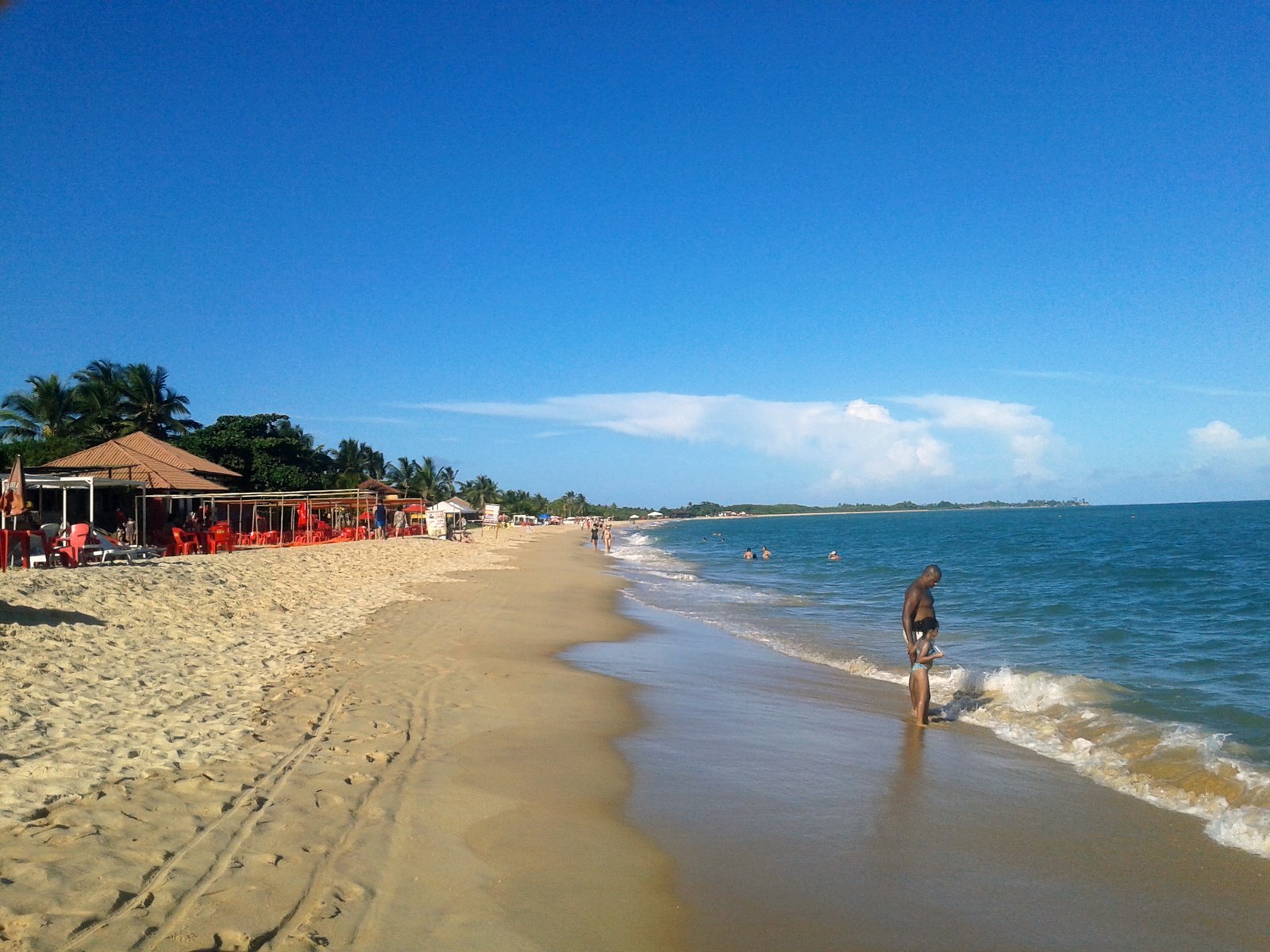
Direct answer: in the main town, the northern beaches have calm water sheltered by reefs and beach clubs with full facilities. Taperapuã is the liveliest, Mundaí and Curuípe are in between, and Mutá is the quietest. The big sea trip is Recife de Fora, a marine park with natural pools that only appear at low tide.
The Orla Norte starts downtown and follows Avenida Beira-Mar toward Santa Cruz Cabrália. In order from the center: Praia do Cruzeiro, Curuípe, Itacimirim, Mundaí, Taperapuã, Ponta Grande and Rio dos Mangues, and finally Mutá. Almost all of them have a reef barrier some distance offshore, which keeps the sea gentler than on much of Brazil’s northeast coast and makes them great for kids.
Taperapuã and the beach clubs
Taperapuã, about 7 km from the center, is Porto Seguro’s signature beach: wide, pale and home to the town’s most famous beach clubs, known locally as barracas. At the large complexes the idea is to spend the whole day: there are loungers, showers, seafood restaurants, dance classes, kids’ activities and live shows. At most barracas, tables and chairs are free as long as you order food or drinks, and a main course for two usually costs R$60 to R$180, according to research by the local guide Em Porto Seguro.
Axé Moi and Tôa Tôa
The two best-known complexes are on Taperapuã. Axé Moi describes itself as a beach leisure complex with its own dance company, entertainers, a seafood restaurant and a stage for concerts, and it hosts events such as Carnaporto and New Year’s parties. Tôa Tôa has a stage with a daily program, dance classes, a kids’ club and massages, and it is famous for its Friday night luau, which starts at 9:30 p.m. and is sold with a party shirt and open bar. If you want peace and quiet, avoid this stretch on peak-season afternoons; if you want to see Porto Seguro’s party side, you will love it.
Mundaí, Curuípe and Itacimirim
Closer to the center, these beaches have smaller barracas and many beachfront hotels. Curuípe and Itacimirim suit travelers staying on the beachfront who want a beach without needing a car, and the water is usually very calm at low tide.
Ponta Grande, Rio dos Mangues and Mutá
At the end of the beachfront, near the border with Santa Cruz Cabrália, development thins out. Mutá is the quietest beach on the Orla Norte, popular with families and guests of the all-inclusive resorts in the area. Rio dos Mangues and Ponta Grande are good for long walks on the sand.
Coroa Vermelha (Santa Cruz Cabrália)
About 15 km north of the center, Coroa Vermelha has a large metal cross and a memorial marking the site of the first Mass. Around it is a Pataxó crafts center selling necklaces, headdresses, pottery and wood carvings. The beach itself has shallow water and natural pools at low tide. You can combine it with a pre-booked visit to the Reserva Pataxó da Jaqueira, where the community shares its culture and a patch of protected forest; visits must be arranged with the community or an authorized agency.
Recife de Fora: the reef pools
The Recife de Fora Municipal Marine Natural Park was created by Municipal Law 260 in December 1997 and lies about 5 nautical miles offshore. At low tide the reef breaks the surface and forms pools full of colorful fish, corals and clear water, ideal for snorkeling. City rules cap visits at 400 people a day, identified with wristbands, and only boats registered with the municipal environment department may operate. On the reef, visitors may walk only in the marked pool area, to avoid trampling the coral.
Departures depend on the tide table and leave from the municipal pier at the start of the Passarela or from the Arraial ferry pier. The boat ride takes 45 minutes to an hour, the stop at the pools lasts 2 to 2.5 hours, and the whole trip takes 4 to 5 hours. In 2026, agencies charge about R$160 per adult, park fee included; children pay R$90 to R$140 depending on age and height, and very young children go free. Hotel transfers to the pier usually cost extra. Since the daily cap sells out in peak season, book a few days ahead and pick a day with a very low tide, when the pools are shallower and clearer.
The historic upper town and the Passarela
Direct answer: the Cidade Histórica, on top of the cliff, gathers the Nossa Senhora da Pena church, the Misericórdia church, the old town hall and jail and the Discovery Landmark, with sweeping sea views. Below, the Passarela da Cultura is the street of bars, shops and restaurants that comes alive at night.
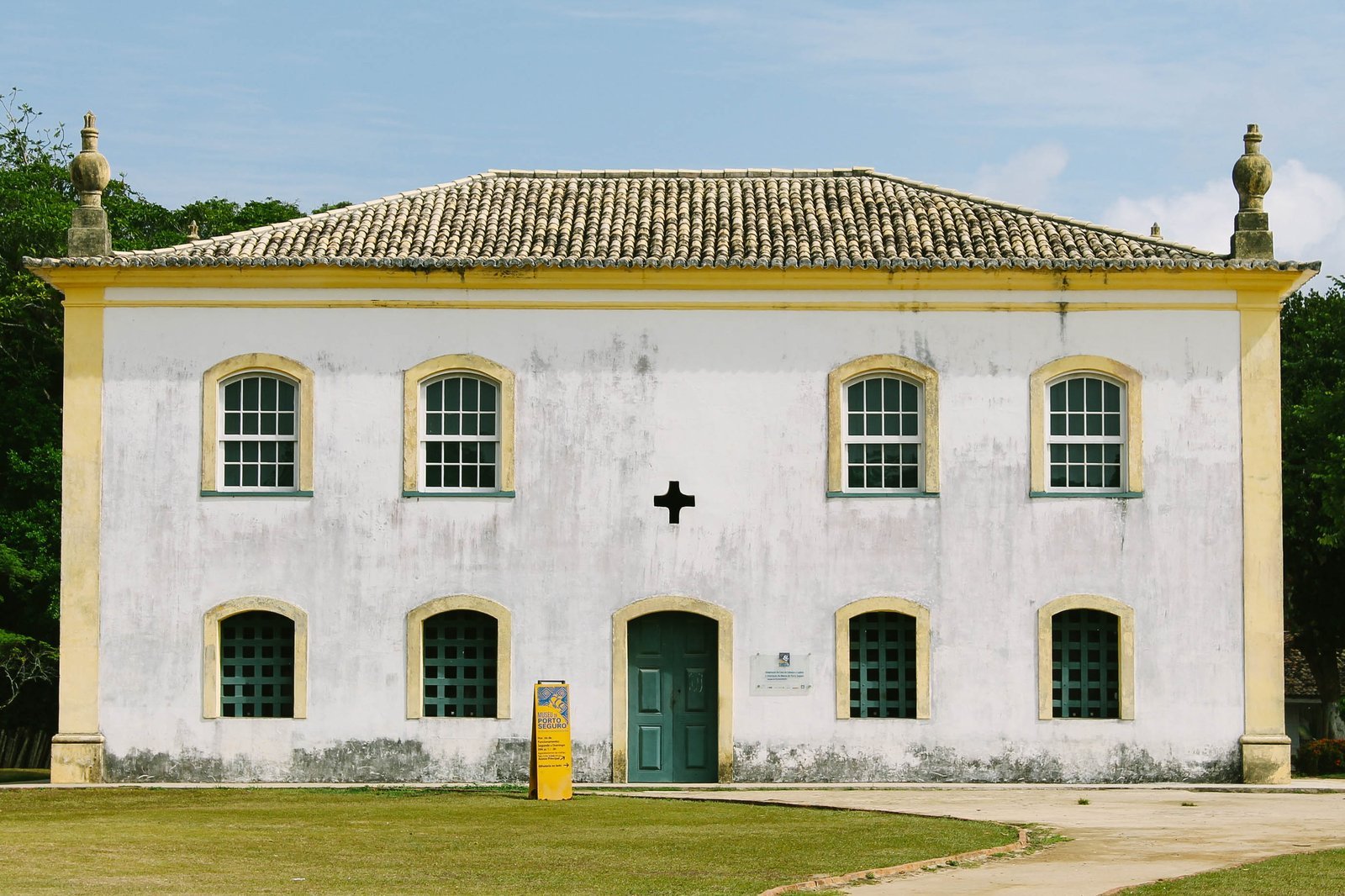
You can walk up to the Cidade Alta on steep lanes from downtown or go by car. At the top, colorful colonial houses surround a large lawn with the Nossa Senhora da Pena mother church, founded in the 16th century, the Misericórdia church and the old Casa de Câmara e Cadeia (town hall and jail) of 1772, which now houses a museum. The Discovery Landmark, a stone pillar with the cross of the Order of Christ, sits under a glass dome. The churches are free to enter; for the museum, check opening hours and prices on site, as they change with the season.
The best time to go is late afternoon, when the heat eases and the viewpoint over the lower town and the sea catches beautiful light. Some days there are capoeira circles and performances for visitors. For a walking route around the upper town, read our guide to Porto Seguro’s historic center.
The Passarela da Cultura
Once known as the Passarela do Álcool and later as the Passarela do Descobrimento, the street is now officially called the Passarela da Cultura, the name adopted by the city after a 2023 makeover. It is a downtown pedestrian strip near the river lined with craft stalls, shops, restaurants, ice cream parlors and the famous capeta stands, which serve a drink of vodka, condensed milk, guaraná powder and fruit. At night, especially in peak season, it becomes the main meeting point in town. We have a dedicated guide to the Passarela.
Arraial d’Ajuda: historic village, Rua do Mucugê and beaches
Direct answer: Arraial d’Ajuda sits across the Buranhém River, 10 to 15 minutes by ferry from the center. It has a small historic core around the Nossa Senhora d’Ajuda church, the restaurant and nightlife street Rua do Mucugê, and cliff-backed beaches such as Mucugê, Parracho and Pitinga.
Arraial grew as a fishing village around the Nossa Senhora d’Ajuda church, whose origins go back to a Jesuit hermitage of 1549 and which is considered one of the oldest Marian shrines in Brazil. The churchyard is a natural lookout over the coast. From there, Rua do Mucugê runs down toward the beach of the same name, lined with shops, bars, guesthouses and restaurants serving many cuisines; it is where Arraial eats and goes out at night. Read our guides to Rua do Mucugê, things to do in Arraial d’Ajuda and where to eat in Arraial d’Ajuda.
Arraial’s beaches
- Mucugê: the closest to the center, with barracas and natural pools at low tide. The Eco Parque water park is here.
- Parracho: right next door, with large beach clubs and activity all day.
- Pitinga: a quieter beach backed by colorful cliffs, a hang-gliding spot and one of Arraial’s most beautiful.
- Lagoa Azul and Taípe: heading south, the cliffs get taller and development thins out. Taípe is already on the way to Trancoso.
Arraial d’Ajuda Eco Parque
Arraial d’Ajuda Eco Parque, a water park on Praia do Mucugê that opened in 1997, has water slides, a 426 m lazy river, a wave pool, a zip line and a kids’ area. It does not open all year and runs on a seasonal calendar, so check the dates before planning. In October 2026, prices published by a local reseller were R$170 per adult in advance and R$180 at the gate, R$125 for children aged 4 to 11 and R$85 for those over 60; children up to 3 enter free. Hours are 10 a.m. to 5 p.m.
Trancoso: the Quadrado and the southern beaches
Direct answer: Trancoso is Porto Seguro’s most upscale district, about 25 km from the ferry on a paved road. Its heart is the Quadrado, a long lawn lined with small colorful houses and the white São João Batista church, now full of restaurants and boutiques. The beaches below the cliff are wide and calm.
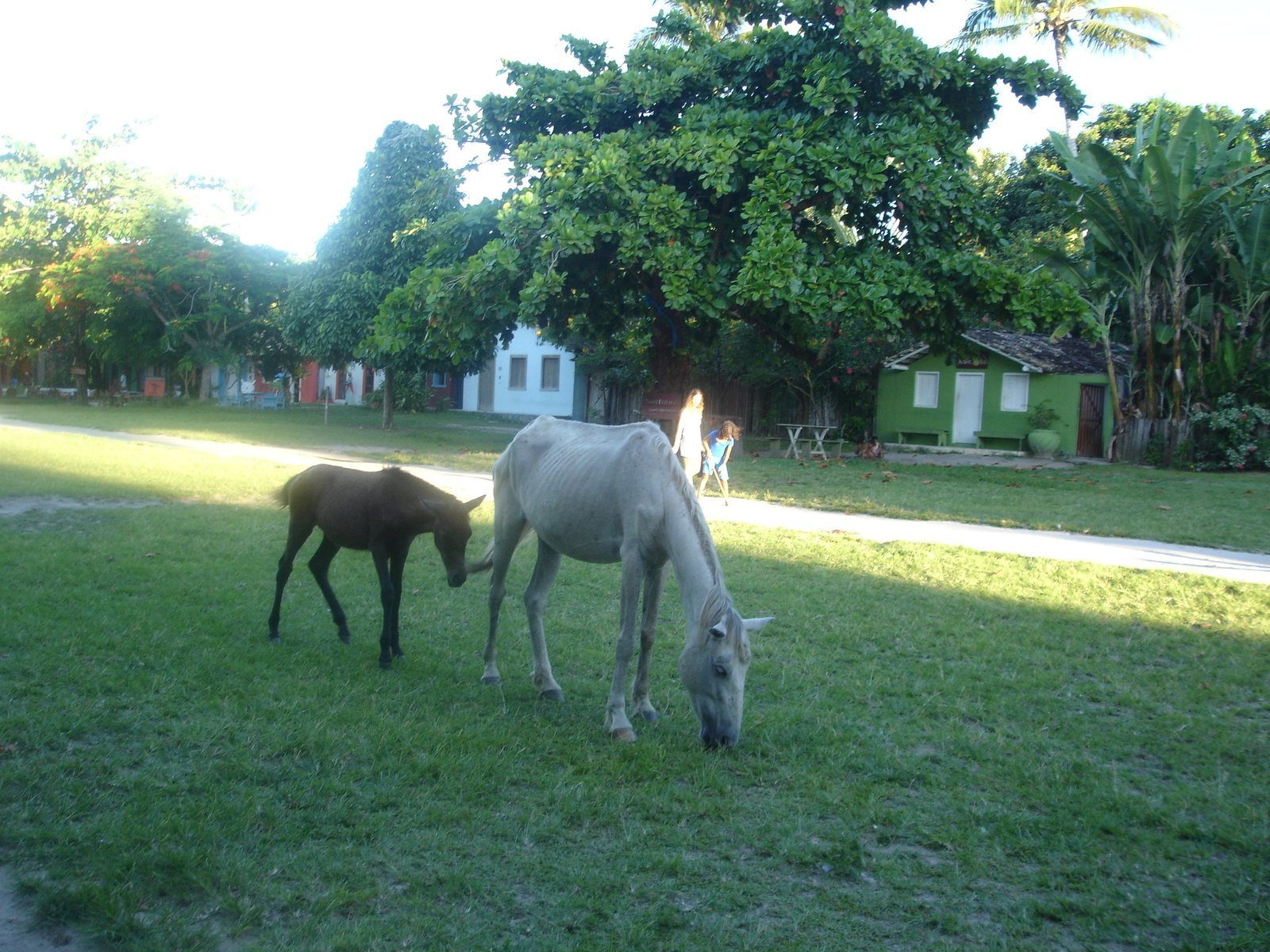
The Quadrado’s layout comes from the Jesuit mission village of São João Batista dos Índios, founded in 1586: a rectangular square with residents’ houses along both sides and the church at one end. The white church you see today was built in the early 19th century, according to the local parish, and its sea-facing churchyard is the most photographed spot in Trancoso. By day the Quadrado is sleepy, with kids playing soccer and horses grazing; at night the little houses become lantern-lit restaurants and shops, and the square fills up.
From the edge of the cliff, a path leads down to Praia dos Nativos and Praia dos Coqueiros, the beaches closest to the Quadrado. Nearby are other beaches such as Rio Verde and Itapororoca, home to some of the most expensive hotels in Brazil. If you want beaches without beach clubs, the ones around Trancoso are the best. See also our guides to Praia dos Nativos, your first day in Trancoso and where to eat on the Quadrado.
Trancoso is expensive across the board: rooms, restaurants and beach clubs. In return, it keeps the look of a historic village, since it lies within the protected heritage area and buildings on the Quadrado follow strict rules.
Praia do Espelho and Caraíva
Direct answer: Praia do Espelho lies between Trancoso and Caraíva, about 25 km from Trancoso, with a final stretch on a dirt road; it is famous for natural pools that appear at low tide. Caraíva is a rustic, car-free village on the bank of the Caraíva River, reached by canoe.
Praia do Espelho
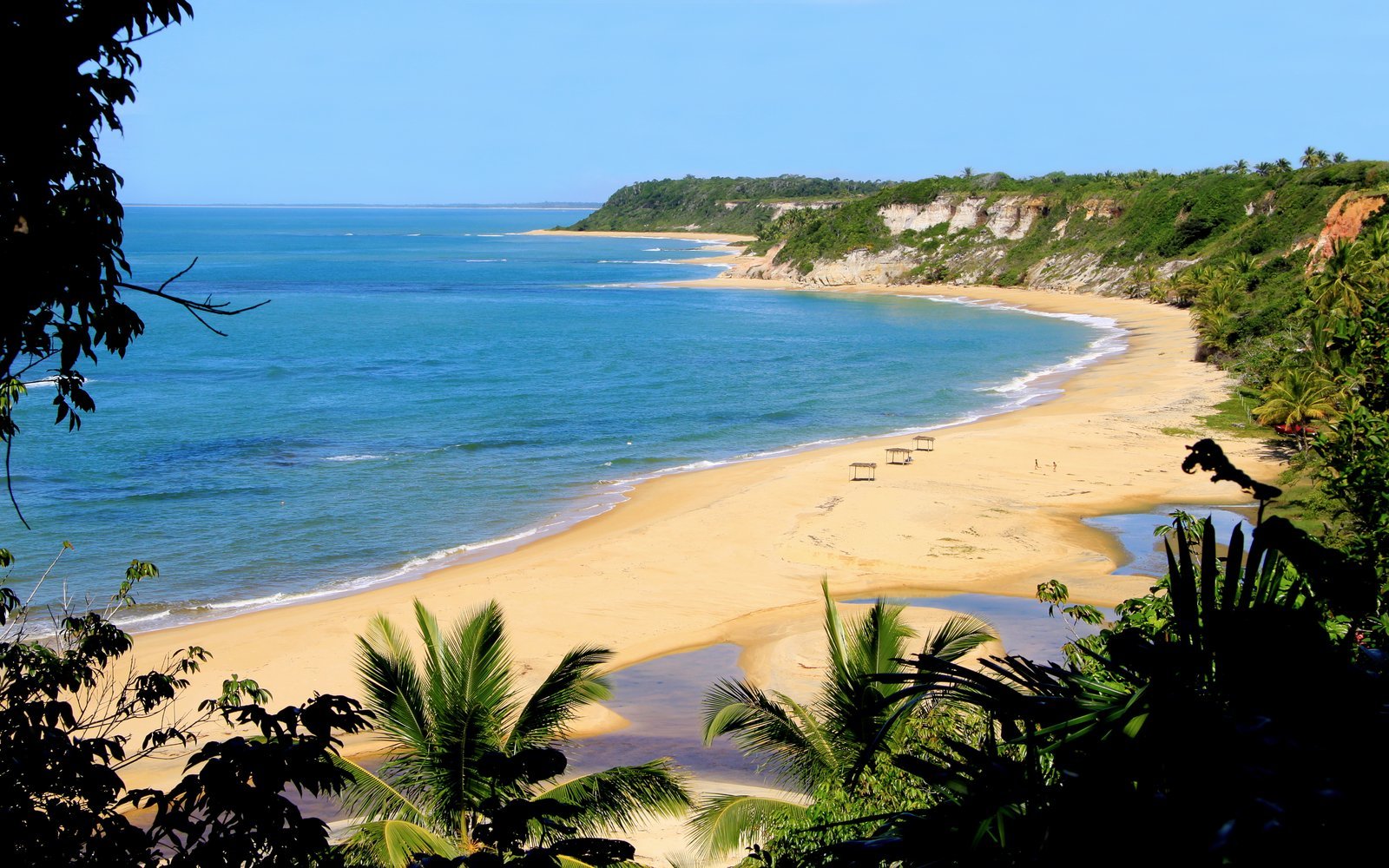
Espelho, meaning “mirror,” is a cove of very clear water sheltered by reefs and framed by cliffs and coconut palms. The name is usually explained by the still, transparent water over the reef at low tide. That is why the most important tip is to check the tide table and arrive a few hours before low water. The dirt road gets tough after heavy rain. In October 2026, Porto Seguro agencies sold round-trip tours to Espelho for about R$105 to R$150 per person, with a few free hours on the beach; food and drinks at the beach restaurants cost extra.
Caraíva
Caraíva sits on a sandbar between the Caraíva River and the sea, and its streets are sand. Cars cannot enter: visitors leave their vehicle on the other side of the river and cross by canoe for about R$10 per person each way, according to the local portal caraiva.net.br; in summer the crossing runs 24 hours. There are no banks or ATMs in the village, so bring cash or confirm whether your guesthouse takes cards and PIX. Since 2015 there has been a voluntary contribution, the Eco Ticket, to help maintain the village.
The point of Caraíva is to slow down: swim where the river meets the sea, float downriver on an inner tube, walk to the Pataxó village of Barra Velha or take a boat to Espelho and Corumbau. Forró dancing on peak-season nights is a tradition. In January, the São Sebastião festival fills the village with colored flags. A day trip from Porto Seguro means a lot of time on the road; ideally, stay at least two nights.
What to eat in Porto Seguro
Direct answer: seafood first. Bahian moqueca with palm oil and coconut milk, fried fish, shrimp, acarajé and coconut sweets are everywhere, from beach clubs to restaurants on the Quadrado. Downtown, pay-by-weight restaurants serve cheap lunches; at night, the Passarela, Rua do Mucugê and the Quadrado have the best choices.
Food on the Discovery Coast follows Bahian tradition, with fish, shrimp or stingray moqueca, shrimp bobó, stuffed crab shells and pirão, a fish-broth porridge. At the northern beach clubs, dishes are served for two or three people. In Arraial and Trancoso the range is wider and includes Italian, Japanese and contemporary cuisine, at prices close to those in big Brazilian cities.
A few specialties to try:
- Moqueca baiana: a stew cooked in a clay pot with palm oil, coconut milk, peppers, tomato and cilantro, served with rice, pirão and farofa.
- Acarajé: a black-eyed pea fritter fried in palm oil and filled with vatapá, caruru and dried shrimp, sold by baianas at fixed stalls.
- Capeta: the drink of vodka, condensed milk, guaraná powder, cinnamon and fruit that became the symbol of the Passarela.
- Cocada and beiju: coconut sweets and tapioca crepes sold on the beach and at markets.
For prices, TripMundao’s 2026 research puts a set lunch at R$28 to R$40 at pay-by-weight restaurants downtown and R$25 to R$50 per person for snacks and drinks at the beachfront barracas. We have dedicated guides on where to eat in Porto Seguro and in Arraial d’Ajuda.
How much does a trip to Porto Seguro cost in 2026?
Direct answer: Porto Seguro is one of the most affordable beach destinations in northeast Brazil if you stay in the main town: simple guesthouses start at about R$150 a night for two in low season. Trancoso is at the other extreme, with entry-level guesthouses from R$400. The main tours cost R$100 to R$160 per person.
The table gathers prices checked in October 2026. Accommodation and food figures come from Brazilian travel guide research and vary widely between low and high season; use them as a reference and confirm when booking.
| Item | 2026 price | Notes |
|---|---|---|
| Ferry Porto Seguro–Arraial (foot passenger) | about R$6 | Return trip free |
| Ferry Porto Seguro–Arraial (car) | about R$22.70 (weekday) and R$28.20 (Sunday, holiday, night) | March 2026 fares |
| City bus | R$5 | Fare since January 2025 |
| TTS (out-of-town car) | R$9.90 per day | Over 6 hours in the municipality |
| Recife de Fora reef tour | about R$160 per adult | Park fee included; transfer extra |
| Praia do Espelho tour with transport | R$105 to R$150 per person | Food extra |
| Arraial d’Ajuda Eco Parque | R$170 to R$180 per adult | Seasonal opening |
| Canoe in Caraíva | about R$10 each way | Per person |
| Bus Salvador–Porto Seguro | R$386 to R$609 | Águia Branca, Oct. 2026 |
| Taxi airport–center | R$40 to R$60 | TripMundao research |
| Simple guesthouse in town (double) | R$150 to R$350 low season; R$400 to R$800 high | TripMundao research |
| Mid-range guesthouse in Arraial | R$280 to R$600 low season; R$500 to R$900 high | TripMundao research |
| Entry-level guesthouse in Trancoso | R$400 to R$700 low season | Mid-range R$700 to R$1,500 |
| Main course for two at a beach club | R$60 to R$180 | Tables and chairs free when ordering |
Sample budget: a couple staying five nights in a simple beachfront guesthouse in low season, doing Recife de Fora, a day in Arraial and the Espelho tour, will spend roughly R$1,300 to R$2,600 on rooms and tours alone, excluding flights and meals. In peak season, accommodation alone can double. For money-saving tips, read our guide to Porto Seguro on a budget.
3, 5 and 7 day Porto Seguro itineraries
Direct answer: with 3 days, stay in the main town and combine Recife de Fora, the historic upper town and an afternoon in Arraial. With 5 days, add a full day in Trancoso and another beach day. With 7 days, you can sleep in Trancoso or Caraíva and include Praia do Espelho.
Before locking in any plan, open the tide table. Recife de Fora and Espelho depend on low tide, and everything else should fit around those two trips.
3-day itinerary
- Day 1: morning on Taperapuã or Mundaí beach, afternoon in the historic upper town for sunset from the viewpoint, evening on the Passarela da Cultura.
- Day 2: Recife de Fora at low tide. Back on land, a moqueca lunch and a free afternoon on the beach. If it is Friday, there is the Tôa Tôa luau.
- Day 3: early ferry to Arraial d’Ajuda, Mucugê and Pitinga beaches, late afternoon at the Nossa Senhora d’Ajuda church and dinner on Rua do Mucugê.
5-day itinerary
- Days 1 to 3: as above.
- Day 4: Trancoso: morning at Praia dos Nativos or Coqueiros, lunch at a beach restaurant, late afternoon and dinner on the Quadrado. Return by pre-booked transfer or stay the night.
- Day 5: Coroa Vermelha in Santa Cruz Cabrália to see the first Mass cross and Pataxó crafts, or a day at the Eco Parque if it is open.
7-day itinerary
- Days 1 and 2: the main town, with the upper town, the Passarela, the northern beaches and Recife de Fora.
- Day 3: move to Arraial d’Ajuda for beaches and Rua do Mucugê.
- Day 4: Arraial d’Ajuda, with the Eco Parque or beaches further south such as Lagoa Azul and Taípe.
- Day 5: move to Trancoso, with an afternoon on the beach and an evening on the Quadrado.
- Day 6: Praia do Espelho at low tide and, if time allows, late afternoon in Caraíva with the canoe crossing.
- Day 7: free morning in Trancoso and back to the airport, allowing time for the ferry.
A quieter variation: swap the two nights in Arraial for two nights in Caraíva and visit Espelho by boat from the village.
Is Porto Seguro safe?
Direct answer: the tourist areas, such as the beachfront, the Passarela, the upper town, Rua do Mucugê and the Quadrado, are busy and policed in peak season. The usual precautions for any Brazilian city apply: keep phones and jewelry out of sight, avoid deserted streets at night, take a taxi or ride-hailing car home after parties and never leave belongings alone on the sand.
Some practical tips:
- Sea: the northern beaches are calm, but Pitinga, Taípe and some Trancoso beaches can have currents. Respect the flags and lifeguards’ warnings.
- Recife de Fora: wear water shoes, do not step on coral outside the marked area and use water-resistant sunscreen applied before boarding.
- Sun: the southern Bahia sun is strong all year. Drink plenty of water and avoid exposure between 11 a.m. and 3 p.m.
- Parties: at big Carnival and New Year’s events, carry only what you need, agree on a meeting point and buy drinks from established bars.
- Roads: avoid driving at night on the dirt roads to Espelho and Caraíva and on the region’s highways, which are poorly lit.
- Cash in Caraíva: carry some cash for emergencies, because there is no ATM.
In an emergency, Brazil’s national numbers apply: 190 for the Military Police, 192 for SAMU ambulances and 193 for the Fire Department.
Where to stay in Porto Seguro
Direct answer: stay on the Orla Norte for beaches with facilities and good prices, in Arraial d’Ajuda for a charming village with nightlife, in Trancoso for luxury and peace, and in Caraíva or at Praia do Espelho for a rustic feel. All links below go to each property’s official website and were checked in October 2026; we do not use agency or booking site links.
Choosing the area matters more than choosing the hotel. Staying in the main town gives easy access to the airport, Recife de Fora and the beach clubs, but you need the ferry to see Arraial and Trancoso. Staying in Trancoso or Caraíva buys peace and quiet, but costs more and makes you dependent on transfers. Since rates vary hugely between low and high season, check prices directly on each official website or via the WhatsApp number listed there.
Porto Seguro Praia Resort (all-inclusive resort, Praia de Curuípe)
Porto Seguro Praia Resort is on Avenida Beira-Mar at Praia de Curuípe, close to the center and the airport. It runs on an all-inclusive basis, with a pool complex, kids’ club, daily activities and a large adventure park, and it is pet friendly. A good pick for families who want everything on site without being far from town.
Quinta do Sol Praia Hotel (hotel, Praia de Curuípe)
Quinta do Sol Praia Hotel faces Praia de Curuípe, about 2 km from the center and 3 km from the airport, according to the hotel. Breakfast is included, there are pools, a bar and a restaurant, and the hotel states that it does not take tour groups, which helps keep things calm. The group has a second property on the same avenue, Quinta do Sol Lite.
Brisa da Praia Park Hotel (hotel, Taperapuã)
Brisa da Praia Park Hotel sits across from Taperapuã Beach, steps from the most famous beach clubs. It covers more than 12,000 m², has a 24-hour front desk and a children’s water area called Water Kids. A fit for families who want to be close to the Taperapuã action.
La Torre Resort (all-inclusive resort, Praia do Mutá)
La Torre Resort is on Avenida Beira-Mar at Praia do Mutá, the quietest stretch of the Orla Norte. It is all-inclusive, with pools, a leisure program and its own restaurants. A good option for a calm beach and full-service resort without crossing the river.
Pousada Oca dos Índios (guesthouse, Rua do Mucugê, Arraial d’Ajuda)
Pousada Oca dos Índios has been running for more than 40 years on Rua do Mucugê in Arraial d’Ajuda, with chalets set in a garden. From here you can walk to the street’s restaurants and to Mucugê beach. The guesthouse publishes a tide table on its website, handy for planning natural pool visits.
Villas de Trancoso (boutique hotel, Trancoso–Arraial road)
Villas de Trancoso is a beachfront boutique hotel at km 23.5 of the Trancoso–Arraial road, set in a garden of about 13,000 m². It is a few kilometers from the Quadrado, with direct beach access. Ideal for couples and anyone who wants hotel comfort with the village nearby.
UXUA Casa Hotel & Spa (house hotel, Quadrado, Trancoso)
UXUA Casa Hotel & Spa occupies houses right on Trancoso’s Quadrado, each decorated individually with local crafts and materials, plus a spa and a beach lounge. It is one of the best-known and most expensive places to stay in Trancoso, for those who want to sleep inside the historic setting.
Fasano Trancoso (luxury hotel, Praia de Itapororoca)
Fasano Trancoso is on the Estrada de Itaquena at Praia de Itapororoca, south of the Quadrado. It has 40 bungalows and 23 villas designed by architect Isay Weinfeld and blended into the vegetation. This is the high-end style of stay that made Trancoso famous with travelers from around the world.
Enseada do Espelho (guesthouse, Praia do Espelho)
Pousada Enseada do Espelho is right on Praia do Espelho, with sea-view suites and a restaurant focused on seafood. Staying at Espelho lets you enjoy low tide without the drive, before the day-trip groups arrive.
Pousada do Rio Caraíva (guesthouse, Caraíva)
Pousada do Rio Caraíva is on Avenida dos Navegantes, on the riverbank in Caraíva. It has double, triple and quadruple suites and accepts pets. A practical base for arriving by canoe and staying close to the river and the village.
Video: Porto Seguro by Visit Brasil
The official video from Visit Brasil, the tourism promotion brand of Brazil’s Embratur agency, shows in about 30 seconds a cycling trip along the Discovery Coast, with scenes from Arraial d’Ajuda and Porto Seguro.
Frequently asked questions about Porto Seguro
When is the best time to visit Porto Seguro?
August, September and October combine little rain with off-peak prices, which makes them some of the best months. January and February are also fairly dry but are the busiest and most expensive. November is, on the long-term average, the wettest month, and March and April also see above-average rain.
How many days do you need in Porto Seguro?
Five days are enough to see the main town, Recife de Fora, the historic upper town, Arraial d’Ajuda and Trancoso without rushing. With three days, focus on the main town and Arraial. With seven, add Praia do Espelho and at least one night in Caraíva or Trancoso.
Are Arraial d’Ajuda and Trancoso part of Porto Seguro?
Yes. Arraial d’Ajuda, Trancoso, Caraíva and Vale Verde are districts of the municipality of Porto Seguro. Arraial is just across the Buranhém River, 10 to 15 minutes by ferry from the center, and Trancoso is about 25 km from the ferry on a paved road.
How does the ferry to Arraial d’Ajuda work?
The ferry crosses the Buranhém River 24 hours a day, leaving every 30 minutes between 6 a.m. and midnight and less often overnight. The crossing takes 10 to 15 minutes. In 2026, foot passengers pay about R$6 one way and return for free; cars pay about R$22.70 on weekdays and R$28.20 on Sundays, holidays and at night.
How much is the Recife de Fora tour?
In 2026, agencies charge about R$160 per adult, including the marine park fee. Children pay R$90 to R$140 depending on age and height. The trip takes 4 to 5 hours, leaves according to the tide table and is capped at 400 visitors a day, so book ahead.
Does Porto Seguro charge a tourist tax?
Only on vehicles. The Sustainable Tourism Fee (TTS) applies to cars and other vehicles registered outside the region that stay more than 6 hours in the municipality, at R$9.90 per day for a passenger car in 2026. It is paid on the Viva Porto Seguro website. Visitors arriving by plane or scheduled bus do not pay.
What are the best beaches in Porto Seguro?
In the main town, Taperapuã is the liveliest and Mutá the quietest. In Arraial, Pitinga is the most beautiful and Mucugê the most convenient. In Trancoso, Praia dos Nativos and Coqueiros are favorites. Praia do Espelho, between Trancoso and Caraíva, often appears among the most beautiful beaches in Brazil.
Where is the best place to stay in Porto Seguro?
The Orla Norte in the main town for beaches with facilities and lower rates, Arraial d’Ajuda for a charming village with nightlife, and Trancoso for peace and luxury stays. Caraíva suits travelers happy with a car-free village with sand streets and no ATMs.
How do you get to Caraíva?
By car or transfer, head south from Trancoso on a road with dirt stretches to the bank of the Caraíva River. There you leave the car in a parking lot and cross by canoe for about R$10 per person each way. No cars circulate in the village, and there is no bank or ATM.
Where was the first Mass in Brazil held?
The first Mass was celebrated on April 26, 1500, by Friar Henrique de Coimbra on an islet at Coroa Vermelha, an area now in the municipality of Santa Cruz Cabrália, about 15 km north of central Porto Seguro. A large cross and a memorial mark the site, next to a Pataxó crafts center.
Is Porto Seguro worth visiting?
Direct answer: yes, mainly because one destination offers very different travel styles. You can have a lively beach with full facilities, a charming historic village, understated luxury and a car-free rustic village on a single trip, with direct flights from several Brazilian cities and Buenos Aires and prices in the main town that are among the most affordable on the northeast coast.
Porto Seguro has a reputation as a party and package-tour destination, and that is fair for Taperapuã and the Passarela. But cross the river and you find another place: the cliffs of Pitinga, Arraial’s churchyard at sunset, the Quadrado lawn and the still waters of Espelho. The secret is choosing the right base and fitting your trips around the tide table. To compare with other Explora Brasil beach destinations, read our guides to Salvador, Bahia’s capital, Fernando de Noronha, which also limits visitor numbers, Florianópolis and Rio de Janeiro.
Sources
- IBGE Cidades: Porto Seguro (BA) overview (2022 census population, area, Indigenous population and anniversary)
- IPHAN: Porto Seguro (BA) heritage listing (1968 listing, expansion, National Monument and protected area)
- Porto Seguro City Hall: portoseguro.ba.gov.br (Carnival 2026, Passarela da Cultura and Recife de Fora rules)
- Viva Porto Seguro: vivaportoseguro.app (Sustainable Tourism Fee, rates and exemptions)
- Via41: start of vehicle fee collection (September 20, 2026)
- Porto Seguro Airport: airlines and destinations (routes, operator and parking)
- Águia Branca: aguiabranca.com.br (Salvador–Porto Seguro schedules and fares, checked October 25, 2026)
- Instituto Produzir: Porto Seguro–Arraial ferry (schedules and March 2026 fares)
- Otimiza.pro: city bus fare (R$5 since January 13, 2025)
- Climatempo: Porto Seguro climatology (average monthly rainfall)
- Caraíva: caraiva.net.br (canoe crossing, no banks and Eco Ticket)
- São João Batista Parish, Trancoso: church history (Jesuit village and church construction)
- Arraial d’Ajuda Eco Parque: tickets and calendar (2026 prices and attractions)
- TripMundao: Porto Seguro and Discovery Coast guide (price ranges for rooms, taxis and food)
- Em Porto Seguro: beach clubs (average dish prices)
- Axé Moi: axemoi.com.br and Tôa Tôa: portaltoatoa.com.br (facilities and program)