Jericoacoara is a village of sand streets on the far western coast of Ceará, in north-east Brazil, about 300 km from Fortaleza and wrapped by Jericoacoara National Park. Until the mid-1980s it was an isolated fishing hamlet among the dunes, with no road and no electricity. Today it draws travellers from all over the world, yet the daily rhythm is the same as ever: climb Sunset Dune in the late afternoon, walk to the Pedra Furada rock arch at low tide, spend a day in a hammock strung over the water at Lagoa do Paraíso, kitesurf at Preá and come back to eat barefoot on an unpaved street. The village belongs to the municipality of Jijoca de Jericoacoara, and everyone simply calls it Jeri.
Jeri has also changed a lot in the past two years, and plenty of the advice online is out of date. This guide was put together with facts checked on 26 October 2026: what the Sustainable Tourism Fee (TTS) costs and who is exempt, the real status of the national park entry fee (currently blocked by the courts), which flights serve Jericoacoara airport, transfer, bus and 4×4 prices, what the buggy drivers’ cooperative charges for the East and West coast tours, the federal park rules for the Árvore da Preguiça, Pedra Furada and the seahorse mangroves, 2- to 5-day itineraries and ten real pousadas and hotels, each linked to its official website.
Quick facts: Jericoacoara (Jijoca de Jericoacoara, Ceará)
- What it is: a former fishing village turned international destination, part of the municipality of Jijoca de Jericoacoara, which had 25,555 residents in the 2022 IBGE census (an estimated 28,198 in 2025).
- Distances: about 300 km from Fortaleza; around 30 km from Jericoacoara Regional Airport (JJD) in the neighbouring municipality of Cruz; Lagoa do Paraíso is 18 km from the village and 5 km from Jijoca town, according to the local council.
- Compulsory fee: the Sustainable Tourism Fee (Taxa de Turismo Sustentável, TTS) costs R$41.50 per person for up to 10 days, plus R$4.15 per extra day. Children up to 12, over-60s and people with disabilities are exempt with proof.
- Park entry fee: the charge planned by the park concessionaire Urbia remains blocked by the federal courts. In October 2026 the municipal tourism authority (ADEJERI) states that the TTS is the only fee to enter the village.
- Getting there: fly to Fortaleza, then a transfer (5 to 6 hours) or a bus to Jijoca plus a 4×4 “jardineira”; or fly direct from São Paulo-Guarulhos or Belo Horizonte-Confins to Jericoacoara airport, about an hour from the village.
- Best time: July to December, the dry and windy season, great for kitesurfing and reliable sunshine. The lagoons are fullest just after the rains, from June to August. The rainy season runs from January to May.
- Checked costs: 4×4 shuttle Jijoca-village from R$65 per person; shared transfer from Fortaleza R$164.50 to R$240; East coast buggy tour R$500 and West coast R$550 per buggy for up to 4 people, with entry fees on top.
- How many days: 3 days for the village, Pedra Furada and one buggy tour; 4 to 5 days to do both the East and West tours, including Tatajuba and a kite day at Preá.
A short history: from the turtles’ den to a national park
Direct answer: the area was the land of the Tremembé people. The Portuguese came through in the early 17th century, and for more than three centuries Jericoacoara remained a fishing village cut off by the dunes. It became an Environmental Protection Area in 1984, part of it was turned into a national park in 2002, and tourism started to grow from the mid-1980s. Electricity only reached the village in 1998, through underground cables.
The name comes from Tupi, and the most quoted translation, recorded by the philologist Silveira Bueno, is “the turtles’ den”. Jijoca, the municipality, would be “the home of frogs”, a nod to the freshwater lagoons scattered among the dunes. Both names describe the place well: sea on one side, lagoons on the other and a lot of sand in between.
Before Europeans arrived, the western coast of Ceará was home to the Tremembé, an Indigenous people who still live on this stretch of coast. In 1614, during the struggle with the French for control of Maranhão, Jerônimo de Albuquerque had the Fort of Nossa Senhora do Rosário built at the foot of the hill, according to the Ceará historian Raimundo Girão as cited by Wikipedia. It was a short-lived military post, attacked by a French pirate named Du Prat, and there are no ruins left for visitors to see.
Over the following centuries Jericoacoara stayed far from everything. Fishermen went to sea in jangadas and canoes, houses were made of mud and palm thatch, and the only way in was along the beach or on sandy tracks. A municipal law of June 1923 created the district of Jericoacoara, then part of Acaraú. The lighthouse on top of the Serrote, the rocky hill of about 95 metres that shields the village from the wind, was inaugurated on 16 November 1952.
Backpackers, windsurfers and environmental protection
Until about 1985 Jericoacoara was just a tiny fishing village. Its fame started with backpackers, surfers and windsurfers who arrived after hours on the back of a truck and a walk across the dunes, and grew with TV reports and foreign newspapers that ranked the beach among the most beautiful in the world. To hold back property speculation, the federal government created the Jericoacoara Environmental Protection Area by Decree 90,379 of 29 October 1984.
In 1991 Jijoca, then a district of Cruz, became a municipality in its own right under the name Jijoca de Jericoacoara, and the village became part of it. In 1997 the beach was the setting for Walter Lima Jr.’s film A Ostra e o Vento (“The Oyster and the Wind”), which fixed the image of the dunes and the lighthouse in Brazilians’ minds. A year later, in 1998, electricity arrived through underground cables, replacing generators, a decision that preserved the pole-free streets that still strike every visitor.
Jericoacoara National Park
Jericoacoara National Park was created by decree on 4 February 2002, covering 8,416 hectares carved out of the protected area. Law 11,486 of 15 June 2007 redrew its limits, bringing the park to about 8,850 hectares, including a 1 km strip of sea. It is run by the federal conservation agency ICMBio, which has its office in the village itself, on Rua da Igreja. Inside the park are the Pedra Furada, the Serrote hill, Sunset Dune, Malhada Beach, the Árvore da Preguiça and the Guriú mangroves, home to longsnout seahorses (Hippocampus reidi).
A common mix-up: the village of Jericoacoara is not the park. It is an urban area of Jijoca municipality, surrounded by the park, so everyone heading to Jeri crosses the park to get there. That distinction is at the heart of the legal battle over the entry fee, explained further down.
The village today
The village has grown a lot, but it has kept the rules that set it apart from any other beach in north-east Brazil: the streets are still sand, private cars cannot drive inside and the lighting is kept low. The church of Nossa Senhora de Fátima, built in 1945 with stones from the Serrote, is the oldest landmark in the centre, and the patron saint’s festival takes place in October. The square, Praça Edvá Esmerino da Silva, opened in 2012 with canoe-shaped benches, is where the evenings begin. In Jijoca town, the feast of Santa Luzia on 13 December is the main religious event. To explore the village street by street, read our walking guide to Jericoacoara village.
When to go to Jericoacoara: rain, wind and lagoons
Direct answer: the best time to visit Jericoacoara is July to December, when it hardly rains and the wind blows hard, perfect for kitesurfing and windsurfing. To see the lagoons at their fullest, go at the end of the rainy season and the start of the dry one, June to August. Rain is concentrated between January and May, peaking in March and April. It is summer-warm all year.
Ceará’s western coast has two clear seasons, and they change the feel of a trip. In the rainy season water collects in the hollows between the dunes and dozens of blue and green lagoons appear; in the dry season the trade wind blows almost every day, the sky is clear and the sea fills with colourful kites. Average temperatures in the park range between 22 °C and 35 °C, and the dry season lasts five to six months.
Brazil’s national weather service, INMET, has no station with official climate normals in Jijoca. The closest full station with 1991-2020 normals is Sobral, inland and more than 100 km away in a straight line. It is hotter and slightly drier than the coast, but it shows the regional rain calendar well. Use the table as a guide to the seasons, not as a beach forecast.
| Month | Average rain in Sobral (INMET, mm) | What to expect in Jeri |
|---|---|---|
| January | 123.7 | Rains begin; wind eases; busy summer holidays |
| February | 161.8 | Frequent showers; Carnival crowds |
| March | 220.1 | Wettest month; some sand tracks flood |
| April | 206.3 | Heavy rain; low season, lower rates |
| May | 93.2 | Rain easing; lagoons filling up |
| June | 30.1 | Lagoons full; wind returning; a good month to save |
| July | 17.4 | Wind season starts; Brazilian school holidays |
| August | 3.9 | Dry, windy, lagoons still lovely |
| September | 0.4 | Peak wind for kite and windsurf |
| October | 2.0 | Dry and windy; great for almost everything |
| November | 5.5 | Dry and windy; some smaller lagoons dry out |
| December | 23.2 | Hot, packed New Year’s Eve, wind still good |
| Year | 887.6 | Wikipedia gives about 793 mm a year for Jijoca |
The gap between the two halves of the year is huge: in Sobral, March gets more than 200 mm of rain while September and October get just a few millimetres. On the coast, rain tends to come in heavy afternoon or night-time showers, and there are plenty of sunny days even in March and April. The problem in the rainy season is not losing the beach but flooded sand tracks and slower buggy tours.
Wind and kitesurfing: July to January
Jericoacoara and nearby Preá are among the best-known kitesurfing spots in the world. Kite schools and specialist sites describe the wind season as July to January, peaking between August and November, when the wind is strong and steady almost every day and usually builds through the afternoon. Outside that window you can still ride on many days, just less reliably. If you do not do wind sports, July to December is also the season of the clearest skies and the most dependable sunsets on the dune.
The lagoons: after the rains
The lagoons between the dunes, such as Lagoa Azul and several smaller ones along the East coast route, form in the rainy season and shrink through the dry months. June, July and August usually give you the best of both worlds: lagoons still full, almost no rain and the wind coming back. Lagoa do Paraíso, by Jijoca town, is much larger and holds water all year, though its level depends on how wet the year has been.
High season, New Year’s Eve and holidays
December, January, Carnival, Easter week and July are the busiest periods, with a full village and peak rates. Over New Year’s many pousadas only sell multi-night packages, and transfer operators warn that prices change between 26 December and 6 January. If your dates are flexible, September, October and November combine dry weather, wind and better prices than December.
How to get to Jericoacoara: Fortaleza, JJD airport, bus and transfer
Direct answer: most travellers fly into Fortaleza and take a shared transfer to the village, about 300 km and 5 to 6 hours, for R$164.50 to R$240 per person each way, according to operators checked in October 2026. The fastest option is a direct flight to Jericoacoara Regional Airport (JJD) in Cruz, served from São Paulo-Guarulhos and Belo Horizonte-Confins, followed by the last 30 km in a 4×4. The cheapest is the Fretcar bus from Fortaleza to Jijoca, then a 4×4 shuttle to the village.
Whichever you choose, the last stretch is always on sand. The paved road ends at Jijoca and Preá; beyond that only authorised 4×4 vehicles drive, on tracks inside the national park. Ordinary cars cannot enter the village. Pack a bag you can carry yourself: the streets are soft sand and the 4×4 shuttles limit luggage size.
Flying direct to Jericoacoara Airport (JJD)
Jericoacoara Regional Airport Comandante Ariston Pessoa, IATA code JJD, is in the municipality of Cruz, about 30 km from the village, and opened in 2017. Auctioned in November 2025, it came under the management of Fraport, the German company that also runs Fortaleza airport, in September 2026, on a 30-year concession. According to reports in the Fortaleza newspaper O Povo in September 2026, the airport only has domestic routes: Latam and Gol fly to São Paulo-Guarulhos and Azul to Belo Horizonte-Confins. Latam has announced a new route to Brasília, with five weekly flights from July 2027 and tickets on sale from November 2026. International flights are only expected after expansion works of up to 36 months, so from 2029 at the earliest. In practice, international visitors usually connect in São Paulo or fly into Fortaleza.
From the airport to the village you ride in a 4×4 pickup or a jardineira. One local operator advertises the shared ride at R$70 per person, taking 45 to 70 minutes, and a private ride at R$240 for up to four people. Book before you fly, because departures depend on flight times and the airport is in the middle of nowhere.
Transfer from Fortaleza: shared or private
A door-to-door transfer is the easiest way in from Fortaleza, whether from the airport or a hotel on Beira Mar. Vehicles take the tarmac to Jijoca or Preá, where passengers switch to a 4×4 or carry on in the same four-wheel-drive vehicle to their pousada. Shared prices we found in October 2026, per person each way: R$164.50 with Sim7 (a price quoted on 1 October 2026 and published by a travel blog), from R$210 with Transfer Jerico (R$400 return, about 5 hours 40 minutes) and R$240 with another local operator. A private transfer costs R$700 to R$1,400 per vehicle, depending on the car and number of passengers.
Shared transfers leave Fortaleza early, make a few pick-ups and reach the village in the early afternoon. If your flight lands at night, sleep in Fortaleza and travel the next morning; our Fortaleza travel guide helps you pick where to stay.
Bus from Fortaleza to Jijoca, then the 4×4 shuttle
Fretcar runs the bus line between Fortaleza and Jijoca de Jericoacoara, boarding at the Engenheiro João Thomé bus station with stops at the airport and on Beira Mar, according to the ticket platform. The ride takes 6 to 7.5 hours, and one transfer operator quotes R$80 to R$90 to Jijoca. Fares vary by time and bus type, so check when you buy.
From Jijoca, the final hour to the village is done in jardineiras, converted 4×4 pickups with benches in the back. Rota Combo charges R$65 per person each way for the shared ride in the 2026/2027 season, with departures roughly every 90 minutes between 8am and 3:30pm, and R$275 per vehicle for a private ride for up to 10 people. It warns that prices change between 26 December and 6 January and limits luggage to one 55 x 35 x 25 cm bag per person. Cooperjeri, a transport cooperative founded in 2014, also runs the route from Avenida Manoel Marques de Albuquerque 1187 in Jijoca, with prices on request via WhatsApp +55 88 99814-6113.
By car: to Jijoca or Preá
You can drive a rental car, but only to the edge of the park. The usual route from Fortaleza follows the CE-085 (known as the Estruturante) and state roads to Jijoca, around 300 km in total. The local council says private cars may not drive inside the village, and the standard advice is to leave the car in a car park in Jijoca, such as Cooperjeri’s, and continue by jardineira. The ICMBio visitation protocol signed on 1 October 2026 temporarily allows private vehicles into the park, preferably with an authorised guide, but driving on soft sand without experience or 4×4 is the classic way to get stuck and lose a day.
Sustainable Tourism Fee and park entry: what you pay in 2026
Direct answer: in October 2026, the only fee to enter Jericoacoara village is Jijoca council’s Sustainable Tourism Fee (TTS): R$41.50 per person for up to 10 days, plus R$4.15 per extra day. The national park entry fee that the concessionaire Urbia wanted to charge everyone crossing the park to reach the village is banned by a federal court ruling, upheld by the Federal Regional Court of the 5th Region (TRF5) on 3 October 2026.
Sustainable Tourism Fee (TTS)
The TTS is a municipal charge that applies to every visitor entering the village, however they arrive. In 2026 it costs R$41.50 per person and covers up to 10 days; longer stays pay R$4.15 per additional day. You can pay before your trip on Jijoca de Jericoacoara council’s official website or at the checkpoints at the entrance to Jijoca and the village. Paying ahead saves queuing, especially on public holidays.
Exempt, with proof: children up to 12, people over 60, people with disabilities, Jijoca residents and people who work in the village. Keep the receipt on your phone, as it may be checked on arrival and during your stay. Many transfer companies ask for the TTS receipt before departure.
The national park entry fee and Urbia
Through a concession, ICMBio handed visitor support services in Jericoacoara National Park to the private sector, and the concessionaire Urbia Cataratas Jericoacoara planned to charge an entry fee even to people simply crossing the park to reach the village. The charge was suspended by the federal courts, and on 3 October 2026 the vice-presidency of the TRF5 rejected the company’s special appeal, according to O Povo, keeping the ban in place. The ruling still allows the concessionaire to charge for specific attractions inside the park, and the case may not be over.
For travellers, the practical summary in October 2026 is simple: pay the TTS, which is compulsory, and be wary of any website selling “Jericoacoara entry tickets”. ADEJERI, the municipal authority for tourism, mobility and quality of life in Jericoacoara, states that the TTS is the only fee to enter the village. Check the news before you travel, because the situation can change.
Getting around Jericoacoara
In the village you walk everywhere. The centre is a handful of sand streets between the main beach, Sunset Dune and Rua Principal, and almost every pousada is less than 15 minutes on foot from the sea. Lighting is low at night and there are no pavements, so wear comfortable sandals and carry a torch, or use your phone’s, if your pousada is further out.
For trips outside the village there are three main options. A buggy with an accredited driver takes up to four people and lets you shape the route. Jardineiras and 4×4 pickups run shared tours that are cheaper per person, on fixed schedules. Quad bikes and UTVs may only be driven in the park with an ICMBio-authorised guide, helmets and a driving licence. Kites, horses and walking complete the list for those who want to go slower.
Buggy tours: the drivers’ cooperative and ICMBio rules
The Jericoacoara Buggy Drivers’ Cooperative (COOPBJ) sells private buggy tours for up to four people, with a 10% deposit. Prices listed on the cooperative’s website in October 2026 are R$500 per buggy for the East coast, about 6 hours, and R$550 for the West coast and Tatajuba, 5 to 6 hours. Entry fees and services at each attraction are paid separately, per person, and are listed in the costs section.
ICMBio’s protocol says vehicles must stay on marked tracks, with a speed limit of 40 km/h on tracks and 20 km/h wherever pedestrians gather, and it bans the so-called “passeio com emoção” (thrill ride): doughnuts, drifting, sudden acceleration and leaving the track to drive into dunes, lagoons and streams. If your driver offers it, say no. Only hire authorised vehicles and drivers, and remember every vehicle must carry a rubbish bin.
Jericoacoara beaches: which one to choose
Jeri does not have a long run of city beaches like Fortaleza or Natal. Instead there is a string of white-sand beaches along the peninsula, each with its own role: the beach in front of the village for sunset and a late-afternoon swim; Malhada for walking to Pedra Furada and surfing; and further away, Preá and Guriú for kitesurfing and mangroves. The best times to swim are low tide and early morning, before the wind picks up.
Main Beach (Praia de Jericoacoara)
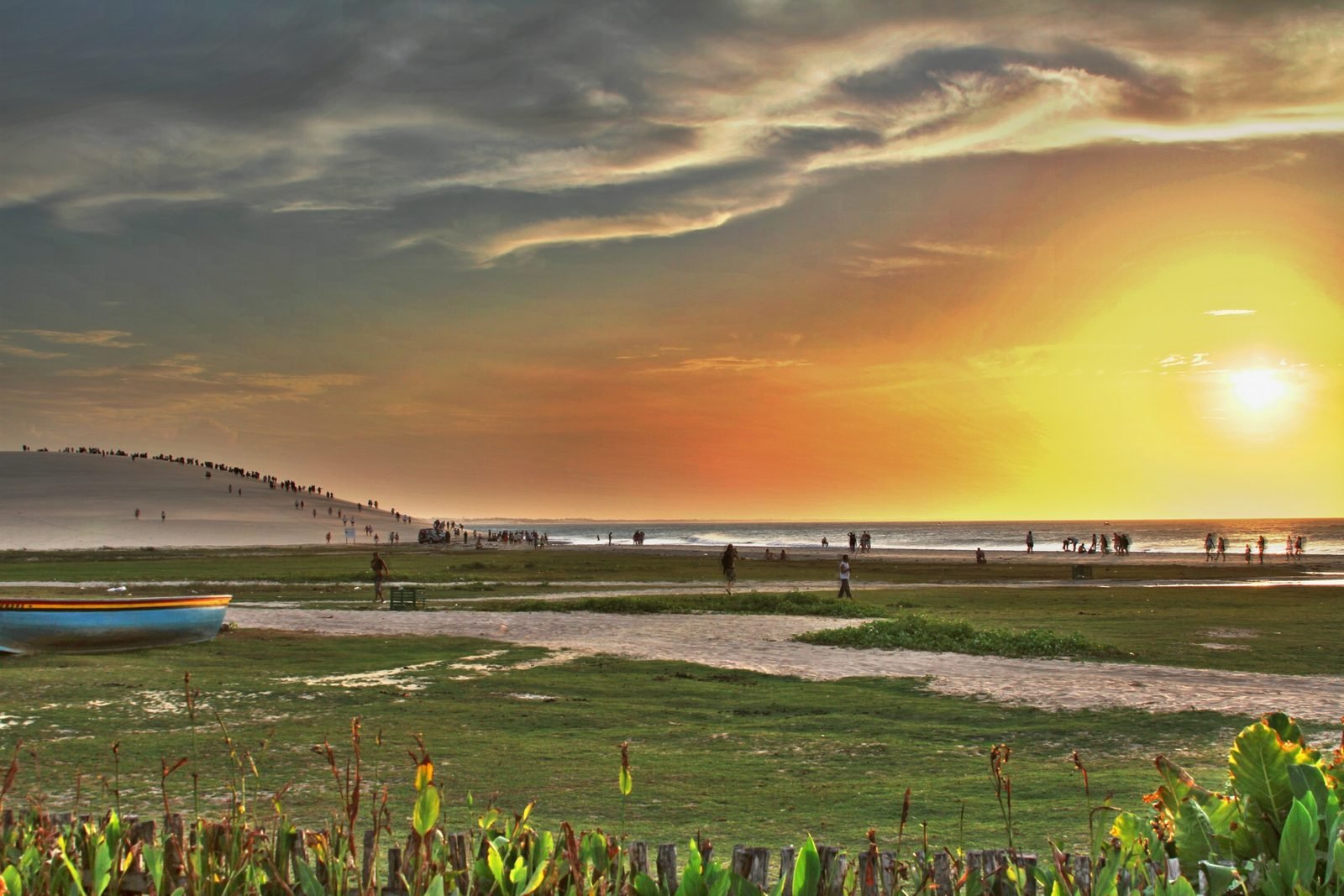
This is the beach in front of the village, where the central streets end and the beach huts and kiosks stand. At low tide the sand becomes huge and firm, great for walking. It is also where you watch the sun set into the sea, with the dune beside you. Pay attention to swimming signs and flags, as currents shift with the tide.
Malhada Beach
East of the village, on the other side of the Serrote hill, Malhada is the walking route to Pedra Furada. It has better waves for surfing and far fewer people than the main beach. ICMBio only allows events on Malhada with prior permission and requires sports to respect the park’s zoning and local signs.
Preá Beach
About 12 km east of the village, in the municipality of Cruz, Preá is the region’s kitesurfing base, with schools, pousadas and restaurants built around the wind. The stretch between Preá and Jeri is part of the park and can only be driven following the markers: ICMBio bans vehicles in the tidal zone. The fishing huts along Preá to the mouth of the Guriú river may not be used for parties with car sound systems.
Mangue Seco and Guriú
To the west, towards Camocim, lie Mangue Seco and Guriú, where the Guriú river meets the sea and forms mangroves. This is where the canoe trips to see seahorses start. Further along on the same side are the dunes and village of Tatajuba.
Pedra Furada: tides, trail and rules
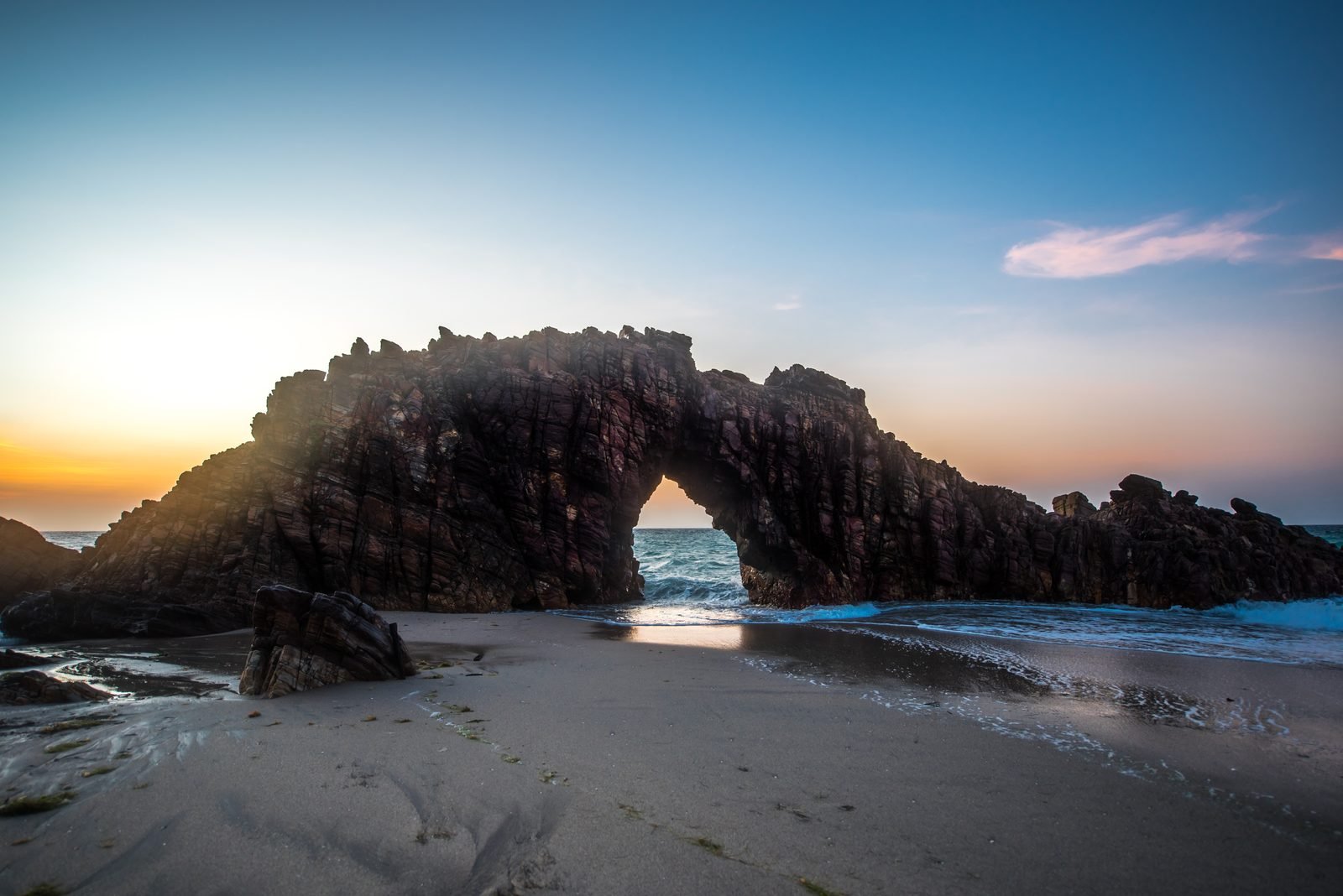
Direct answer: Pedra Furada is a rock arch carved by the sea at the Serrote, east of the village, and the classic way there is a 20- to 40-minute walk along Malhada Beach. The beach route is only safe at low tide: ICMBio itself advises avoiding high tide, when the sea covers the path along the rocks. Climbing the rock is not allowed.
Pedra Furada is Jericoacoara’s postcard and the sight that needs the most planning. Before setting out, check the official Brazilian Navy tide tables on the TábuaMares system, or a tide app, and time your walk to arrive close to low water. Plan the return before the tide comes back in too. At high tide the path is cut off, and some people try to scramble over wet rocks, which is dangerous.
From mid-July to mid-August the sun sets in line with the arch, a show that draws photographers and fills the beach in the late afternoon. Outside that window, morning is the best time for photos, with softer light and fewer people. ICMBio’s protocol bans paid photographers at the site and only allows authorised, identified vendors.
How to get to Pedra Furada
There are two ways. The prettiest is the beach walk: leave the village along the main beach, round the Serrote onto Malhada Beach and follow the sand to the arch, always at low tide. The other is the Serrote trail, about 40 minutes, the option when the tide is high; it is a more tiring route with strong sun and little shade, so wear trainers and take water. ICMBio bans all motor vehicles on the Serrote trails, including e-bikes. Many East coast buggy tours also stop at a point nearby for those who would rather not walk. For more on the arch and the dune, see our Pedra Furada and Sunset Dune guide.
Things to do in Jericoacoara: the essentials
Direct answer: the must-dos in Jericoacoara are watching the sunset from Sunset Dune, walking to Pedra Furada at low tide, taking the East coast buggy tour (Árvore da Preguiça, Buraco Azul, Lagoa Azul and Lagoa do Paraíso) and the West coast tour (Mangue Seco, seahorses and the Tatajuba dunes). If you like sport, try a kitesurfing lesson at Preá. At night, life happens in the village, with capoeira, forró and restaurants.
Sunset Dune (Duna do Pôr do Sol)
This is the big dune beside the village, facing the sea, and the most famous spot to watch the sun sink into the water. Thanks to the shape of the peninsula, from Jericoacoara you can see the sun both rise and set over the ocean. Arrive about 40 minutes before sunset to climb without rushing, and bring a sarong and something to protect your phone from the sand, which blows hard in the windy season. Motor vehicles are banned on the dune except for wheelchair users, and only authorised vendors may work there. Afterwards many people head down to the beach, where capoeira circles and kiosks liven up the early evening.
Serrote and Jericoacoara Lighthouse
The Serrote is a small group of rocky hills, about 95 metres at the highest point, that shelters the village from the wind and the dunes. The lighthouse on top opened in 1952. The climb is short but steep, and the view takes in the village, the dunes, the sea and, in the distance, the lagoons. Go early in the morning or late in the afternoon, with water and a hat, and stick to existing paths, because shortcuts speed up erosion.
Lagoa do Paraíso
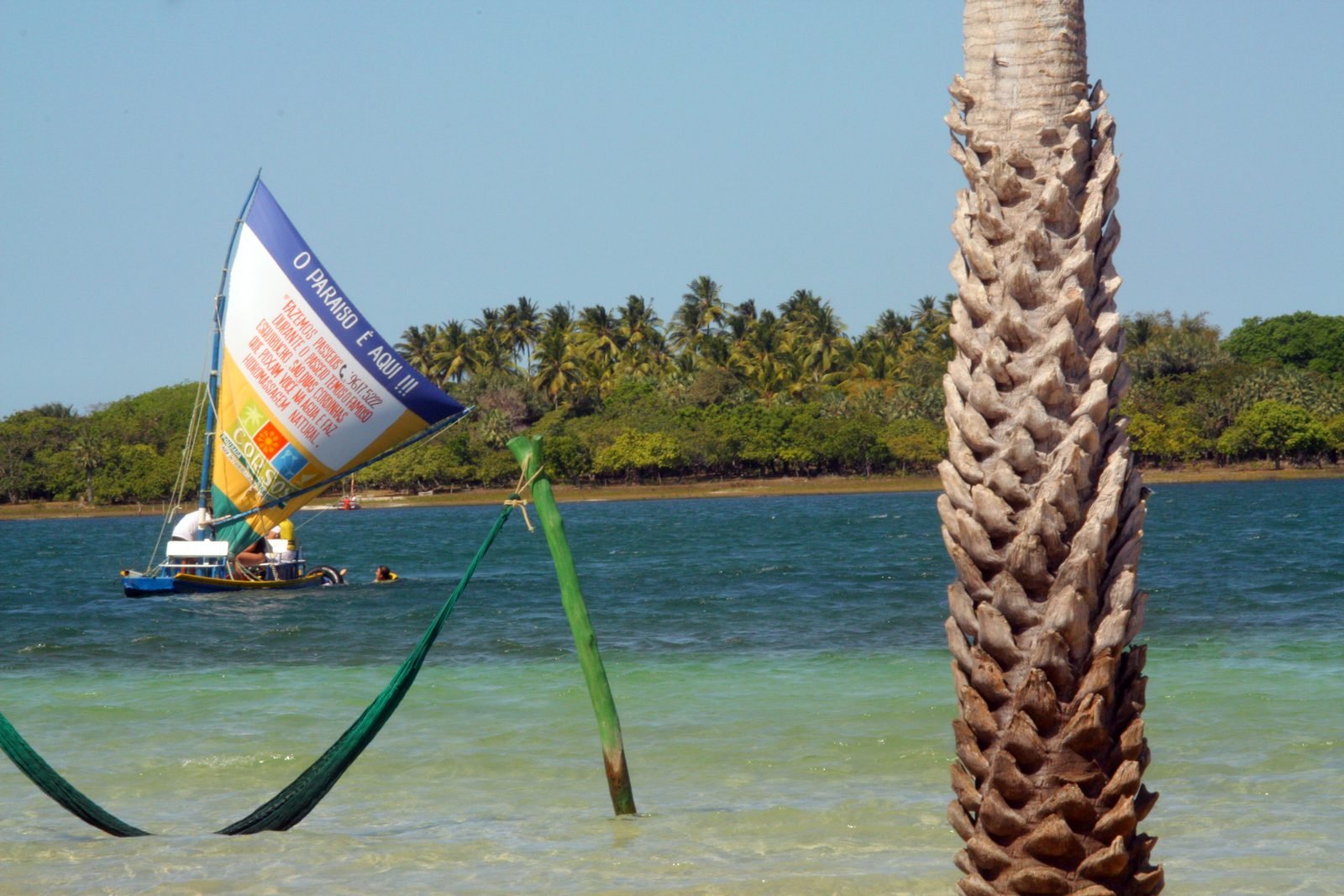
Lagoa do Paraíso, also called Lagoa de Jijoca, lies 5 km from Jijoca town and 18 km from the village, according to the council. It is a large freshwater lagoon, clear and green-blue, ringed by dunes and famous for the hammocks strung right in the water, where you sit with your feet wet sipping a juice or a coconut. The shores are lined with bars and beach clubs that charge entry or a minimum spend. The buggy cooperative lists, for example, R$50 per person at Alchymist. The lagoon is part of the East coast tour, but you can also get there by jardineira or taxi from Jijoca and spend the whole day.
Lagoa Azul
Next to Lagoa do Paraíso, Lagoa Azul is smaller and also has bars with hammocks in the water. The entry listed by the buggy cooperative is R$40 per person. The level varies a lot with each year’s rain, and by the end of the dry season it can be much lower than in promotional photos.
Árvore da Preguiça (the “Lazy Tree”)
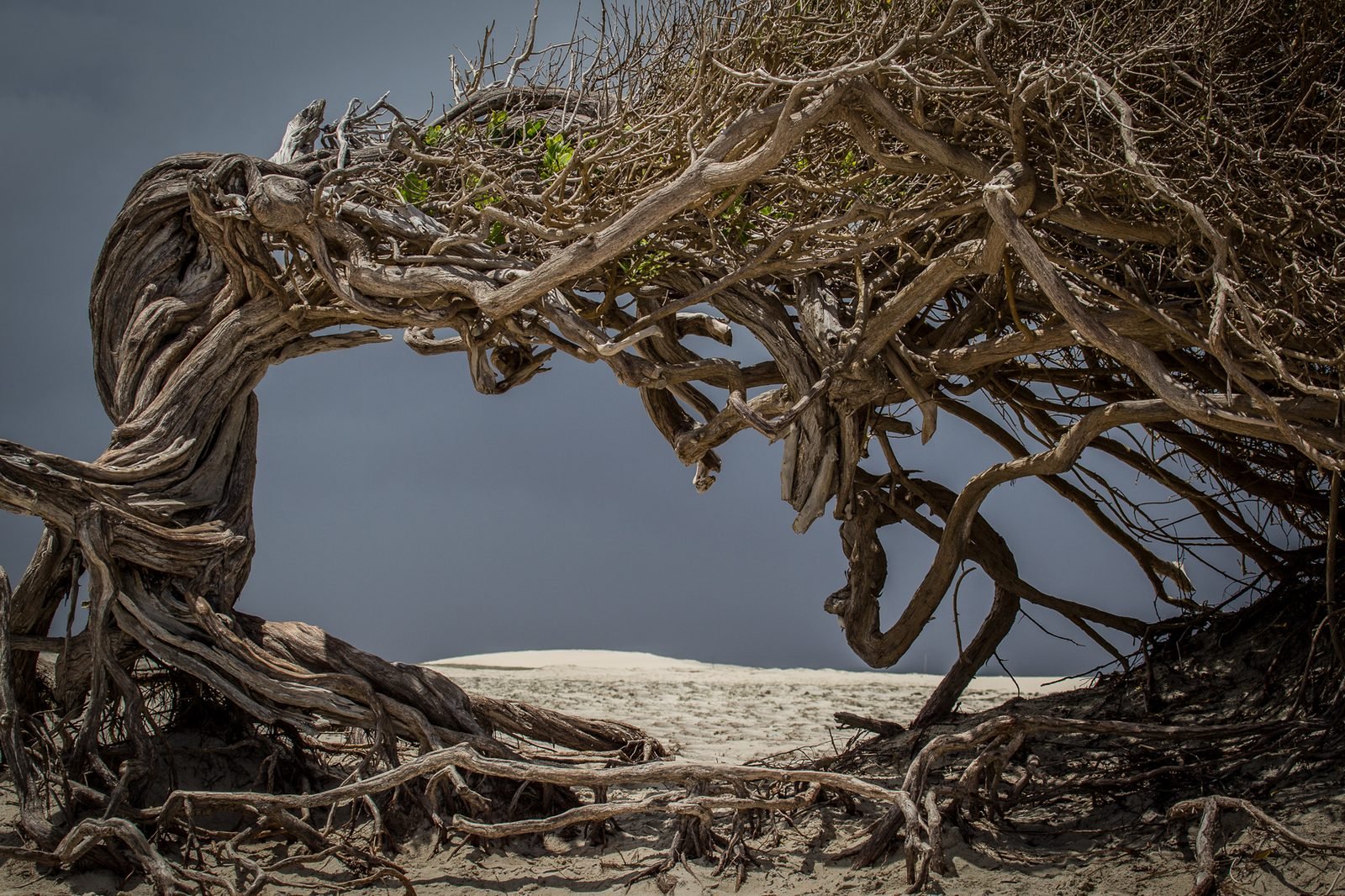
This is a button mangrove (Conocarpus erectus) that grew lying down, almost parallel to the ground, shaped by the constant sea wind. It stands inside the park on the way from the village to Preá and is a fixed stop on the East coast tour. The tree is fragile, and ICMBio’s protocol is clear: do not cross the markers around it, and do not climb, touch, lean on or hang from it. Paid photographers and street vendors are not allowed there either. It is a short stop, but it makes one of Jeri’s best-known photos.
Buraco Azul
Buraco Azul is in the Caiçara area, in the municipality of Cruz: a lagoon of intensely blue water with facilities for swimming. The entry listed by the buggy cooperative is R$30 per person. It is one of the East coast tour stops and tends to get busy around midday.
East coast tour
The East coast tour is Jericoacoara’s most popular trip. On the buggy cooperative’s itinerary, about 6 hours and R$500 per buggy for up to four people, you get the Árvore da Preguiça, Preá Beach, Lagun Beach, Buraco Azul at Caiçara, Lagoa Azul, Lagoa do Paraíso, Lagoa do Amâncio and the park’s dunes. Entry fees are extra: R$50 at Alchymist, R$40 at Lagoa Azul, R$30 at Buraco Azul and R$30 at Lagun Beach, per person. Not everyone stops everywhere; agree with your driver on your priorities and how long you want at Lagoa do Paraíso, usually the longest stop.
West coast tour and Tatajuba
The West coast tour costs R$550 per buggy, 5 to 6 hours, according to the cooperative, and follows the coast towards Camocim. It includes Mangue Seco, a ferry crossing, the eco-trip to see seahorses, the Guriú mangrove trail with its aerial roots, the Tatajuba dunes, a water slide, a zipline and a lagoon with a bar. Extras per person are R$40 for the ferry, R$30 for the seahorse trip and R$30 each for the water slide, the zipline and the “skibunda”, sliding down a dune sitting on a board.
Tatajuba deserves a chapter of its own. The old village, which had a church, schools and festivals, was buried by moving dunes from the 1970s on, and residents rebuilt their lives in Nova Tatajuba, now a district of Camocim, as G1 reported in May 2026. High dunes, freshwater lagoons and the river running through the landscape make this the wildest tour in the region, with fewer facilities and fewer people than the East coast.
Mangue Seco and the Guriú seahorses
Longsnout seahorses (Hippocampus reidi) live in the mangroves of the Guriú river, and the eco-tour is done by canoe with a local guide who looks for them among the roots. ICMBio sets strict rules: sightings only with a trained, authorised guide; no catching seahorses or putting them in containers, even briefly; no alcohol during the trip; life jackets compulsory; and boats may only be paddled, no motors. If anyone offers you a seahorse in a jar for a photo, refuse and choose another guide.
Kitesurfing and windsurfing at Preá
Preá, 12 km from the village, is one of Brazil’s top kitesurfing spots, with cross-shore wind and open sea. Kite schools and specialist pousadas such as Rancho do Peixe and Chalet du Kite are just metres from the spot. The season runs from July to January, peaking from August to November, and the wind usually gets stronger in the afternoon. Beginners buy lessons in packages of hours; before you book, ask about the instructor’s certification, the safety gear and whether they use helmet radios. In the village itself, windsurfing and surfing at Malhada round out the options.
Capoeira, forró and nightlife in the village
Jeri’s evenings start on the beach after sunset and continue along Rua Principal and around the square. Capoeira circles on the sand in the late afternoon are a common sight, and forró, the accordion-driven dance music of north-east Brazil, is the soundtrack of many nights. Days and venues change from season to season, so ask at your pousada what is on that week. Beach bars, restaurants on the square and forró parties make the village far livelier than its size suggests.
Sandboarding, horse riding and walks
The dunes around the village are good for sandboarding, and boards can be rented locally. There are also horse rides over the dunes and along the beach, and walks to Pedra Furada, the Serrote and Sunset Dune. For any activity inside the park, ICMBio’s rule applies: no fires, no camping and take your rubbish back with you.
Day trips and next stops: Camocim, Lençóis Maranhenses and Fortaleza
Jericoacoara sits in the middle of the Rota das Emoções (Route of Emotions), the itinerary that links Jeri, the Parnaíba Delta in Piauí and the Lençóis Maranhenses in Maranhão. Many agencies run the 4×4 crossing from Jeri to Barreirinhas, with stops along the way. To extend your trip, see our Lençóis Maranhenses travel guide. In the other direction, Fortaleza and the beaches of Ceará’s east coast are the natural add-on if you arrive via the capital, and Camocim, to the west, has the Coreaú river and Ilha da Testa Branca, known as Ilha do Amor, opposite the town.
What to eat in Jericoacoara
Jeri’s food blends Ceará’s fishing traditions with the influence of the foreigners who moved to the village: Italians, Argentinians, French and other Europeans opened restaurants, pizzerias and cafés next to the fish shacks. On the beach and in simpler places, the local classics are fried or grilled fish, prawns, crab at Mangue Seco, baião de dois (rice and beans cooked together with cheese), carne de sol (salted sun-dried beef) and tapioca crêpes. At the lagoons, bars serve snacks, regional fruit juices and fresh coconut water.
Restaurants cluster around the square and on Rua Principal, and prices are higher than elsewhere in Ceará because almost everything arrives by truck over the sand. To save money, look for tapioca stalls and set lunches on the back streets. Our list of Jericoacoara restaurants has options by style and price. Carry some cash, but check beforehand whether a place takes cards or Pix, Brazil’s instant payment system.
Safety and environmental rules in Jericoacoara
Direct answer: Jericoacoara is a relaxed destination for visitors, and the main precautions are about nature: the tide on the way to Pedra Furada, strong sun and wind, sea currents, and buggy and quad tours, which should only be done with ICMBio-authorised guides. Inside the park, fires, camping, driving up dunes and touching the Árvore da Preguiça are all banned.
Sea, tide, sun and wind
Jeri’s sea is not dangerous in itself, but it changes a lot with tide and wind. Swim near the main beach, ideally in the morning, and respect flags and signs. In the windy season sand blows hard on the dunes and beach; bring sunglasses and protect cameras and phones. The sun is intense all year this close to the Equator: wear sunscreen and a hat and drink plenty of water, especially on buggy tours that spend hours in the sun.
Buggies, quads and UTVs
Only hire accredited buggy drivers and guides with visible ID. ICMBio requires quads and UTVs driven by visitors to be accompanied by an authorised guide leading no more than four vehicles; everyone must wear a helmet with a visor or goggles; and the driver must hold a category B (car) licence. Speed limits are 40 km/h on tracks and 20 km/h near pedestrians. Risky manoeuvres and off-track driving are banned.
National park rules
In the park, ICMBio’s visitation protocol applies: no fires, camping, bivouacs or overnight stays in trailers; no driving up the dunes, except for wheelchair users; no climbing Pedra Furada or touching the Árvore da Preguiça; no catching seahorses; and events need prior permission. ICMBio also asks visitors to take their rubbish back, not to feed animals, not to take shells or stones as souvenirs and to leave loud music at home.
Staying safe in the village
The village is small and busy until late. As in any crowded tourist spot, watch your phone and wallet in crowds, especially at New Year and Carnival, and do not leave valuables unattended on the beach. Streets are sand and dimly lit; at night use a torch and stick to busier routes. Book tours with identified companies and cooperatives, and be wary of anyone selling “tickets” to enter the village.
How much does a trip to Jericoacoara cost in 2026
Direct answer: apart from accommodation, the fixed costs of a trip to Jeri are the TTS (R$41.50 per person), transport to the village (roughly R$150 to R$240 per person each way on a shared transfer from Fortaleza) and buggy tours at R$500 to R$550 per vehicle for up to four people, plus R$30 to R$50 per person at each attraction. Splitting a buggy four ways is the single biggest saving.
The table gathers prices we found on official websites, cooperatives and operators in October 2026. Prices change often, especially in high season, so confirm before booking.
| Item | 2026 price | Notes |
|---|---|---|
| Sustainable Tourism Fee (TTS) | R$41.50 per person | Up to 10 days; R$4.15 per extra day; exempt: 12 and under, over 60, people with disabilities |
| National park fee to enter the village | Not charged | Suspended by the federal courts; status as of October 2026 |
| Shared transfer Fortaleza-village | R$164.50 to R$240 per person | Each way; Sim7, Transfer Jerico and a local operator |
| Private transfer Fortaleza-village | R$700 to R$1,400 per vehicle | Depends on operator and vehicle size |
| Bus Fortaleza-Jijoca (Fretcar) | about R$80 to R$90 | Figure quoted by a transfer operator; check when buying |
| Shared jardineira Jijoca-village | R$65 per person | Rota Combo, each way, 2026/2027 season |
| Private jardineira Jijoca-village | R$275 per vehicle | Up to 10 people |
| JJD airport-village | R$70 per person (shared) or R$240 (private, up to 4) | Local operator |
| East coast buggy (6 h) | R$500 per buggy | Up to 4 people; COOPBJ |
| West coast and Tatajuba buggy (5-6 h) | R$550 per buggy | Up to 4 people; COOPBJ |
| East coast entry fees | R$50 Alchymist, R$40 Lagoa Azul, R$30 Buraco Azul, R$30 Lagun Beach | Per person |
| West coast extras | R$40 ferry, R$30 seahorses, R$30 water slide, R$30 zipline, R$30 skibunda | Per person |
| Budget daily spend | R$200 to R$400 per person | Excluding accommodation and paid tours (our estimate) |
To save money, travel between March and June outside holidays, or in September and October, when there is wind and prices are lower than in December; pay the TTS online; fill your buggy with four people; take the bus plus jardineira if you have time; and eat set lunches on the back streets.
Jericoacoara itineraries: 2, 3, 4 and 5 days
Direct answer: with 2 days, walk to Pedra Furada at low tide, watch sunset from the dune and do the East coast tour. With 3, add the West coast with Mangue Seco, seahorses and Tatajuba. With 4, keep a full day for Lagoa do Paraíso or a kite lesson at Preá. With 5, slow down, climb the Serrote and go back to the lagoons. Remember that your first and last days are partly taken up by the 5- to 6-hour journey from Fortaleza.
Jericoacoara in 2 days
- Day 1: arrive in the morning or early afternoon, drop your bags and wander around the village. When the tide is low, walk along Malhada to Pedra Furada. Get back in time to climb Sunset Dune and end the evening on the square.
- Day 2: take the East coast buggy tour with the Árvore da Preguiça, Buraco Azul, Lagoa Azul and Lagoa do Paraíso. Return for a final sunset on the main beach and dinner in the village.
Jericoacoara in 3 days
- Days 1 and 2: as in the 2-day plan.
- Day 3: West coast tour: Mangue Seco, the seahorse canoe trip at Guriú, the ferry and the Tatajuba dunes, with lunch at one of the lagoons. In the evening, find a forró night.
Jericoacoara in 4 days
- Days 1 to 3: as in the 3-day plan.
- Day 4: choose between a full day at Lagoa do Paraíso, with a hammock in the water and an unhurried lunch, or a morning kite lesson at Preá. In the late afternoon, climb the Serrote to the lighthouse for a view over the village.
Jericoacoara in 5 days
- Days 1 to 4: as in the 4-day plan.
- Day 5: a free day to repeat your favourite: sandboarding, horse riding, surfing at Malhada or another try at the Pedra Furada photo early in the morning. If you are continuing along the Rota das Emoções, use this day to start the crossing towards the Lençóis Maranhenses.
Where to stay in Jericoacoara
Direct answer: on a first trip, stay in the village, close to the main beach or the square, so you can walk everywhere. Streets further from the beach have lower rates and quieter nights. Preá, 12 km away, is for people who plan to kitesurf every day. Every link below goes to the hotel’s or pousada’s official website and was checked on 26 October 2026; we do not use agency or booking-site links.
Jericoacoara has few tall buildings and almost no chain hotels: accommodation means pousadas (small guesthouses), boutique hotels and chalets, many of them owned by foreigners. Rates climb steeply in December, January, Carnival and July, and over New Year many places only sell packages. The category given for each option below is based on the property’s own description; we did not check prices, which vary by date. Ask directly on the official website and book early.
The Chili Beach (luxury, Malhada Beach)
The Chili Beach is a beachfront boutique hotel on Malhada Beach, at Rua da Matriz 250, with just six suites and a maximum of 20 guests. It has an infinity pool, a spa and a restaurant. It is the most exclusive choice on this list, for couples and honeymooners, close to the Pedra Furada walk.
Casa na Praia Jeri (boutique, Main Beach)
Casa na Praia Jeri is a beachfront boutique hotel facing the main beach, with ten rooms, a sea-view pool, the La Plage restaurant and breakfast by the sea. It is in the best spot in the village for sunset and for walking everywhere.
Jeribá (upscale pousada, centre)
Jeribá is on Rua do Ibama in the centre of the village, with a restaurant, a spa and luxury room categories. It suits travellers who want hotel comfort in a central location, a few minutes from the beach and the square. Bookings via reservas@jeriba.com.br.
MyBlue Hotel (full-service hotel, village)
MyBlue Hotel is large by village standards, with 80 suites, two pools, panoramic jacuzzis, a spa, a sauna, a gym, an international restaurant and a wet bar. It is the pick for full hotel facilities and works well for families and groups.
Villa Mango Jeri (eco boutique, village)
Villa Mango Jeri is a boutique hotel that describes itself as environmentally responsible, on Rua João Julião, with rooms among native trees and king-size beds. A good fit for couples who want peace and quiet while staying inside the village.
Villa Nautica Boutique Hotel (boutique, centre)
Villa Nautica Boutique Hotel has Austrian-influenced design and is about 300 metres from the centre and 450 metres from the beach, according to the hotel. It offers support for windsurfing, surfing, kitesurfing, wing foiling and stand-up paddle, plus boat trips, so it appeals to people coming for the sports.
Vila Kalango (charming pousada, village)
Vila Kalango has been in Jeri since the 1990s, at Rua Angela Marques 30, and is known for its stilt houses (six 28 m² cabins raised 3 metres off the ground), its red pool and its water-sports centre. It has a kids’ play area and works well for families. It belongs to the same group as Rancho do Peixe in Preá.
Pousada Surfing Jeri (mid-range pousada, village)
Pousada Surfing Jeri is a mid-range pousada in the village with rooms and suites and a website in six languages. The official site gives few details about facilities, so ask for photos and the exact location when booking, via info@surfingjeri.com.br.
Rancho do Peixe (bungalows, Preá Beach)
Rancho do Peixe has been on Preá Beach, 12 km from Jeri, for about 20 years. Its bungalows are spread across a 64,000 m² plot with only 8% built up, and it has a water-sports centre focused on kitesurfing. It is the right choice if you will ride every day and prefer Preá’s calm to the buzz of the village.
Chalet du Kite (chalets, Preá Beach)
Chalet du Kite has chalets in Preá about 100 metres from the kite spot, with fibre internet and Starlink, a plus for remote workers during the wind season, which the site itself gives as July to January. It is a simpler, more independent option than the village hotels.
Video: Jericoacoara by Visit Brasil
Visit Brasil, the official tourism promotion channel of Embratur, Brazil’s tourism board, shows the dunes, lagoons, kites and sunsets of Jericoacoara in this English-language video.
Frequently asked questions about Jericoacoara
How much is the Jericoacoara entry fee in 2026?
The Sustainable Tourism Fee (TTS) costs R$41.50 per person and is valid for up to 10 days; each extra day costs R$4.15. Children up to 12, people over 60 and people with disabilities are exempt with proof. Pay online on the Jijoca council website or at the entry checkpoints.
Do I need a national park ticket to visit Jericoacoara?
No, as of October 2026. The fee the concessionaire Urbia planned to charge everyone crossing the park to reach the village is banned by the federal courts, and the TRF5 rejected the company’s appeal on 3 October 2026. The municipal TTS is the only fee to enter the village. Check the news before travelling, as the case could still change.
When is the best time to visit Jericoacoara?
July to December, the dry season, with clear skies and strong wind that is ideal for kitesurfing. For full lagoons, go in June, July or August. Rain falls from January to May, peaking in March and April, though there are plenty of sunny days even then.
How do I get from Fortaleza to Jericoacoara?
By shared transfer, R$164.50 to R$240 per person each way, in 5 to 6 hours; by private transfer, R$700 to R$1,400 per vehicle; or by Fretcar bus to Jijoca, about 6 to 7.5 hours, followed by a jardineira to the village for R$65 per person. Ordinary cars cannot enter the village.
What is the nearest airport to Jericoacoara?
Jericoacoara Regional Airport Comandante Ariston Pessoa (JJD), in Cruz, about 30 km from the village. In 2026 it has flights to São Paulo-Guarulhos (Latam and Gol) and Belo Horizonte-Confins (Azul), and Latam has announced Brasília flights from July 2027. There are no international flights yet. The 4×4 ride to the village takes 45 to 70 minutes.
How do I get to Pedra Furada?
On foot along Malhada Beach, 20 to 40 minutes, always at low tide, or via the Serrote trail, about 40 minutes, when the tide is high. Check the tide tables before setting out. Climbing the rock is forbidden.
How much does a buggy tour in Jericoacoara cost?
With the Buggy Drivers’ Cooperative, the East coast tour costs R$500 per buggy and the West coast and Tatajuba tour R$550, for up to four people, as of October 2026. Entry to the attractions is paid separately, R$30 to R$50 per person at each.
Where can I see seahorses in Jericoacoara?
In the mangroves of the Guriú river, around Mangue Seco, west of the village, on a paddled canoe trip with an authorised guide. ICMBio forbids putting seahorses in jars or containers, requires life jackets and bans alcohol during the trip.
How many days should I spend in Jericoacoara?
Three days cover the village, Pedra Furada, the dune and both the East and West tours. With four or five you can enjoy Lagoa do Paraíso at leisure, take a kite lesson at Preá and climb the Serrote. Bear in mind that getting there and back from Fortaleza takes a good part of two days.
Can I drive in Jericoacoara?
To Jijoca or Preá, yes. Inside the village, no: private cars may not drive on the sand streets, according to the council. Leave the car in a car park in Jijoca and take a jardineira, or book a transfer. Driving on the park’s sand without experience and without 4×4 is the quickest way to get stuck.
Is Jericoacoara worth it?
Very much so, as long as you know what you are signing up for. Jeri is not a resort beach: it is a sand village, far from everything, where time is measured by the tide, the wind and the sunset. The journey is long, prices are higher than in the rest of Ceará, and the park rules exist so that the dunes, the mangroves and the Árvore da Preguiça are still there for the next visitor. In return, few places in Brazil pack so much into such a small radius: dunes that run into the sea, freshwater lagoons with hammocks in the water, a stone arch carved by waves, seahorses in a mangrove and some of the best wind in the world for kitesurfing. Pair the trip with our Fortaleza travel guide and, if you are planning a longer route through north-east Brazil, see our guides to Natal, Recife, Porto de Galinhas, Maceió and Salvador.
Sources
- IBGE Cidades: Jijoca de Jericoacoara (CE), panorama (2022 census population and 2025 estimate)
- INMET: Brazil climate normals 1991-2020 (monthly rainfall, Sobral station)
- ICMBio: Jericoacoara National Park and Visitation Operational Protocol no. 01/2026 (visitor rules, signed on 1 October 2026)
- Jijoca de Jericoacoara council: frequently asked questions and online Sustainable Tourism Fee payment
- ADEJERI: notice to visitors about fees
- O Povo: federal court upholds ban on entry fee to Jericoacoara, airport internationalisation postponed until after works and new route to Brasília
- G1 Ceará: the Tatajuba village buried by dunes
- Wikipedia (Portuguese): Jijoca de Jericoacoara, Parque Nacional de Jericoacoara and Aeroporto de Jericoacoara (history, etymology, climate and areas)
- Brazilian Navy: TábuaMares (official tide tables)
- Jericoacoara Buggy Drivers’ Cooperative (COOPBJ): East and West coast tours (prices and fees, October 2026)
- Rota Combo: shared and private Jijoca-Jericoacoara 4×4 shuttle; Cooperjeri: transport cooperative
- Sim7 Viagens: transfer Fortaleza-Jericoacoara; Transfer Jerico: Fortaleza-Jericoacoara prices; Jericoacoara.tur.br: transfers and airport
- ClickBus: Fretcar (Fortaleza-Jijoca bus)
- Brazil Kite: wind season in Ceará; 360meridianos: Pedra Furada trail