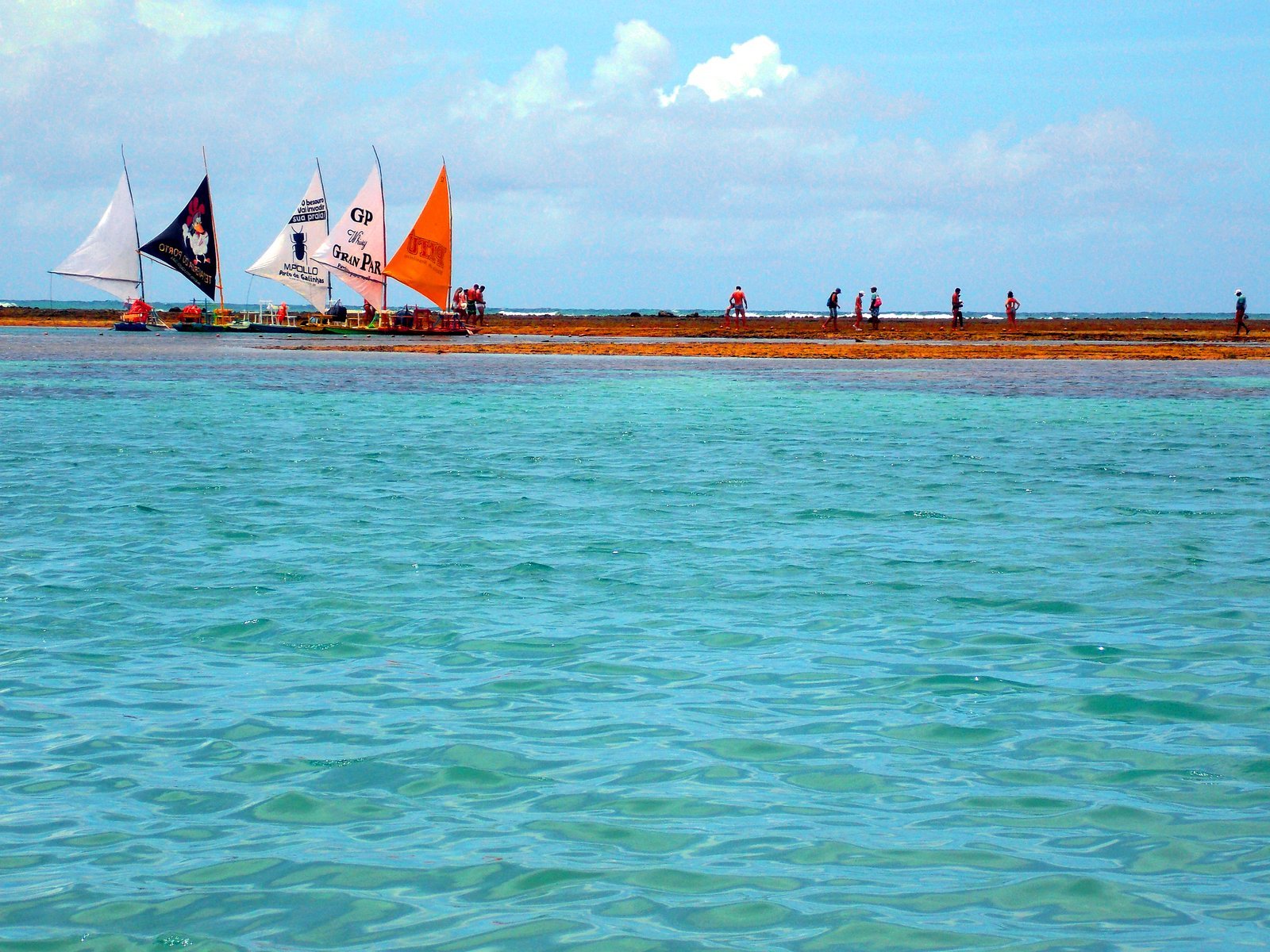
Porto de Galinhas is not a city. It is a district of Ipojuca, a municipality on the south coast of Pernambuco, about 60 km from Recife International Airport, and its name has come to stand for a whole strip of beaches running from Muro Alto in the north to Serrambi in the south. What put it on the map are the natural pools: at low tide, the reef in front of the village is exposed and forms shallow, warm, crystal-clear pools full of fish, and traditional wooden sailboats called jangadas have been ferrying visitors out to them for decades. The local government says the water sits at around 27 °C, and readers of Brazil’s Viagem e Turismo magazine have voted Porto the best beach in the country more than once.
This guide was put together with information checked in October 2026: month-by-month climate from Brazil’s national weather institute (INMET), how to get there from the airport by transfer, taxi, car or bus, the official jangada fare, how to read the tide table so you don’t miss the pools, the rules that cap visitor numbers on the reef, every beach in the area based on information from the Ipojuca city government, the day trip to Praia dos Carneiros, what the trip costs, itineraries from 2 to 5 days and ten real hotels, resorts and pousadas, each linked to its official website.
Quick facts: Porto de Galinhas (Ipojuca, Pernambuco)
- What it is: a beach district of Ipojuca, a municipality in the Recife metropolitan region with 98,932 residents in the 2022 IBGE census and 521.8 km² of land.
- Distance from the airport: about 60 km from Recife International Airport (REC), around 1 hour by car on the PE-009 highway, according to the Ipojuca city government.
- Best time to go: September to February, the driest and sunniest stretch. October, November and December get the least rain. April to July is the rainy season: June averages 390 mm at the nearest INMET weather station.
- Temperature: average highs between 27.9 °C and 31 °C (82–88 °F) and lows between 20.7 °C and 23.3 °C (69–74 °F) all year (INMET 1991-2020 normals, Recife station). Sea temperature around 27 °C (81 °F).
- Natural pools: only appear at low tide. The local rule of thumb is a tide of 0.5 m or lower, arriving 1 to 2 hours before low water.
- Checked prices: jangada ride to the pools R$60 cash or Pix (R$63 by card); Recife–Porto bus R$14.80 to R$22.50; shared airport transfer from R$136; end-to-end buggy tour from R$450 per buggy.
- How many days: 3 days for the pools, Muro Alto and Maracaípe; 4 to 5 to add Praia dos Carneiros and a day in Recife and Olinda.
- Where to stay: the Vila (village) to walk everywhere; Muro Alto and Cupe for resorts and calm water; Maracaípe and Pontal for surf, small pousadas and sunsets.
A short history: from Porto Rico to Porto de Galinhas
Direct answer: the place was first called Porto Rico (“rich port”) because of its brazilwood. After Brazil banned the slave trade, ships kept landing enslaved Africans here illegally, hidden under crates of guinea fowl, and the code word announcing a new arrival was “tem galinha nova no porto” (“there are new hens at the port”). That is where the name Porto de Galinhas (“Port of Hens”) comes from, according to the Ipojuca city government and the most widely told local history. The fishing village became a tourist destination from the 1990s on.
The story behind the name is a dark one, and it is worth knowing before you pose next to the colourful wooden hens in the village. The southern coast of Pernambuco was home to the Caeté people when the Portuguese arrived, and the natural harbour sheltered by the reef was first used to ship brazilwood, the red-dye timber that drove European trade in the 16th century. That is why the first recorded name is Porto Rico.
When sugar cane took over the fertile massapê clay plains of Ipojuca, the ports of Suape and Porto de Galinhas shipped sugar and received enslaved people for the plantations. In 1850 the Eusébio de Queirós Law outlawed the Atlantic slave trade to Brazil, but the trade went on clandestinely for some time. Tradition says traffickers hid the people brought from Africa under crates of guinea fowl and announced the cargo with the phrase about new hens at the port. Some local sources place the episode “after abolition”, which does not make historical sense: what was being hidden was the illegal trade, after 1850 and before slavery was abolished in 1888.
The artist Gilberto Carcará, born in Piauí and raised in Olinda, has lived in Ipojuca since 1997 and turned the name into a light-hearted symbol. He carves hens from fallen coconut-palm trunks and roots and paints them in bright colours. The work, made from wood that would otherwise be thrown away, began in the 1990s and helped turn a painful memory into the destination’s trademark without erasing where the name came from. Today his hens are all over the village, including at the Praça das Esculturas (Sculpture Square).
Ipojuca: sugar mills, convents and the Port of Suape
The name Ipojuca comes from the Tupi language and is usually translated as “swamp”, a reference to the flooded plains of the Ipojuca River, which runs through the municipality. European colonisation began in the second half of the 16th century, after the Caeté were driven out and enslaved, and sugar mills spread across the massapê lands. The founding date is disputed; a parish vicar once pointed to 1596. During the Dutch occupation of northeastern Brazil in the 17th century, Ipojuca took part in the resistance.
Buildings from that era are worth an afternoon away from the beach. The Convento de Santo Antônio, founded in 1606 by Friar Leonardo de Jesus, keeps the Santo Cristo, an image of the crucified Christ with arms raised above the head that survived a fire in 1935. The Igreja Matriz de São Miguel, the mother church in the town’s historic centre, is about 13 km from Porto de Galinhas village, roughly 20 minutes by car, according to the city government.
The municipal seat moved several times between the settlements of Nossa Senhora do Ó and São Miguel de Ipojuca. State law 173 of 6 June 1896 raised Ipojuca to the status of city, and the municipality celebrates its anniversary on 30 March. Today Ipojuca has an unusual double identity: besides tourism, it is home to the Suape Industrial Port Complex, with an oil refinery and a shipyard, which gives it one of the largest economies in Pernambuco.
From fishing village to Pernambuco’s most famous beach
For much of the 20th century, Porto de Galinhas was a fishing village where families from Recife kept holiday homes. Tourism really took off in the early 1990s, first with pousadas, then with resorts in Muro Alto and Cupe and the fame of the natural pools. Success came at a cost: trampling and fish feeding damaged the reef, and the city began capping the number of boats and visitors per day in 2013 and 2014. Growth continues in 2026. According to the Porto de Galinhas Convention & Visitors Bureau, the area added about 5,800 beds in a single year across hotels, flats and other lodging.
When to go to Porto de Galinhas: weather month by month
Direct answer: the best time to visit Porto de Galinhas is September to February, when it rarely rains and the sun shines almost every day; October, November and December are the driest months. April to July is the rainy season on the Pernambuco coast, with June the wettest month. Temperatures barely change: average highs stay between 28 °C and 31 °C (82–88 °F) all year. More important than the month is the tide, so check the tide table before you set your dates.
The table uses the 1991-2020 climate normals from Brazil’s National Institute of Meteorology (INMET) for the Recife (Curado) station, the nearest complete official station to Porto de Galinhas, about 55 km away. The Ipojuca coast is a little breezier, and rain tends to come in short showers, often at night or early in the morning.
| Month | Average low and high | Average rainfall (mm) |
|---|---|---|
| January | 23.1 °C to 30.8 °C | 106.6 |
| February | 23.3 °C to 31.0 °C | 127.0 |
| March | 23.2 °C to 30.9 °C | 197.2 |
| April | 22.8 °C to 30.4 °C | 268.9 |
| May | 22.3 °C to 29.6 °C | 317.1 |
| June | 21.5 °C to 28.5 °C | 390.5 |
| July | 21.0 °C to 27.9 °C | 314.8 |
| August | 20.7 °C to 27.9 °C | 186.7 |
| September | 21.5 °C to 28.6 °C | 93.3 |
| October | 22.4 °C to 29.6 °C | 52.8 |
| November | 22.8 °C to 30.4 °C | 39.0 |
| December | 23.0 °C to 30.8 °C | 61.6 |
| Year | 22.3 °C to 29.7 °C | 2,155.5 |
The numbers show why spring (September to November in Brazil) is so popular: in October and November it rains less than a sixth as much as in June. Even in the rainy season, though, there are plenty of fully sunny days, and the natural pools appear just the same whenever the tide is low. If your dates are flexible, May, June and August bring lower rates and a quieter village, at the risk of a few showers. After heavy rain the water in the pools is less clear, because the region’s rivers wash more sediment into the sea.
Low tide matters more than the calendar
If you are going to Porto de Galinhas for the natural pools, the tide table is the most important document of your trip. The tide rises and falls twice a day, and low water comes about 50 minutes later each day. Around the full and new moon come the spring tides, with the lowest lows of the month, and those are the dates the jangada crews consider ideal. Before booking, open the tide table for the Port of Suape, published by the Brazilian Navy’s Hydrographic Centre, and look for days with a morning low tide of 0.5 m or less. The next section explains how to read it.
High season, New Year’s Eve and Carnival
December, January, Carnival, Easter week and the July school holidays are when the village is packed, the jangada queues are long and room rates peak. Over New Year’s Eve 2025-2026, the Ipojuca city government reported 96% hotel occupancy, one of the best results of the past decade. For those dates, book months ahead and get to the jangada point early. Carnival 2026 in Porto de Galinhas had free events from 12 to 17 February, with the main stage on Rua Beijupirá and a gathering of frevo brass bands on the beachfront promenade. It is a far calmer street Carnival than those of Recife and Olinda, and many visitors stay in Porto, spend the day at Olinda’s Carnival and come back to the beach.
How to get to Porto de Galinhas from Recife Airport
Direct answer: Porto de Galinhas is about 60 km from Recife International Airport, around 1 hour by car on the PE-009. Your options are a shared transfer (from R$136 per person with Luck Receptivo in October 2026), a private sedan transfer (from R$405 per car), a taxi, a ride-hailing app, a rental car, or the metropolitan buses 191 (R$14.80) and 195 Opcional with air conditioning (R$22.50), which leave from central Recife.
The airport serving Porto de Galinhas is Recife/Guararapes – Gilberto Freyre International Airport (REC), with domestic flights from every region of Brazil and international flights. The road to the beach is good and mostly dual carriageway: head south on the BR-101 or the road towards Suape, take the PE-060 and then the PE-009, the access road to Porto de Galinhas.
Shared and private transfers
This is the easiest option if you arrive with luggage and do not want to drive. In October 2026, Luck Receptivo, one of the largest tour operators in northeastern Brazil, sold shared arrival or departure transfers to Porto de Galinhas from R$136 per person, private sedan or SUV transfers from R$405 per car and private vans for up to 10 people from R$715. Most hotels and resorts also run their own transfer or recommend partners; ask when you book.
Taxis and ride-hailing apps
Taxis wait outside arrivals, and ride-hailing apps work in Recife and Ipojuca. We found no official taxi fare between the airport and Porto de Galinhas, and app prices swing a lot with time and demand, so check the fare in the app before deciding. Agree on the taxi price before you get in. On the way back, at peak times and in high season, it can take a while to find a driver willing to go to the airport, so book ahead.
Buses 191 and 195 Opcional
This is the cheapest way. The Grande Recife transport consortium runs two lines to Porto de Galinhas: the 191, without air conditioning, for R$14.80, and the 195 Recife/Porto de Galinhas (Opcional), with air conditioning, for R$22.50, according to the official fare table checked in October 2026. Buses leave from the Cais de Santa Rita terminal in central Recife. From the airport, you can reach the centre by metro, from Aeroporto station, or by taxi. The bus ride takes much longer than driving because the line makes many stops. One local news site listed R$15.40 for line 191; we use the consortium’s official figure.
By car: PE-060, Rota do Atlântico and tolls
Renting a car makes sense if you want to do day trips on your own (Carneiros, Calhetas, Recife and Olinda) or are staying in Muro Alto or Pontal de Maracaípe, away from the village. From the airport, the fastest route uses the Rota do Atlântico, the tolled expressway linking the Suape area to the PE-009. In October 2026 the toll for a car was R$11.60 (R$5.80 for motorbikes), according to the Rota do Atlântico fare table valid since 4 January 2026. There is also a toll-free route on the PE-060, a little slower. In the village, parking is paid and hard to find, and many streets are pedestrian-only, so leave the car at your pousada and walk.
Getting around Porto de Galinhas
Direct answer: the village is walkable. For the other beaches, use a car, taxi, ride-hailing app, bicycle or the buggy tour that links Muro Alto to Pontal de Maracaípe. Muro Alto is about 9 km north of the village; Maracaípe is 3 km south; and Pontal de Maracaípe is about 6 km away.
The Porto de Galinhas area is a long strip of beaches linked by the PE-009 and by small access roads to the shore. The village packs shops, restaurants, bars, the jangada point and the craft fair into a few flat streets that are perfect for walking. Many hotels in Muro Alto and Cupe run shuttles to the village at set times; check before you book, because a daily round-trip taxi adds up quickly.
To reach Maracaípe and the Pontal, many people cycle or walk along the beach at low tide; by car, follow the road that leaves the PE-009 towards Maracaípe. Parking lots at the Pontal charged R$10 to R$20 in 2025 and early 2026, according to the local guide GoAny. The end-to-end buggy tour, described below, is the most fun way to see all the beaches in a single day.
The beaches of Porto de Galinhas: which one is for you
Direct answer: from north to south, Ipojuca’s beaches are Muro Alto (pool-calm water, resorts), Cupe (waves, surf, resorts and pousadas), Porto de Galinhas (the village and the natural pools), Maracaípe (surf and pousadas), Pontal de Maracaípe (river mouth, seahorses and sunsets) and Serrambi (reef on one side, open sea on the other). For calm water with kids, pick Muro Alto; for buzz and the pools, the village; for surf, Maracaípe. For a shorter overview, see our post on the beaches near Porto de Galinhas.
Muro Alto
Muro Alto (“high wall”) is named after the reef wall that runs parallel to its roughly 3 km of beach and holds back the waves, creating a huge natural pool of calm, warm water, according to the city government. It lies about 9 km north of the village and around 50 km from the airport, close to 1 hour by car. Some of the area’s best-known resorts are here, including Nannai and Summerville, and it is the best beach for families with small children. Kayaks, stand-up paddleboards and clear-bottom kayaks are the activities of the moment, and there are beach bars and beach clubs selling day passes. At high tide the water comes close to the resort walls and the strip of sand shrinks.
Cupe
Between Muro Alto and the village, Cupe beach runs for about 4.5 km, with open sea, stronger waves and a few reef pools at low tide. It is a beach for surfing and long walks, with large resorts and pousadas on the shore and far fewer people than in the village. The southern end of Cupe joins Porto de Galinhas along the sand, so you can walk to the natural pools at low tide. Watch out for currents when the sea is rough.
Porto de Galinhas and the village
This is the heart of the destination. The beach in front of the village has the reef with the natural pools, the colourful jangadas and a promenade lined with beach stalls, restaurants and shops. The village streets, such as Rua Beijupirá, are packed with restaurants, ice-cream parlours, swimwear and craft shops, and come alive in the evening. North of the village are the Merepe neighbourhoods and the newer part of town, full of flats and pousadas. Don’t expect peace and quiet: in high season, the beach in front of the pools gets crowded. Our guide to the village centre has more on its streets.
Maracaípe
About 3 km south of the village, Maracaípe has good waves for surfing and is a traditional venue for surf competitions. The name is said to mean “river of the maracás”, and the beach is about 65 km from the airport, close to 1 hour 20 minutes by car. The vibe is younger and more laid-back, with surfer pousadas, surf schools and beach bars. For swimming, choose calmer days and follow the lifeguards’ flags.
Pontal de Maracaípe
At the southern tip of Maracaípe, about 6 km from the village, the Maracaípe River meets the sea among mangroves. This is where pole-pushed jangadas leave for the natural seahorse nursery, and where you can watch one of the most beautiful sunsets on the Pernambuco coast. The estuary is part of the Sirinhaém and Maracaípe Environmental Protection Area, created by state law in 1986, and the city created a natural park of about 15 hectares at the Pontal in 2017.
Serrambi
In the south of Ipojuca, about 70 km from Recife, Serrambi has two sides: on one, the reef forms natural pools and calm water; on the other, there is open sea. The name is said to come from the cernambi, a mollusc common in the area. It is a beach of holiday homes, gated communities and few pousadas, great if you want to escape the crowds. Serrambi’s reefs are protected by a state marine Environmental Protection Area created in 2018.
Natural pools and jangadas: tide table, price and rules
Direct answer: the natural pools of Porto de Galinhas only appear at low tide, ideally 0.5 m or lower on the Navy’s tide table for the Port of Suape. Go by jangada, the official and easiest way: in October 2026, the Jangadeiros Association charged R$60 per person in cash or Pix (R$63 by card), R$30 for children aged 4 to 6, and nothing for children up to 3. The ride takes about 1 hour. Don’t step on the coral and don’t feed the fish.
The pools are just a few metres off the beach, on the reef in front of the village. At low tide the water between the reefs becomes shallow, warm and transparent, with shoals of sergeant majors and other reef fish swimming around the legs of people standing in the permitted areas. One of the most photographed formations has an outline that resembles the map of Brazil. At high tide the pools simply disappear underwater and the jangada rides do not run. For more detail, see our post on natural pools, tides and jangadas.
How to read the tide table
The official reference is the tide table for the Port of Suape, the nearest station, published by the Brazilian Navy’s Hydrographic Centre (CHM). For each day, the table shows four times, two high tides and two low tides, with the height in metres. Look for low tides with small values that fall during daylight. The table below sums up the rule of thumb used by jangada crews and tour agencies; it is not an official standard, but it works as a guide.
| Low tide height (Suape table) | What to expect at the pools |
|---|---|
| 0.0 m to 0.3 m | Excellent: well-formed pools, shallow clear water, more reef exposed. Typical around the full and new moon. |
| 0.4 m to 0.5 m | Good: jangadas run normally and you can float and see the fish. |
| 0.6 m to 0.8 m | Fair: deeper pools, less room to stand; may still be worth it, ask the jangada crews. |
| Above 0.8 m | Poor or no trips: the reef stays covered and jangadas usually do not go out. |
Get to the jangada point, on the beach in front of the village, about 1 to 2 hours before low tide. The queue forms early in high season, and the trips only run during a window of a few hours around the lowest water. Remember that the tide shifts about 50 minutes a day; if low tide is at 9 am on Monday, it will be around 10:40 am on Wednesday. Many hotels post the week’s tide table at reception, and the jangada crews will tell you the times.
Jangada ride: price and how it works
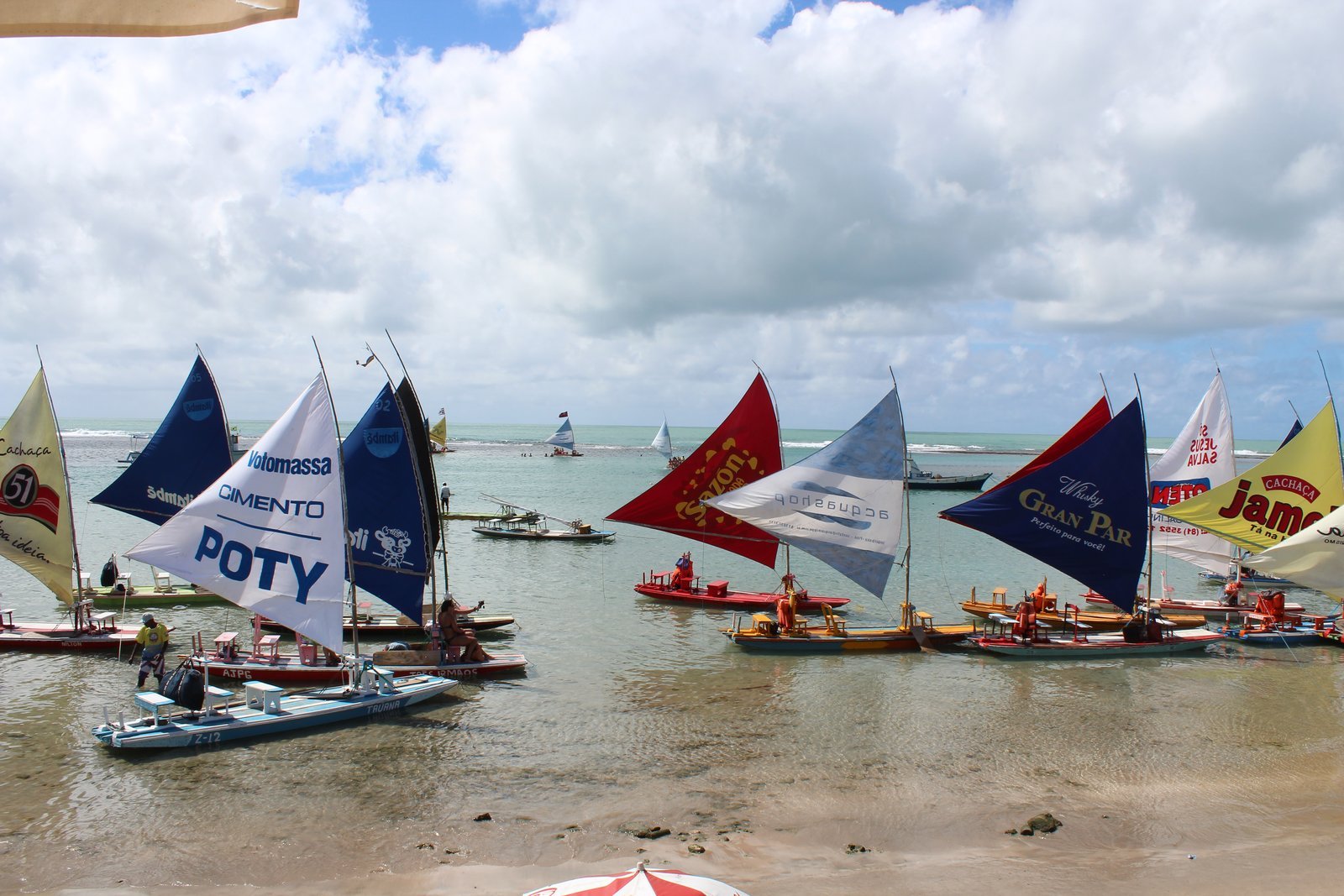
Jangadas are wooden sailboats, the traditional fishing craft of northeastern Brazil, and in Porto de Galinhas they are run by licensed jangadeiros. The Porto de Galinhas Jangadeiros Association sells the ride at the beach and on its own website. In October 2026 the fare was R$60 per person in cash or Pix and R$63 by card for ages 7 and up; R$30 (or R$33 by card) for children aged 4 to 6; and free up to age 3. The ride takes about 1 hour: the jangada stops by the reef, you step down into the area set aside for swimming and floating, and the jangadeiro points out the fish and formations, including the pool shaped like the map of Brazil.
Bring cash or Pix, water-resistant sunscreen (or better, UV-protective clothing), rubber reef shoes so you don’t cut your feet, and a waterproof phone pouch. Masks and snorkels can be rented on the beach. Non-swimmers can enjoy it too, because the water is shallow at the stopping points, but small children should stay in your arms or wear a life jacket. Photographers with underwater cameras offer pictures as you board; the price is negotiated separately.
You can reach some pools on foot, walking across the sand and shallow water at a very low tide, but municipal law caps the number of people on foot on the reef, and inspectors guide visitors. If you want to float in the main pools, the jangada is the simplest option and the one that does least harm to the coral.
Environmental rules and visitor limits
The reefs of Porto de Galinhas suffered from mass tourism, and the response came in the form of law. Municipal Law 1,711 of 2013 set a daily limit on visitors to the natural pools, and Law 1,771 of 2014 adjusted the cap to 1,220 people a day: 1,020 carried by jangadas and 200 on foot. A carrying-capacity study published in 2013 suggested an even lower number, 565 visitors a day, which shows how much pressure the reef is under. In January 2026, a municipal decree reorganised the strip of sand used by the jangadas in the village.
The city asks for simple rules: don’t step on or touch the coral, which is alive; don’t feed the fish, because human food upsets the reef’s balance; don’t take shells, sea urchins or starfish; and take your trash back with you. In October 2026, we found no environmental fee charged to tourists in Porto de Galinhas, unlike Fernando de Noronha or Jericoacoara. In May 2026, Ipojuca’s city council approved rules for coach tours, requiring guides registered with Cadastur (the federal tourism register) and advance booking, which still awaited regulation by the city. If you are on an organised excursion, check that the company is properly registered.
The Coral Biofactory
Next to the pools, on Rua das Piscinas Naturais, the Biofábrica de Corais (Coral Biofactory) is a project that grows coral in nurseries and replants it on the reef, and opens its work to visitors through guided experiences in Portuguese and English. In October 2026 the simplest experience, called Despertar Coralíneo, cost R$247 by Pix (R$279.10 by card), and there were longer packages at R$347, R$1,097 and R$1,997, all including a jangada ride, floating and an explanation of the science. It is pricey by local standards, but it is the most interesting way to understand why Porto’s reefs need care. In 2026, the Corais project backed by Brazil’s development bank BNDES included Porto de Galinhas and Serrambi among the reef-restoration sites in Brazil.
Things to do in Porto de Galinhas: beaches, tours and the village
Direct answer: the must-dos are the jangada ride to the natural pools at low tide, the sunset and seahorses at Pontal de Maracaípe, a day of calm water in Muro Alto, the end-to-end buggy tour and a stroll through the village to spot Gilberto Carcará’s hens. With more time, take the day trip to Praia dos Carneiros and visit the historic centre of Ipojuca.
The village and Gilberto Carcará’s hens
Porto de Galinhas village is small and easy to explore on foot. Start at the beach in front of the village, where the jangadas leave, and follow the promenade. The painted wooden hens are everywhere: outside shops, on top of walls, in the Praça das Esculturas, opened in 2014 with 12 pieces. Gilberto Carcará’s studio is in Merepe II, reached from the PE-009 around kilometre 7; visiting hours change, so call ahead. The village also has a craft fair, swimwear shops and plenty of ice-cream and tapioca stands.
In the evening, Rua Beijupirá and the lanes around it fill with restaurants and bars, many with tables on the pavement. This is not a big-club nightlife scene: the appeal is a good dinner, a drink and a wander through the lit-up alleys. On weekends and in high season, several bars have live music.
Muro Alto: kayaks, SUP and pool-calm sea
Muro Alto is the beach for spending the day afloat. The reef wall keeps the sea as still as a lagoon, and beach stalls rent kayaks, stand-up paddleboards and clear-bottom kayaks. In October 2026, agencies sold a kayak crossing in Muro Alto with an underwater photo package from R$100 per person, and day passes at beach clubs there started at R$30. If you are not staying at a resort, arrive early and pick a stall; remember that since late 2025 the city has banned minimum-spend charges at beach stalls in Ipojuca.
Cupe: surf and long walks
Cupe is for people who like long beaches and fewer crowds. At low tide you can walk along Cupe’s firm sand to the village. Surfers ride Cupe’s waves when there is a swell, and the resorts’ beach areas offer facilities if you don’t want to leave the front of your hotel.
Maracaípe and surfing
Maracaípe is Pernambuco’s surf beach. Schools offer beginner lessons, boards are for rent and the beach bars are relaxed. Even if you don’t surf, it is worth an afternoon to watch the waves and have fried fish for lunch. Many people cycle there from the village, by road or along the beach at low tide.
Pontal de Maracaípe: seahorses and sunset
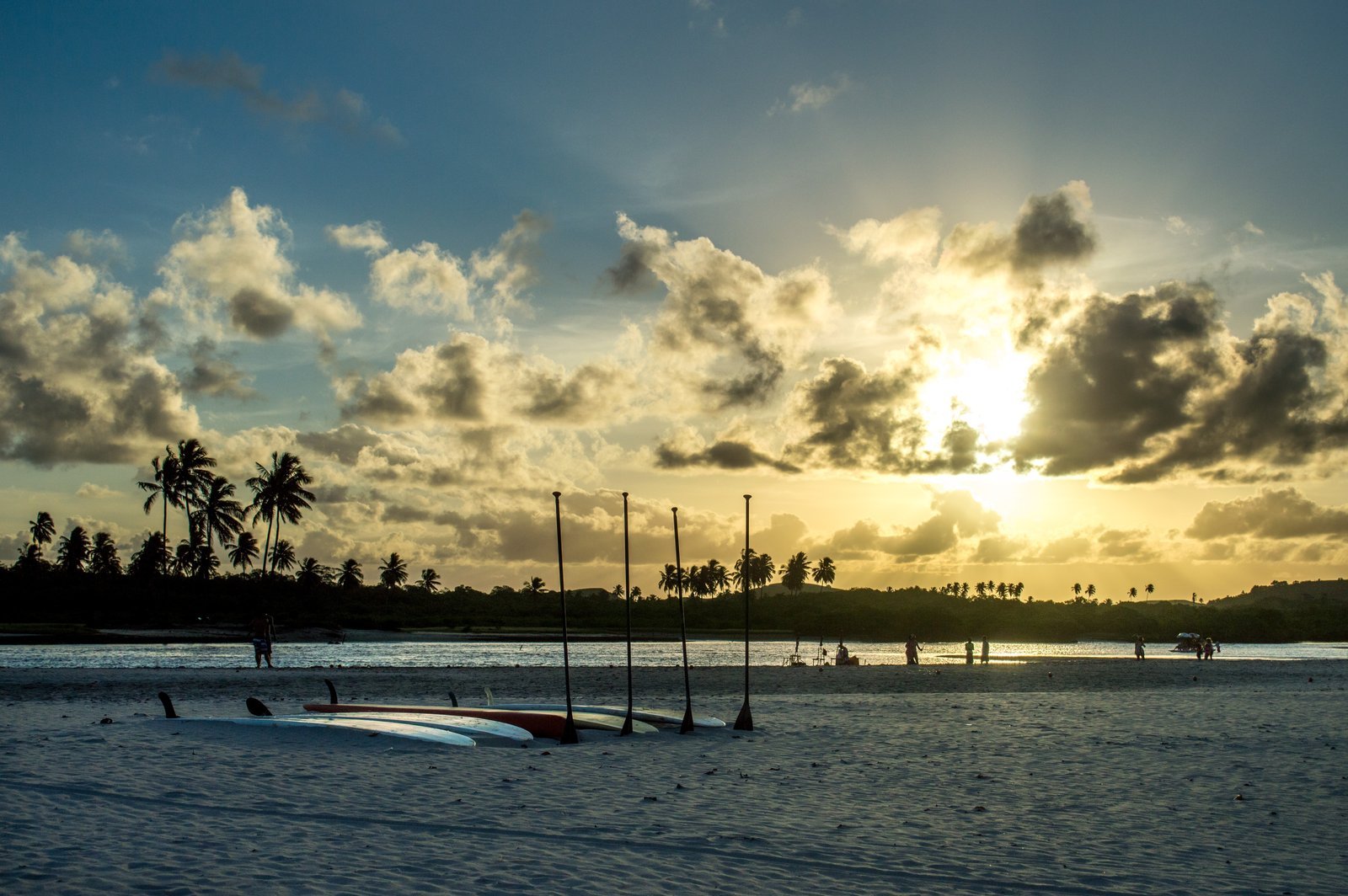
At the Pontal, boatmen pole jangadas through the Maracaípe River estuary to mangrove areas that are home to longsnout seahorses (Hippocampus reidi), a species on Brazil’s threatened list. According to the local guide GoAny, the trip cost R$60 per person in 2025 (up from R$25 in 2018 and R$40 in 2022), takes about 1 hour and works best at high tide, when the jangada can navigate the river. Other guides quote between R$40 and R$60; agree on the price before you board. To combine the seahorses with the sunset, leave around 4 pm.
One important point: on some trips, the boatman scoops a seahorse into a jar to show the tourists. Studies in the estuary have recorded a population decline, and handling stresses the animals. Ask to see the seahorse in the water without taking it out, and choose boatmen who already work that way. Projeto Hippocampus, which studies the species, used to run a visitor space in the village that closed in 2020.
Serrambi and the southern beaches
Serrambi is worth a low-tide morning on the reef side with calm water and an afternoon on the open-sea side. It is a beach for Pernambuco families, with little tourist infrastructure, which makes it a good escape when the village is packed. Bring water and snacks, because there are few beach stalls outside high season.
End-to-end buggy tour
The buggy ride is a Porto de Galinhas classic. Drivers licensed by the local association take up to four passengers per buggy from beach to beach, from Muro Alto to Pontal de Maracaípe, with stops for swimming, photos and lunch. According to the association’s price list published by the local guide Vivo Porto de Galinhas in January 2026, the 4-hour Ponta a Ponta (end to end) tour cost R$450 per buggy, the 6-hour version R$550, the 9-hour Super Diária R$650, the 6-hour trip to Calhetas beach R$700 and the 9-hour end-to-end plus Calhetas R$900, with a 5% to 10% surcharge for card payments. In October 2026, Luck Receptivo sold the same routes from R$470 (4 hours), R$570 (6 hours) and R$680 (full day), plus a Serrambi buggy tour from R$600. Split four ways, it is good value.
Diving, snorkelling and clear kayaks
Beyond the pools, licensed operators offer scuba dives on the area’s reefs and guided snorkelling trips. In 2026, a clear-kayak crossing with drone footage was sold from R$150 per person. Before booking any water activity, check that the company is registered with Cadastur, the Ministry of Tourism’s official register.
Historic centre of Ipojuca
For a change of scene, set aside half a day for the town of Ipojuca, about 13 km from the village. The Igreja Matriz de São Miguel and the Convento de Santo Antônio, founded in 1606, tell the story of Ipojuca’s sugar-mill past. The town is small and has no polished tourist infrastructure, and that is exactly why it shows a side of Pernambuco few Porto visitors see. Combine it with the drive to Serrambi or Carneiros.
Day trips from Porto de Galinhas: Carneiros, Calhetas, Maragogi, Recife and Olinda
Direct answer: the most famous day trip is Praia dos Carneiros in Tamandaré, with the little São Benedito chapel on the sand, about 50 km south; agencies sold the trip from R$160 per person in October 2026. Calhetas beach in Cabo de Santo Agostinho, the island of Santo Aleixo, Maragogi in the state of Alagoas and a day in Recife and Olinda are also worth it.
Praia dos Carneiros and the São Benedito chapel
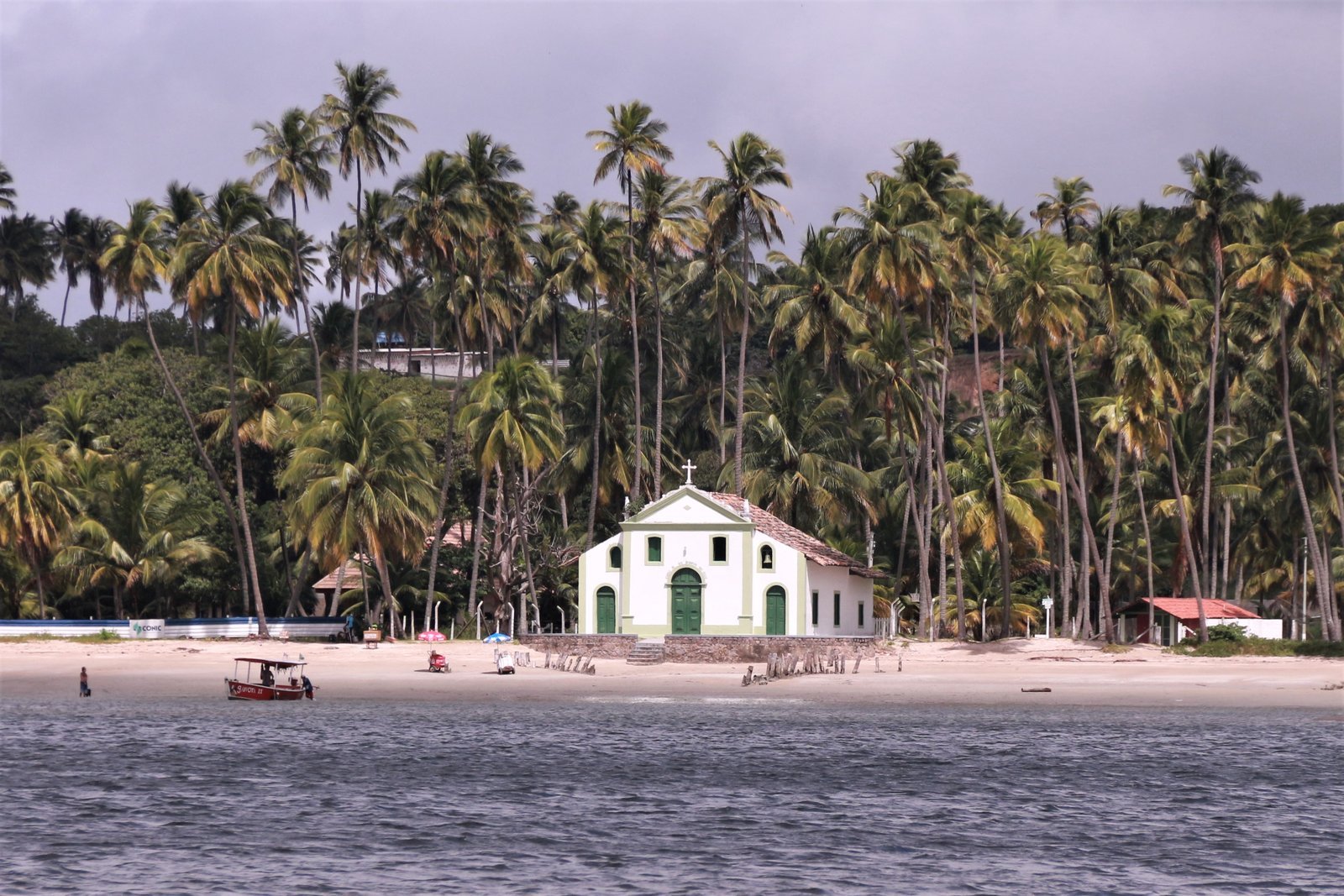
Praia dos Carneiros is in Tamandaré, a municipality that became independent from Rio Formoso in 1995, about 113 km from Recife and 90 km from the airport. From Porto de Galinhas it is about 50 km, roughly 1 hour 15 minutes by car. The beach has extremely calm water sheltered by reefs, coconut palms right down to the sand and the mouth of the Rio Formoso on one side, with sandbanks and natural pools at low tide. The name comes from a former landowner from the Carneiro family.
The postcard image is the Capela de São Benedito, the little white chapel facing the sea, much in demand for weddings and christenings. Pernambuco’s heritage foundation, Fundarpe, opened the listing process in February 2026 and states that the chapel was built in the 18th century; with the official notice, it already enjoys provisional protection. Some travel guides say it dates from the 19th century; we follow the heritage body. The chapel stands on private land, and entry is usually allowed for a donation at the door; dress respectfully, not in swimwear.
Land access to the sand at Carneiros is through private beach clubs and restaurants that charge a day-use fee or minimum spend. Prices vary a lot between venues and seasons; one local guide quoted R$30 per adult at one of them in 2025. By sea, catamarans and speedboats leave from Tamandaré and Rio Formoso and stop at the pools and in front of the chapel. The simplest option from Porto is an agency tour: in October 2026, Luck Receptivo sold Praia dos Carneiros from Porto de Galinhas from R$160 per person. Carneiros is also home to the Acquaventura water park, sold as a transport-plus-ticket combo from R$279.90.
Santo Aleixo Island
Between Porto de Galinhas and Carneiros, off Sirinhaém, Santo Aleixo is a privately owned island of pale sand and forest with a curious history: in 1531 it was occupied by the French, who were eventually driven out by the Portuguese. Speedboat and catamaran trips leave from the mainland beaches; check with the operator which parts of the island can be visited.
Calhetas and Cabo de Santo Agostinho
To the north, in Cabo de Santo Agostinho, Calhetas is a small cove between rocks with blue, clear water and a zipline over the beach. Cabo is also home to the Armando de Holanda Cavalcanti Metropolitan Park and to a local tradition holding that the Spanish navigator Vicente Yáñez Pinzón landed there in January 1500, before Pedro Álvares Cabral reached Brazil. The Cabo de Santo Agostinho tour from Porto cost from R$130 in October 2026, and the buggy route that includes Calhetas R$700 per buggy.
Maragogi and São José da Coroa Grande
Maragogi, across the state line in Alagoas, has the galés, natural pools out at sea about 6 km from the coast, reached by catamaran at low tide. It is a long day with plenty of driving, but worth it if you are not going to Maceió. Agencies sold the trip from Porto de Galinhas from R$160 in October 2026, the same price as the day trip to São José da Coroa Grande, the last beach in Pernambuco before the border. For more on the Alagoas coast, read our Maceió travel guide.
Recife and Olinda
Set aside at least one day for the state capital and its historic neighbour. In Recife, walk around Recife Antigo, visit the Paço do Frevo museum and the Oficina Brennand; in Olinda, climb the hilly streets of the UNESCO World Heritage historic centre up to the Alto da Sé. The Recife and Olinda city tour from Porto cost from R$142 in October 2026. If your trip starts or ends in Recife, see our complete Recife travel guide, with tips on Boa Viagem, Olinda and where to stay.
What to eat in Porto de Galinhas
Direct answer: fish and seafood are the backbone, especially peixe na telha (fish baked on a clay tile), moqueca stew, fried agulhinha, shrimp and the caldinho broth served at beach stalls. For dessert, try cartola, fried banana with coalho cheese, sugar and cinnamon, and bolo de rolo, a thin rolled guava cake that is part of Pernambuco’s intangible heritage. The village has everything from cheap tapioca stands to well-known restaurants.
Food in Porto de Galinhas blends northeastern beach cooking with Recife influences. At beach stalls, order fried agulhinha (a slender little fish eaten whole as a snack), bean or fish caldinho, fried cassava (macaxeira) and grilled coalho cheese. At lunch, dishes for sharing are the thing: whole fried fish, moqueca, garlic shrimp and peixe na telha, baked with vegetables on a clay roof tile.
The Ipojuca city government recommends four places in the village: Beijupirá, for creative cooking with regional ingredients; Barcaxeira, famous for its macaxeira gratin; Peixe na Telha, for seafood and traditional food on the beachfront; and La Tratoria, for pasta and Mediterranean dishes. The same page lists Pernambuco-style fish stew, shrimp and lobster among the regional dishes to try. Prices vary a lot; at tourist restaurants, a fish dish for two can cost as much as several ordinary meals, so check the menu before you sit down. In Brazil the 10% service charge is optional. For more names, see our post on where to eat in Porto de Galinhas.
To spend less, look for tapioca stands, snack bars and pay-by-weight (por quilo) restaurants on the inner streets of the village and in Merepe. Regional fruits such as cajá, pitanga (Surinam cherry), soursop and mangaba turn up in juices and ice cream. Also try bolo de rolo, a paper-thin sponge rolled with guava paste, recognised as Pernambuco’s intangible cultural heritage, and cartola, the state’s signature dessert.
Safety in Porto de Galinhas
Direct answer: Porto de Galinhas is a relaxed destination by Brazilian standards, with extra policing in the village in high season. The main precautions concern the sea and the sun: follow the flags and lifeguards, don’t walk on the coral and wear reef shoes. The high-risk zone for shark incidents in Pernambuco lies between Piedade and Olinda, outside Ipojuca. Since December 2025, beach stalls may not demand a minimum spend.
Sea, coral and sun
The reef beaches shelter you from the open sea but still need care. Coral cuts and can cause infections, so wear rubber reef shoes in the pools and don’t walk on the reef outside the permitted areas. In Cupe and Maracaípe, waves and currents can be strong; respect the red flags and swim near the lifeguard posts. The sun on the Pernambuco coast is very strong all year, even under cloud: sunscreen, a hat and water are essential, especially between 10 am and 3 pm.
Sharks: where the risk zone is
Pernambuco has a well-known record of shark incidents, with 83 cases since 1992, according to the state Shark Incident Monitoring Committee (CEMIT). The high-risk area is a 33 km strip between Reserva do Paiva, in Cabo de Santo Agostinho, and Praia do Farol, in Olinda, which includes Piedade and Boa Viagem. Porto de Galinhas and the beaches of Ipojuca are outside that strip, and the natural pools are sheltered by the reef. Even so, follow local signs and advice.
Beach stalls, minimum spend and prices
After an assault on tourists at a beach stall in Porto de Galinhas in late December 2025, the Ipojuca city government issued Decree 149/2025, which bars stall owners from demanding a minimum spend, charging a fee for not consuming or forcing bundled purchases; breaking the rule can lead to suspension or loss of the permit. Before sitting at a stall, ask the price of renting chairs and an umbrella, ask for a menu with prices and check the bill. If you have a problem, contact the city’s inspectors or the Tourism Department on (81) 3552-1439.
Staying safe in the village and on the road
As in any busy destination, keep an eye on your phone and wallet in crowds, especially at Carnival and New Year’s Eve. Use licensed taxis and transfers, and avoid flashing valuables on the beach. At night the village is busy and well lit; avoid isolated stretches of beach and dirt roads after dark. When driving, take care on the PE-009 and PE-060 at night, where there are pedestrians and motorbikes on some stretches.
How much does a trip to Porto de Galinhas cost in 2026?
Direct answer: Porto de Galinhas’ essential tours are cheap for such a famous place: the jangada to the pools costs R$60 per person, the seahorse trip around R$60 and the end-to-end buggy R$450 per buggy for up to four people. The big expense is lodging, which runs from budget pousadas in the village to upscale all-inclusive resorts in Muro Alto.
The table brings together prices we checked on official websites, with local associations and with tour operators in October 2026. Prices can change without notice, especially in high season.
| Item | 2026 price | Notes |
|---|---|---|
| Bus 191 Recife–Porto de Galinhas | R$14.80 | Grande Recife consortium, no air conditioning |
| Bus 195 Recife–Porto de Galinhas (Opcional) | R$22.50 | Grande Recife consortium, air conditioned |
| Shared airport transfer to Porto | from R$136 per person | Luck Receptivo, one way |
| Private sedan or SUV transfer | from R$405 per car | Luck Receptivo, one way |
| Rota do Atlântico toll | R$11.60 (car) | Valid since 4 January 2026 |
| Jangada to the natural pools | R$60 (R$63 by card) | Jangadeiros Association; R$30 ages 4–6, free up to 3 |
| Seahorse jangada (Pontal) | R$60 per adult | Local guides, 2025–2026; about R$30 for young children; agree beforehand |
| Parking at Pontal de Maracaípe | R$10 to R$20 | 2025 and early 2026 prices |
| End-to-end buggy (4 h) | R$450 to R$470 per buggy | Up to 4 people; association and agency |
| Buggy 6 h / full day | R$550 to R$680 per buggy | Up to 4 people |
| Coral Biofactory | from R$247 | By Pix; R$279.10 by card |
| Day trip to Carneiros or Maragogi | from R$160 per person | Luck Receptivo; local fees extra |
| Recife and Olinda city tour | from R$142 per person | Luck Receptivo |
| Beach club day pass (Muro Alto or Cupe) | from R$30 | Varies by venue |
| Daily budget, shoestring | R$200 to R$400 | Per person, excluding lodging and paid tours (our estimate) |
Ways to save: travel between March and June or in August, outside public holidays; stay at a pousada in the village so you don’t depend on taxis; book the buggy with four people; eat on the inner streets, away from the beachfront; and pay for the jangada in cash or Pix to avoid the card surcharge. Agency packages bundling transfers and tours, sold from about R$362, can work out cheaper than buying everything separately.
Porto de Galinhas itineraries: 2, 3, 4 and 5 days
Direct answer: with 2 days, take the jangada to the natural pools and watch the sunset at Pontal de Maracaípe. With 3, add Muro Alto. With 4, include the end-to-end buggy or a day in Carneiros. With 5, save a day for Recife and Olinda or Maragogi. Always build your plan around the tide table: the pools go on the day and at the hour of the lowest tide.
Porto de Galinhas in 2 days
- Day 1: at low tide, take the jangada ride to the natural pools. Then stroll around the village, hunt for Carcará’s hens and have lunch. Spend the afternoon on the beach or at the hotel pool, and have dinner on Rua Beijupirá.
- Day 2: in the morning, head to Maracaípe to watch the surfers. In the late afternoon, take the seahorse jangada at the Pontal and stay for the sunset.
Porto de Galinhas in 3 days
- Days 1 and 2: as in the 2-day itinerary.
- Day 3: spend the day in Muro Alto, kayaking or paddleboarding on the calm sea. If you are staying in the village, rent a chair at a beach stall or buy a day pass.
Porto de Galinhas in 4 days
- Days 1 to 3: as in the 3-day itinerary.
- Day 4: take the day trip to Praia dos Carneiros and the São Benedito chapel. If you would rather stay close, swap it for the end-to-end buggy tour through Muro Alto, Cupe, the village, Maracaípe and the Pontal, or add Calhetas.
Porto de Galinhas in 5 days
- Days 1 to 4: as in the 4-day itinerary.
- Day 5: a day in Recife and Olinda, for Recife Antigo and Olinda’s hills; or Maragogi, if the tide suits the galés. With more time, extend the trip to Maceió, Natal or Salvador; see our guides to Natal, Fortaleza and Salvador.
Where to stay in Porto de Galinhas
Direct answer: on a first trip, stay in or near the village so you can walk to the pools, restaurants and nightlife. Muro Alto and Cupe are for resorts, calm water and kids’ facilities, while Maracaípe and the Pontal suit smaller pousadas, surfing and sunsets. Every link below goes to the hotel’s official website and was checked on 26 October 2026; we do not use agency or booking-site links.
Porto de Galinhas has it all: all-inclusive resorts in Muro Alto and Cupe, beach hotels in Merepe, boutique pousadas in the village and chalets in Maracaípe. Rates climb steeply in December, January, Carnival and July, and over New Year’s many hotels only sell multi-night packages. Check prices directly on the official site and book early.
Nannai Muro Alto (luxury, Muro Alto)
Nannai Muro Alto is a luxury beachfront resort in Muro Alto, known for bungalows with private pools and a huge pool that winds through the gardens. It is the classic choice for honeymoons and high-budget couples’ trips, facing the calm sea behind the reef wall.
Summerville All Inclusive Resort (resort, Muro Alto)
Summerville All Inclusive Resort is on Muro Alto beach and runs on an all-inclusive basis, with a focus on families. It has pools, a recreation programme and direct access to the calm sea, good for small children.
Enotel Porto de Galinhas (all-inclusive, beachfront)
Enotel Porto de Galinhas is an all-inclusive beachfront resort with a children’s water park and leisure facilities designed for families. A good fit if you plan to spend most of your time at the resort, with meals and drinks included.
Vivá Porto de Galinhas Resort (resort, Cupe)
Vivá Porto de Galinhas Resort is on Avenida Maldivas, on Cupe beach, between Muro Alto and the village. It is a beachfront resort with pools and activities for the whole family, on a beach far less crowded than the village.
Pousada Tabapitanga (boutique, Cupe)
Pousada Tabapitanga is on Cupe beach and has beachfront chalets set among gardens and palm trees. It is a boutique pousada for couples who want a more intimate atmosphere than the big resorts, with the beach on the doorstep.
Hotel Village Porto de Galinhas (beach hotel, 4-star)
Hotel Village Porto de Galinhas is a four-star hotel with an aquatic complex of about 1,000 m² and bungalows, a full-leisure option for families without a mandatory all-inclusive plan.
Armação Resort (resort, Merepe)
Armação Resort sits on the beachfront in Merepe, north of the village, and is family-oriented, with pools and leisure facilities. Its location puts the village a few minutes away by car or taxi.
Hotel Solar Porto de Galinhas (beach hotel, Merepe)
Hotel Solar Porto de Galinhas is on Avenida Pau Brasil in Merepe, facing the sea. It is a long-standing beach hotel in the area, for travellers who want hotel facilities and easy access to the village.
Pousada Privê Pontal de Maracaípe (pousada, Pontal)
Pousada Privê Pontal de Maracaípe is on the Rota dos Cavalos Marinhos in Maracaípe, close to where the river meets the sea. It makes a good base for surfing, the seahorse trip and the Pontal sunset without having to drive.
Pousada Vila do Porto (budget, village)
Pousada Vila do Porto is at Rua Cavalo Marinho 1, in the heart of the village, with compact, modern rooms. It is the most affordable option on this list and the most convenient for walking to the jangadas, restaurants and nightlife.
Video: Porto de Galinhas by Visit Brasil
A one-minute film about Porto de Galinhas from Visit Brasil, the official tourism promotion channel of the Brazilian government, made for English-speaking travellers.
Frequently asked questions about Porto de Galinhas
When is the best time to visit Porto de Galinhas?
September to February, the driest and sunniest period, especially October, November and December, which get less than 65 mm of rain a month according to INMET normals. April to July is wetter, but the natural pools appear all year at low tide. More important than the month is picking days with a daytime low tide of 0.5 m or less.
How many days do you need in Porto de Galinhas?
Three days are enough for the natural pools, Muro Alto and the sunset at Pontal de Maracaípe. With four or five days, you can add the day trip to Praia dos Carneiros, the end-to-end buggy tour and a day in Recife and Olinda.
How do I get from Recife Airport to Porto de Galinhas?
It is about 60 km, around 1 hour by car on the PE-009. In October 2026, shared transfers cost from R$136 per person and private ones from R$405 per car. You can also take a taxi, a ride-hailing app, a rental car or buses 191 (R$14.80) and 195 Opcional (R$22.50), which leave from central Recife.
How much is the jangada ride to the natural pools?
In October 2026, the Jangadeiros Association charged R$60 per person in cash or Pix and R$63 by card for ages 7 and up; children aged 4 to 6 paid R$30 and under-4s rode free. The trip lasts about 1 hour and only runs at low tide.
What tide is best for the natural pools in Porto de Galinhas?
The jangada crews’ rule of thumb is a low tide of 0.5 m or less on the Brazilian Navy’s tide table for the Port of Suape. The best tides fall around the full moon and new moon. Get to the jangada point 1 to 2 hours before low tide.
Is there a tourist tax in Porto de Galinhas?
In October 2026, we found no environmental or entry fee charged to tourists. There is a limit of 1,220 visitors a day at the natural pools, set by Municipal Law 1,771/2014, and rules for coach tours approved in 2026 that still awaited regulation. Check before you travel, as rules change.
Where can you see seahorses in Porto de Galinhas?
At Pontal de Maracaípe, about 6 km from the village, where pole-pushed jangadas travel up the Maracaípe River estuary. The trip cost about R$60 per adult in 2025 and 2026, takes about 1 hour and is best at high tide. Ask to see the seahorse without it being taken out of the water.
Is the day trip from Porto de Galinhas to Praia dos Carneiros worth it?
Yes, if you have at least four days. Carneiros is about 50 km south, around 1 hour 15 minutes by car, and has very calm water, palm groves and the 18th-century São Benedito chapel. In October 2026, agency tours started at R$160 per person; land access to the beach is through beach clubs that charge a day-use fee or minimum spend.
Is Porto de Galinhas good for kids?
Yes. Muro Alto’s sea is as calm as a pool, the natural pools are shallow where the jangadas stop, and several resorts have kids’ clubs and water parks. Use reef shoes, sunscreen and a life jacket for little ones, and avoid Cupe and Maracaípe when the sea is rough.
Are there sharks in Porto de Galinhas?
Pernambuco’s high-risk area for shark incidents is the 33 km strip between Reserva do Paiva, in Cabo de Santo Agostinho, and Praia do Farol, in Olinda, according to the state monitoring committee CEMIT. Porto de Galinhas is outside that strip, and the natural pools are sheltered by the reef. Always follow the signs and lifeguards.
Is Porto de Galinhas worth it?
Yes, as long as you plan around the tide. Few places in Brazil pack so much into such a short stretch of coast: warm natural pools a few metres from the sand, a pool-calm beach for kids, surf breaks, seahorses in a mangrove and one of the loveliest sunsets in the Northeast, all an hour from an international airport. The village is packed in high season and beachfront prices can sting, but outside December and January Porto de Galinhas shows what made it famous: colourful jangadas waiting for the tide, clear water over the reef and wooden hens on every corner, a reminder of a history worth knowing. If you can, combine it with Recife, Olinda and Carneiros and you will have seen the best of the Pernambuco coast.
Sources
- IBGE Cidades: Ipojuca (PE) overview (2022 census population, area, anniversary)
- INMET: Brazil climate normals 1991-2020 (rainfall, highs and lows, Recife-Curado station)
- Ipojuca city government: Porto de Galinhas, Muro Alto beach, Maracaípe beach and São Miguel church
- Wikipedia (Portuguese): Porto de Galinhas, Ipojuca and Praia dos Carneiros (history, beaches and distances)
- Brazilian Navy Hydrographic Centre: tide tables (Port of Suape)
- Porto de Galinhas Jangadeiros Association: jangada ride to the natural pools (October 2026 prices)
- Guaju journal (UFPR): tourism practices on the reefs of Porto de Galinhas (laws 1,711/2013 and 1,771/2014 and carrying capacity)
- Biofábrica de Corais: experiences and prices; Movimento Econômico: BNDES funds coral restoration in the Northeast
- GoAny: Pontal de Maracaípe and seahorse jangada trip
- Vivo Porto de Galinhas: buggy tour and Carneiros chapel; Porto de Galinhas CVB: buggy
- Luck Receptivo: tours and transfers in Porto de Galinhas (prices as of 26 October 2026)
- Grande Recife transport consortium: fares; Rota do Atlântico: toll rates
- Fala Caruaru: Fundarpe opens heritage listing of the Carneiros chapel
- G1: Ipojuca bans minimum spend; Pernambuco municipal gazette: Decree 149/2025
- Notícias Porto de Galinhas: council approves rules for coach tours
- O Globo: Pernambuco has recorded 83 shark incidents since 1992; Semas-PE: CEMIT
- Brasilturis: 96% occupancy over New Year’s and Porto de Galinhas steps up promotion as supply grows