Fernando de Noronha is a volcanic archipelago of 21 islands, islets and rocks in the middle of the Atlantic, about 545 km (340 miles) off Recife and 350 km (220 miles) from the coast of Rio Grande do Norte. The main island covers roughly 17 km² (6.5 square miles), has a single 7 km (4.3-mile) road, the BR-363, and 3,167 residents according to Brazil’s 2022 census. About 70% of the archipelago has been a National Marine Park since 1988, and together with Atol das Rocas it has been a UNESCO World Heritage Site since 2001.
For trip planning, that means two things. First, it really is as beautiful as people say: clear water at around 26 °C (79 °F), spinner dolphins showing up almost every morning, sea turtles gliding past snorkelers and beaches such as Sancho, Baía dos Porcos and Leão that have few rivals anywhere in Brazil. Second, Noronha runs on rules, fees and bookings that no other Brazilian beach destination has. If you arrive without knowing how the environmental tax, the park ticket, the Sancho ladder schedule or the Atalaia tide window work, you will miss things and spend more. This guide explains all of it with 2026 prices, walks through the beaches and trails one by one, suggests a 3 to 5-day itinerary and lists real pousadas (guesthouses) with links to their official websites.
Quick facts: Fernando de Noronha
- Best time to go: August to February is the drier stretch, with a calm “inner sea” from August to November and the best visibility for diving. March to July is the rainy season (April is the wettest month), and the swell arrives between December and May, which is great for surfing and bad for some inner-sea beaches.
- How many days: 4 or 5 days is ideal to fit in an Island Tour, a boat trip, Sancho, Baía dos Porcos, Atalaia and at least one booked trail. Three days works, but it is rushed.
- Getting there: by plane only. Direct flights leave from Recife (about 1h15 to 1h20) and São Paulo-Guarulhos (about 3h40 to 4h), operated by Azul, Gol and Latam. In 2026 there is no direct flight from Natal.
- Mandatory fees: the Environmental Preservation Tax (TPA) costs R$105.79 per day in 2026, on a sliding scale (R$423.17 for 4 days, R$520.50 for 5), plus the National Marine Park ticket: R$384 for foreign visitors (R$192 for Brazilians) until 31 October 2026 and R$393 (R$196.50 for Brazilians) from 1 November, valid for 10 days.
- Daily costs: a rental buggy runs R$450 to R$480 a day outside New Year, the bus about R$5, a boat trip R$300 to R$390 and the Island Tour R$250 to R$370 per person.
- Where to stay: Vila dos Remédios to walk everywhere and be near restaurants; Floresta Velha, Floresta Nova and Vila do Trinta for mid-range pousadas; Boldró and Sueste for boutique stays and more quiet.
A short history: from forgotten fief to national park
Short answer: Portuguese navigators sighted the archipelago in the early 1500s, and in 1504 it was granted to Fernão de Loronha as Brazil’s first hereditary captaincy. It was later occupied by the Dutch and the French, became a prison, a World War II military base and a federal territory, and in 1988 it returned to the state of Pernambuco and became a National Marine Park.
Historians still debate the exact date and who first saw the islands. What is certain is that in January 1504 King Manuel I of Portugal gave what was then called São João island to Fernão de Loronha, a merchant who financed the brazilwood trade. It was Brazil’s first hereditary captaincy, and the grantee’s name stuck. Amerigo Vespucci, who sailed past with Gonçalo Coelho’s expedition in 1503, left one of the earliest descriptions of the place.
Loronha never actually settled the island, and it was left to whoever sailed by. The Dutch held it for about 25 years in the 17th century and built a stronghold where the walls of the Nossa Senhora dos Remédios fortress stand today. In 1736 the French East India Company moved in and renamed it Isle Dauphine; the following year an expedition from Recife drove them out. Portugal then decided to fortify Noronha: work on the Remédios fort began in 1737, the village of Vila dos Remédios was laid out and the island became a penal colony.
For almost two centuries, Noronha meant prison. It held common convicts, soldiers and, at several points, political prisoners, including under the Estado Novo dictatorship, when the federal government took it over as a political prison in 1938. In 1832 HMS Beagle stopped at the island and Charles Darwin went ashore to take notes on its geology and plants. In 1942, during World War II, the archipelago became a Federal Territory run by the military and gained an airport built to support the air route between Brazil and Africa.
Tourism took off in 1988. Brazil’s new constitution returned Noronha to Pernambuco as a state district, and Decree 96,693 of 14 September 1988 created the Fernando de Noronha National Marine Park, now managed by the federal agency ICMBio. In 2001 UNESCO listed the Brazilian Atlantic Islands (Fernando de Noronha and Atol das Rocas) as a natural World Heritage Site, and in 2017 Brazil’s heritage institute, Iphan, protected the archipelago’s historic ensemble, including the forts and the old houses of Vila dos Remédios.
When to visit Fernando de Noronha: rain, swell, turtles and dolphins
Short answer: the drier period runs from August to February, with the best diving visibility from September to November. Rain falls mostly from March to July. The swell, which brings waves to the inner sea, runs from December to May. Turtles nest on Praia do Leão from December to May, and spinner dolphins are around all year, mostly in the early morning.
Noronha is warm all year. The annual average is close to 27 °C (81 °F), with little difference between months, and the sea sits at around 26 to 28 °C (79 to 82 °F). So picking dates is less about heat and more about rain, waves and price.
- August to November: dry season, calm water on the inner-sea beaches (Sancho, Porcos, Cacimba do Padre, Conceição) and the best visibility for diving, which can exceed 30 m (100 ft). This is the favourite window for divers and snorkelers.
- December to February: still fairly dry, but peak season, with New Year and Carnival. Prices climb sharply and the swell starts to arrive. Surfers come in and Cacimba do Padre gets big waves.
- March to July: rainy season, with April the wettest month. Rain comes in showers rather than all day, but trails get muddy and some flights are delayed or cancelled by bad weather. On the plus side, the island is usually quieter and pousadas run discounts.
The swell deserves special attention. ICMBio warns that from January to May the sea tends to get stronger swells and asks visitors to take extra care before going in; in practice, wave season starts in December in some years. For surfers it is the best time. For anyone who wants to float in Baía dos Porcos or climb down the Sancho ladder in flat water, not so much. In those months the outer-sea beaches such as Sueste and Leão, and the Atalaia tide pools, become alternatives, always depending on the day’s conditions.
Turtles follow their own calendar. Praia do Leão is the archipelago’s main nesting beach and the season runs from December to May, which is why access is controlled and the beach closes in the late afternoon. Green and hawksbill turtles also feed around the island all year, and you will often see them at Sueste, Atalaia, the port and Sancho.
Spinner dolphins (Stenella longirostris) are the most reliable sight. They enter Baía dos Golfinhos to rest and are often seen from the viewpoint early in the morning. They also follow the tour boats very often, though it is never guaranteed.
How to get to Fernando de Noronha
Short answer: only by plane. Azul, Gol and Latam fly to Fernando de Noronha Airport, with direct routes from Recife (about 1h15 to 1h20) and São Paulo-Guarulhos (about 3h40 to 4h). There has been no direct flight from Natal since March 2025; travellers coming from Rio Grande do Norte connect in Recife.
Recife is the main gateway. Azul flies daily and Gol runs the route on several days a week. From São Paulo, Latam and Gol fly direct from Guarulhos, a good option for international travellers who land there and want to avoid a second connection.
The Natal–Noronha route, long an alternative, was dropped by Azul in March 2025, and according to a G1 report from April 2026 no airline has resumed it. The island’s management committee wants it back, but there was no confirmation at the time of this update. Be wary of packages advertising a direct flight from Natal without a flight number.
A few practical tips for the flights:
- Book early. Flight capacity is limited and is part of the visitor cap; on holidays and over New Year seats sell out fast.
- Leave a buffer before any important onward flight. Heavy rain cancelled flights in Noronha several times in 2026, especially in April.
- If you scuba dive, respect the no-fly interval: operators recommend at least 12 hours after a single dive and 18 hours after several days of diving.
- Pack for a buggy. Buggies have no trunk, and large suitcases make getting to your pousada awkward.
TPA and park ticket: what it costs to enter Noronha in 2026
Short answer: every visitor pays two separate charges. The Environmental Preservation Tax (TPA), charged by the state of Pernambuco, costs R$105.79 per day in 2026, on a sliding scale for longer stays. The National Marine Park ticket, charged by ICMBio, costs R$384 (R$192 for Brazilians) until 31 October 2026 and R$393 (R$196.50 for Brazilians) from 1 November, valid for 10 days.
These are two different things and people often mix them up. The TPA is collected by the island administration under state law 10,403 of 1989 and applies to every tourist for the length of their stay. The park ticket is collected by ICMBio and gives access to the beaches, viewpoints and trails inside the National Marine Park. Without the ticket you can still visit the beaches in the Environmental Protection Area (APA), but you lose Sancho, Baía dos Porcos, Leão, Sueste and the booked trails, which is a big part of the trip.
Environmental Preservation Tax (TPA) in 2026
In 2026 the TPA rose 4.4%, from R$101.33 to R$105.79 per day, in line with inflation (IPCA). The amount is not linear: after the fourth day the daily increase drops, but beyond two weeks it climbs steeply again. This is the official 2026 table from the Fernando de Noronha administration:
| Days on the island | TPA in 2026 | Note |
|---|---|---|
| 1 day | R$105.79 | Base daily rate |
| 2 days | R$211.59 | |
| 3 days | R$317.38 | |
| 4 days | R$423.17 | |
| 5 days | R$520.50 | Daily increase drops from here |
| 6 days | R$596.68 | |
| 7 days | R$672.85 | |
| 10 days | R$901.36 | |
| 15 days | R$1,747.71 | |
| 30 days | R$7,460.56 |
You can pay the TPA before the trip on the official website, tpa.noronha.pe.gov.br, by card or boleto (a Brazilian bank slip). Foreign cards are accepted only at the airport counter, which takes cash, Pix and cards. Keep the receipt, because it is checked on arrival. If you stay longer than you paid for without authorisation, each extra day costs double under state law, so if you extend your stay, sort it out first at the administration office.
National Marine Park ticket (PARNAMAR)
The park ticket is valid for 10 days and costs R$384 until 31 October 2026, with a 50% discount for Brazilians (R$192). ICMBio Ordinance 4,932 of 15 October 2026, published in the Official Gazette on 19 October, raises it to R$393 from 1 November 2026, keeping the 50% discount for Brazilians, which works out at R$196.50. Exempt: children up to 12, Brazilians over 60, island residents and their first-degree relatives, authorised workers and researchers with a SISBio permit.
You can buy it online on the park’s official website, parnanoronha.com.br, which issues a QR code to show at checkpoints, or at the ICMBio Visitor Center in Boldró, from 8 am to 7 pm. Buying online before the trip is easier, because it also unlocks trail bookings on the same site.
The ticket is required at Sueste, the São Joaquim do Sueste fort, the Ponta das Caracas viewpoint, Leão, Caieira, the Baía dos Golfinhos viewpoint, Sancho, Baía dos Porcos and on the Capim-Açu, Abreu, Atalaia, Pontinha-Caieira and Morro São José trails, as well as for scuba dive sites. APA beaches are free to visit: Cacimba do Padre, Bode, Americano, Boldró, Conceição, Meio, Cachorro and Porto de Santo Antônio.
Visitor cap
Noronha has a visitor cap. A shared-management agreement approved by Brazil’s Supreme Court sets the limit at 11,000 tourists a month and 132,000 a year. In 2025 the island received 139,901 visitors and exceeded the monthly cap in 8 of 12 months. In the first half of 2026 it received 64,970, with January (13,870) and February (11,781) above the limit and the following months below it. The cap is enforced through park access and the number of airline seats, and in August 2026 the administration asked Brazil’s civil aviation agency, Anac, for a meeting on flight allocation. For travellers the takeaway is simple: in high season, book flights and accommodation well ahead.
Getting around the island: buggy, bus, taxi and Island Tour
Short answer: the BR-363 links Porto de Santo Antônio to Sueste in 7 km (4.3 miles), and almost everything is a few minutes’ drive away. A rental buggy gives the most freedom (about R$450 to R$480 a day outside New Year, fuel extra). The Porto–Sueste bus runs about every 30 minutes for around R$5. Taxis and the guided Island Tour complete the options.
The island is small, but walking distances are deceptive. Between beaches there are hills, dirt roads and strong sun, and walking from Vila dos Remédios to Sancho, for example, is not a sensible plan. Your options:
- Rental buggy: the island’s signature vehicle, a converted VW Beetle with no power steering or air conditioning, seating up to four. In 2026 the average daily rate is R$450 to R$480, higher in January, on holidays and at Carnival, and close to R$700 over New Year. Fuel is extra and cost about R$10.26 a litre in early 2026; a normal day uses 8 to 10 litres. There is no insurance for rental vehicles on the island, so the renter is liable for any damage.
- Bus: a single line runs Porto–Sueste along the BR-363 roughly every 30 minutes, for about R$5 a ride. Ask your pousada when the last bus leaves. It stops near the access points to several beaches but does not use the dirt roads to Sancho and Leão, so you will walk a bit from the highway.
- Taxi: there are taxis on the island, handy for the airport transfer, getting back from restaurants at night and for anyone who does not want to drive. Agree on the fare before you get in.
- Island Tour: the classic full-day land tour in a 4×4 with a guide. It covers viewpoints, beaches with swim stops and historic sites, and ends with the sunset at the Boldró fort. Shared tours cost R$250 to R$370 per person; private ones start at around R$1,400 per group. It is a great way to get your bearings on day one.
A combination that works well if you do not want to pay for a buggy every day: Island Tour on day one, bus and walking on the following days, and one or two buggy days for the farther beaches. Groups of four usually find the buggy worth it, since they split the rate and the fuel.
The best beaches in Fernando de Noronha
Short answer: the beaches split between the inner sea (Mar de Dentro), facing mainland Brazil, with Sancho, Baía dos Porcos, Cacimba do Padre, Boldró and Conceição, and the outer sea (Mar de Fora), facing Africa, with Sueste, Leão and Atalaia. Some require the park ticket, set hours or a booking; APA beaches are free.
Knowing this split helps you plan each day. The inner sea is usually flat from August to November and gets the swell between December and May. The outer sea is more exposed to the trade winds and has waves much of the year, but it has sheltered bays and natural pools. Before picking a beach, check the tide table and the ICMBio notices, because rules change often.
Baía do Sancho
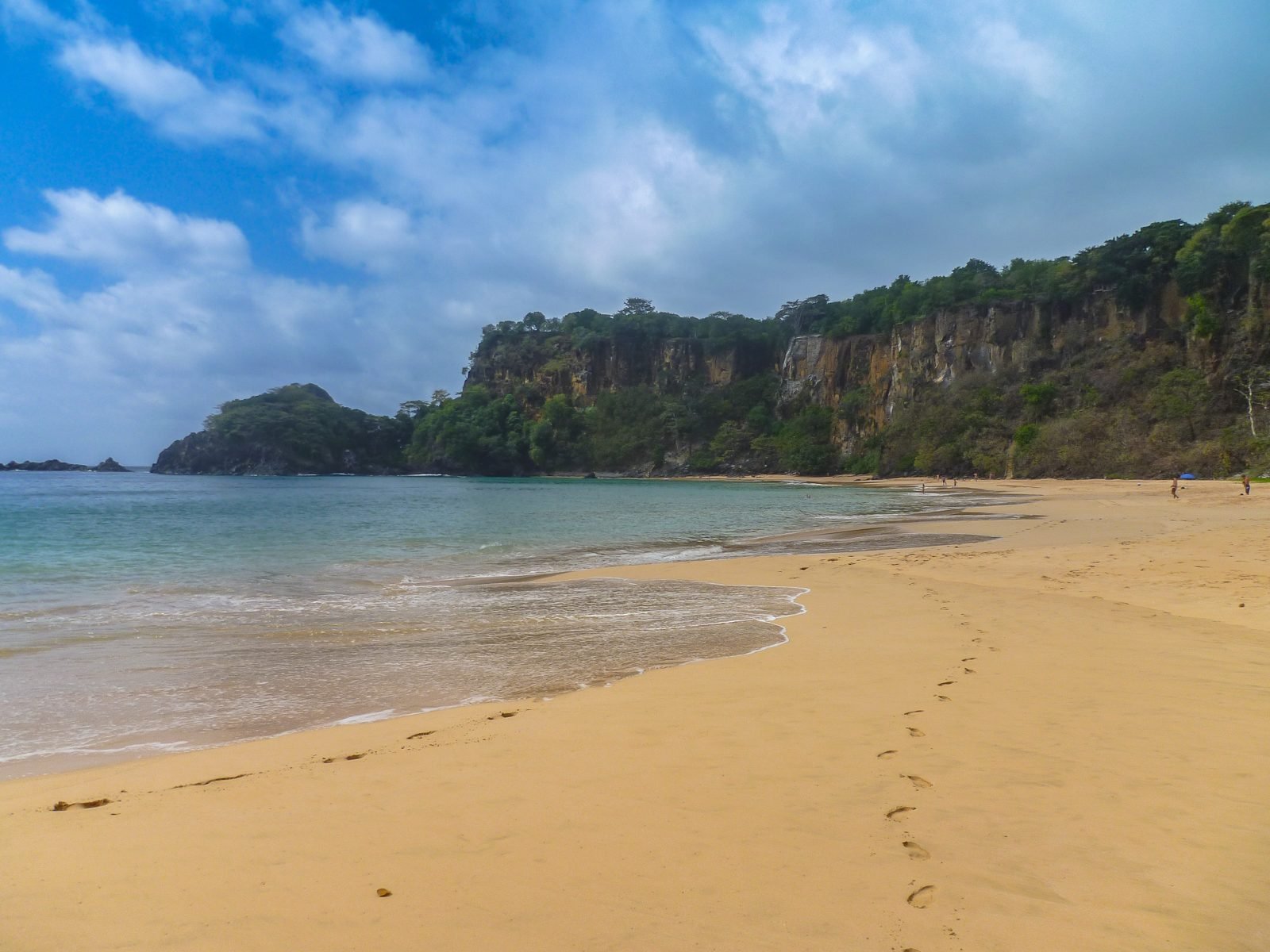
Sancho is Noronha’s most famous beach and has been voted the world’s best beach more than once in Tripadvisor’s Travelers’ Choice ranking. It is inside the park, open from 8 am to 6 pm, and land access starts at the Golfinho-Sancho checkpoint (PIC). An accessible elevated boardwalk leads to the viewpoints, which take in the whole bay and the Morro Dois Irmãos. To reach the sand you climb down a steel ladder set in a crack in the cliff, with alternating down and up slots:
- 8:00 to 8:50: open both ways
- 9:00 to 10:20: down; 10:30 to 11:20: up
- 11:30 to 12:20: down; 12:30 to 13:20: up
- 13:30 to 14:20: down; 14:30 to 15:20: up
- 15:30 to 16:20: down; 16:30 to 17:20: open both ways
- 17:30 to 18:00: up
Down on the beach, the water is clear and full of fish, with frequent turtles. Snorkelling is best at the right-hand end, near the rocks. Tour boats also stop in the bay, with no more than four boats at a time. Access to the Sancho waterfalls is closed by ICMBio because of landslide and rockfall risk.
Baía dos Porcos
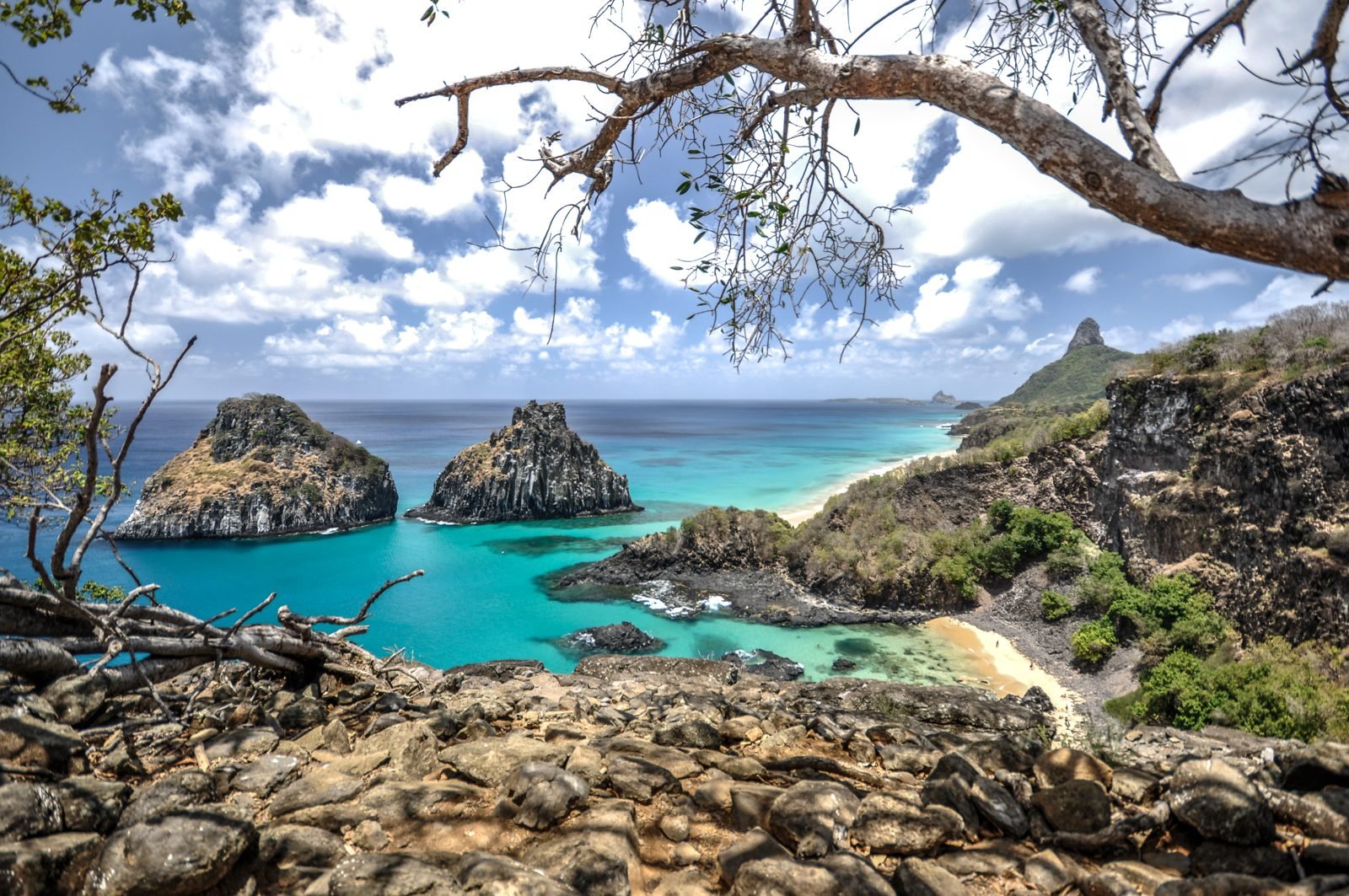
This is the beach in the classic photo with Morro Dois Irmãos behind it. You reach it by a short scramble over rocks from the left end of Cacimba do Padre, and it only works well at low tide. In calm conditions it is one of the island’s best snorkelling spots. Note the current ICMBio notice: the left side of the beach, including the natural pool on the rock shelf, has been closed on the advice of Brazil’s Geological Survey because of rockfall risk from the cliff. Swimming is still allowed in the rest of the bay, and land access now runs continuously within the tide window.
Cacimba do Padre
A long, open beach with free access and views of Morro Dois Irmãos. In the swell, from December to March, it gets the island’s biggest waves and becomes the main surf spot, with powerful waves that call for experience. The rest of the year the sea is calm and it is a lovely beach for walking and watching the sunset. It has a kiosk and sits next to Baía dos Porcos.
Praia do Leão
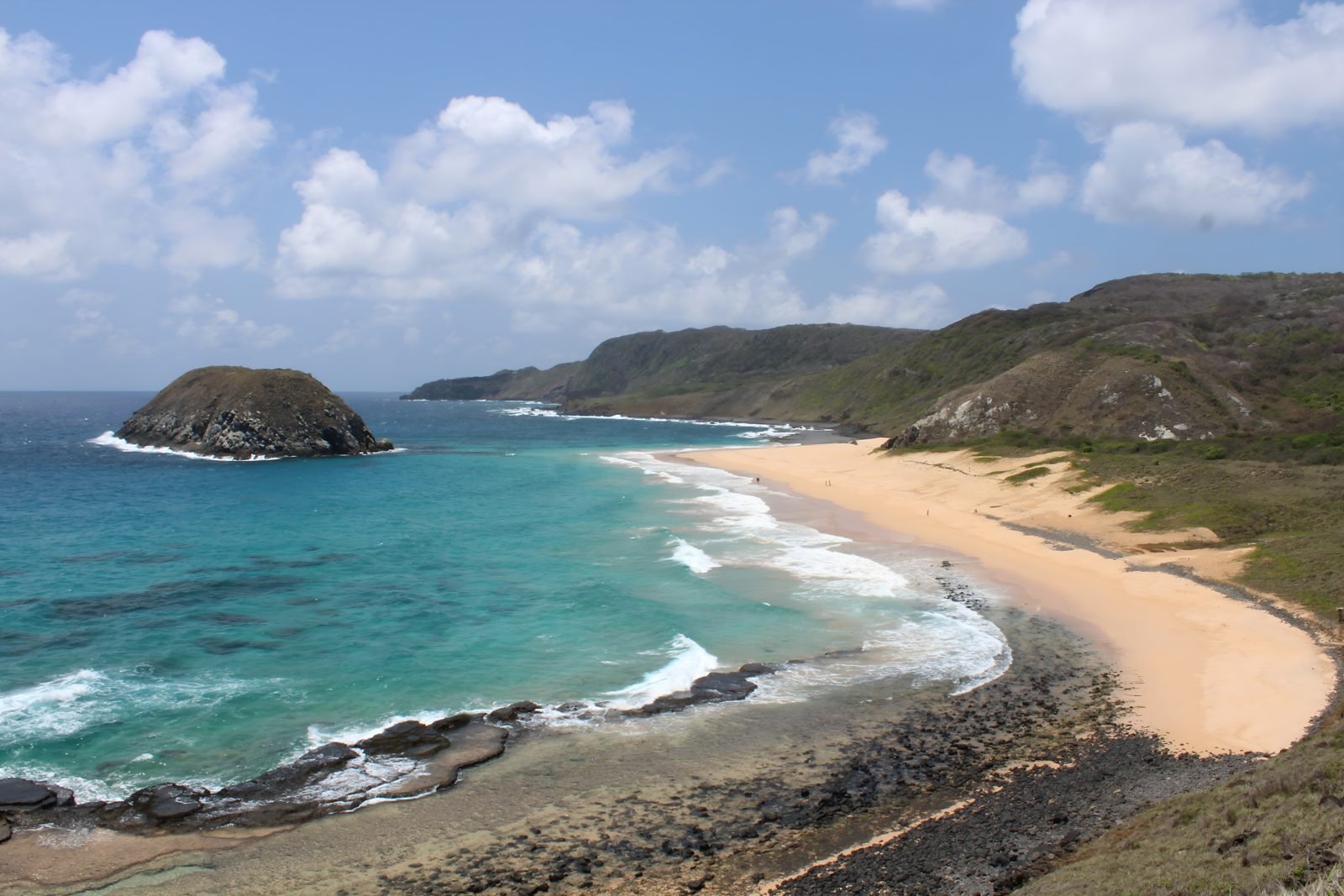
One of the most beautiful outer-sea beaches, with Ilha da Viúva just offshore and a wide strip of sand. It is in the park, open from 8 am to 6 pm, and it is the archipelago’s main green turtle nesting beach, from December to May. Currents are strong and walking on the reef is not allowed. It is a beach for looking, walking and swimming very carefully, never far from shore.
Baía do Sueste
A wide outer-sea bay known for its turtles and for the only mangrove on an oceanic island in the South Atlantic. The checkpoint is open from 9 am to 5 pm and the beach from 9 am to 4 pm. Right now, activities in the water are suspended: after tiger sharks were seen feeding, ICMBio banned swimming and suspended snorkelling, and a study is assessing whether to reopen it. You can still use the sand to walk and look at the sea and the mangrove. The ruined São Joaquim do Sueste fort sits above the bay with a viewpoint.
Atalaia
The Atalaia natural pool is one of the island’s most sought-after experiences, with colourful fish, octopus and sometimes small sharks in shallow water. It was closed from June 2025 to January 2026 because of silting and reopened on 14 January 2026. The rules are strict: you must book on the park website, visits happen only in the low-tide window, floating is mandatory with a life vest, mask and snorkel, standing or touching anything is forbidden, and no sunscreen or other cosmetics may be applied beforehand. The depth is around 80 cm (2.6 ft). Because the pool can close again for silting or sea conditions, check ICMBio notices before booking.
Conceição, Boldró, Cachorro, Meio and Porto
These are the APA beaches, free to visit without a park ticket. Conceição, at the foot of Morro do Pico, is the liveliest, with kiosks and footvolley, and is within walking distance of Vila dos Remédios. Cachorro and Meio are also close to the village and good for a late-afternoon swim. Boldró is best known for its sunset viewpoint. Porto de Santo Antônio has a shallow wreck that is great for snorkelling with turtles, plus the pier where the boats leave.
Fernando de Noronha trails: which ones need booking
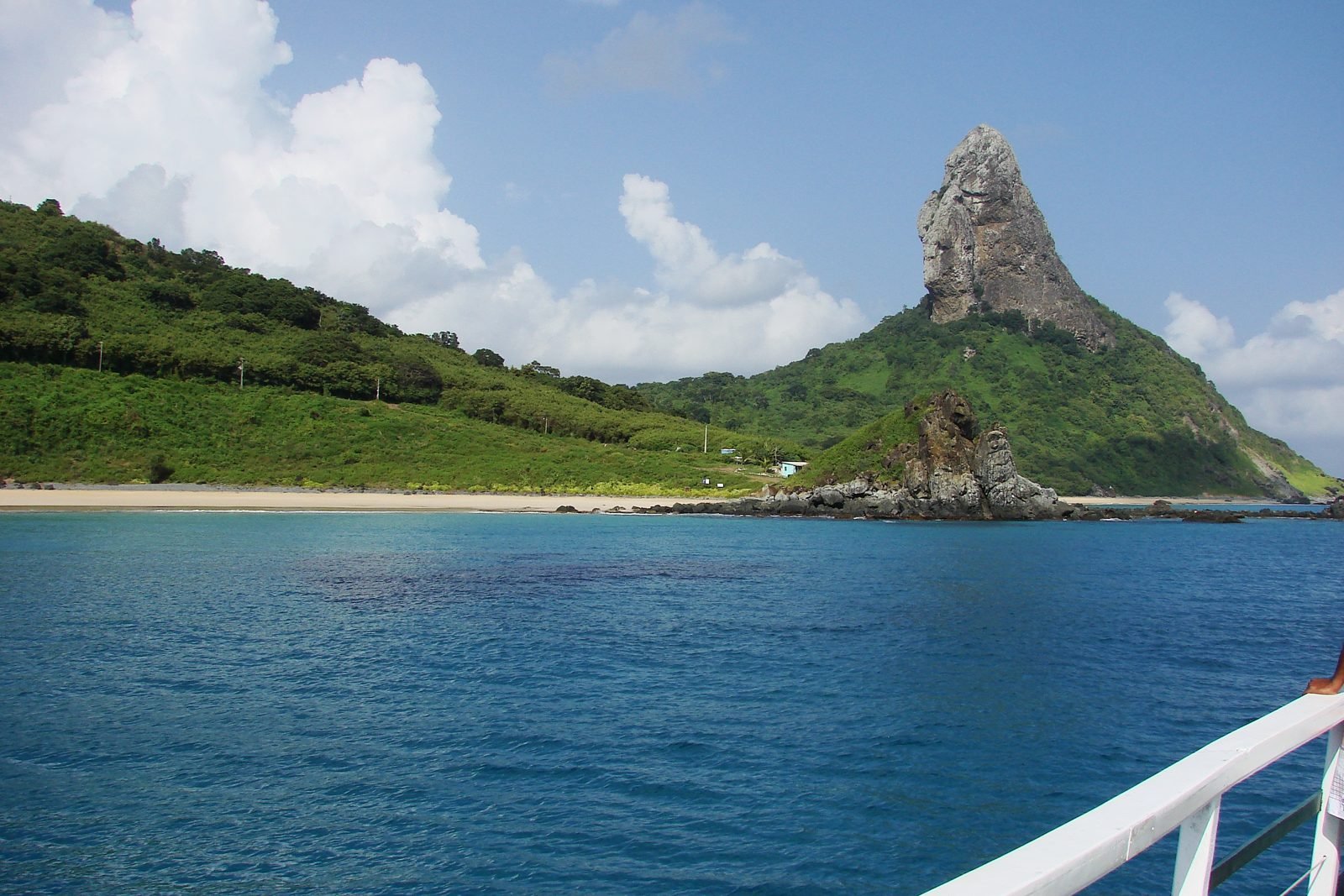
Short answer: the Capim-Açu, Abreu, Atalaia, Pontinha-Caieira, Atalaia-Pontinha-Caieira and Morro São José trails must be booked on the park website or at the ICMBio Visitor Center. The full Capim-Açu, Pontinha-Caieira, Atalaia-Pontinha-Caieira and Morro São José also require an ICMBio-accredited guide. The short paths to Sancho, Golfinhos, Porcos and Leão need no booking, only the park ticket.
Daily slots are limited, and the coastal trails depend on the tide. If you bought your ticket online, book on the website; if you bought it at the Visitor Center, book there, from 8 am to 7 pm. Accredited guides can be hired at the ACITUR FN stand inside the Visitor Center or through agencies. Be at the meeting point 30 minutes early. In the rainy season, from March to July, trails get slippery and muddy.
| Trail | Distance | Level | Requirements |
|---|---|---|---|
| Atalaia | 3 km (1.9 mi) round trip, about 30 min each way | Moderate | Booking; tide window |
| Abreu | 1.2 km (0.7 mi) round trip, about 30 min each way | Hard | Booking; rope descent |
| Pontinha-Caieira | 4.3 km (2.7 mi) one way, about 3h30 | Hard | Booking and guide |
| Atalaia-Pontinha-Caieira | 6 km (3.7 mi) one way, about 3 km over rocks | Hard | Booking and guide |
| Capim-Açu | 7.5 km (4.7 mi) one way, ends at Praia do Leão | Hard | Booking; guide for the full route |
| Morro São José | 1.1 km (0.7 mi) round trip | Moderate | Booking and guide; on foot only at tides of 0.3 m or lower |
Capim-Açu is the island’s longest trail and passes the lighthouse, a natural pool and a cave before reaching Leão; the stretch to the lighthouse can be done without a guide. Pontinha-Caieira follows the outer-sea coastline and is the most technical. On all of them, wear closed shoes or sturdy sandals, carry at least 1 litre of water per person and stay on the marked path.
Outside the park, the historic walk around Vila dos Remédios, with the Nossa Senhora dos Remédios church (built between 1737 and 1772), the São Miguel palace and the ruins of the old prison, is easy to do on your own.
Diving, boat trips, Projeto Tamar and sunsets
Short answer: Noronha is considered Brazil’s best dive destination, with water around 26 °C (79 °F) and visibility that can exceed 30 m (100 ft). The inner-sea boat trip, with dolphins and a stop at Sancho, is a must. In the evening, Projeto Tamar’s free talks in Boldró round off the day, and the classic sunset spots are the Boldró fort and the Remédios fort.
Scuba diving and snorkelling
The best-known dive sites are Pedras Secas, Ilha do Meio, Cagarras and Ressurreta, while the corvette Ipiranga wreck, at 62 m (203 ft), is for technical divers only. Scuba diving is only allowed with ICMBio-authorised operators. For first-timers, a boat-based discovery dive with an instructor costs R$990 to R$1,200 per person in 2026; cheaper shore-based versions use the wreck at the port. Snorkelling on your own works well at Sancho, Baía dos Porcos, the port and, with a booking, Atalaia. Rent a mask and fins or bring your own.
Boat trip
The shared boat trip leaves Porto de Santo Antônio, cruises the inner sea past the smaller islands and Baía dos Golfinhos, almost always with dolphins alongside, and continues to Ponta da Sapata or Sancho, where it stops for snorkelling. It takes about 4 hours and costs R$300 to R$390 per person. There is also a late-afternoon version with sunset at sea, and private boats for groups. Only book authorised companies.
Outrigger canoe, kayak and planasub
The outrigger canoe leaves the port very early to catch the sunrise and, with luck, dolphins and turtles, for R$200 to R$280 per person. The planasub, a board towed by the boat while you wear a mask and snorkel, was invented on the island and is offered on some boat trips.
Projeto Tamar
The Projeto Tamar Foundation Visitor Center is on Alameda do Boldró and opens Monday to Saturday from 9 am to 8 pm, free of charge. It has an exhibition on sea turtles, a shop and, at night, free environmental talks in its auditorium. Check the weekly programme at the center or at your pousada. Tamar has worked in Noronha since 1984, the center opened in 1996, and the project monitors nesting on Praia do Leão.
Sunset: the Boldró and Remédios forts
The Boldró viewpoint, by the ruins of the São Pedro do Boldró fort, is the island’s traditional sunset spot. It is free and faces Morro Dois Irmãos and Baía dos Porcos. At the other end, the Nossa Senhora dos Remédios fort, begun in 1737, is now Forte Noronha, with an immersive museum, a guided visit at 3 pm, a restaurant and music in the late afternoon. It opens Tuesday to Sunday from 2 pm to 10 pm, and the pass costs R$100, valid for 10 days, with a half price of R$50 and free entry for children up to 12. It does not replace the TPA or the park ticket.
What to eat in Fernando de Noronha and how much it costs
Short answer: island food revolves around fresh fish, seafood and northeastern Brazilian dishes. Eating out costs more than on the mainland: a simple lunch is R$40 to R$70 per person and a restaurant dinner R$70 to R$180, without drinks. Pousada food festivals are an island tradition.
Almost everything arrives by plane or barge, and that shows in supermarket and restaurant prices. In Vila dos Remédios and Floresta Nova there are set-plate lunches (prato feito) and pay-by-weight buffets that help balance the budget. At the APA beaches, kiosks sell snacks, coconut water and finger food. There is nothing for sale at Sancho or Leão, so bring water and snacks and take your rubbish back.
The catch of the day, especially tuna, dorado and serra (Spanish mackerel), comes grilled, in a moqueca stew or as tartare. Peixe na telha (fish baked on a clay tile), caldinho (a small bean or fish broth), tapioca and baião de dois (rice and beans with cheese) are on many menus. Some pousadas open their dinners to non-guests, such as the Pousada Zé Maria food festival on Wednesdays and Saturdays, which needs an advance booking. Forte Noronha has the Paiol restaurant, open Tuesday to Sunday from 4 pm to 10 pm.
How much a trip to Fernando de Noronha costs in 2026
Short answer: on top of flights and accommodation, budget for the TPA (R$423.17 for 4 days), the park ticket (R$384, or R$393 from November; half for Brazilians), transport and tours. A 4 to 5-day trip easily tops R$5,000 (roughly US$900 to 1,000) per person, and accommodation is the most variable part.
| Item | Price in 2026 | Note |
|---|---|---|
| TPA (4 days) | R$423.17 | R$105.79 per day, sliding scale |
| TPA (5 days) | R$520.50 | Official 2026 table |
| Park ticket (PARNAMAR) | R$384 (Brazilians R$192) until 31 Oct; R$393 (Brazilians R$196.50) from 1 Nov | Valid for 10 days |
| Buggy (per day) | R$450 to R$480; about R$700 over New Year | Fuel extra, about R$10.26 a litre |
| Porto–Sueste bus | about R$5 a ride | About every 30 minutes |
| Shared Island Tour | R$250 to R$370 per person | Full day, lunch not included |
| Shared boat trip | R$300 to R$390 per person | About 4 hours, stop at Sancho |
| Discovery dive | R$990 to R$1,200 per person | Authorised operators |
| Outrigger canoe | R$200 to R$280 per person | Leaves at dawn |
| Forte Noronha | R$100 (half price R$50) | Valid for 10 days |
| Projeto Tamar | Free | Free evening talks |
| Simple lunch | R$40 to R$70 per person | Set plate or buffet |
Tour and buggy prices are ranges gathered from local operators and guides in October 2026 and vary between agencies. Paying upfront and booking several tours with the same company usually gets a discount. Always ask about the cancellation policy for rough seas.
Fernando de Noronha itinerary: 3 to 5 days
Short answer: on day one, settle in and catch the Boldró sunset; on day two, take the Island Tour; on day three, the boat trip and Sancho; on day four, Baía dos Porcos, Cacimba do Padre and Atalaia or a booked trail; on day five, a dive or a free day at your favourite beaches. Fit everything around the tide table.
- Day 1: arrival, pay the TPA if you have not already and get your park ticket. In the afternoon, Praia da Conceição or Cachorro and sunset at the Boldró fort. In the evening, a Projeto Tamar talk.
- Day 2: a full-day Island Tour for the big picture: viewpoints, Sueste, Leão, Vila dos Remédios and sunset. If you prefer, do the same loop by buggy.
- Day 3: boat trip in the morning, with dolphins and a stop at Sancho. In the afternoon, go back to Sancho by land via the Golfinhos viewpoint and the boardwalk, and climb down the ladder in a “down” slot.
- Day 4: low tide at Baía dos Porcos and Cacimba do Padre. In the afternoon, Atalaia (booked) or the Capim-Açu trail to the lighthouse. Dinner at a pousada food festival.
- Day 5: a discovery dive, if you are not flying in the next 12 hours, or the outrigger canoe at sunrise and a last day at Leão or Conceição. Late afternoon at Forte Noronha.
With three days, merge days 1 and 2, do the boat trip on day two and save day three for Porcos, Sancho and Boldró. With more time, add Pontinha-Caieira with a guide, an afternoon snorkelling with turtles at the port and a rest day, which is never wasted in Noronha.
Safety and sustainability in Noronha
Short answer: crime is low in Noronha, and the main risks come from the sea, the trails and the sun. Follow park rules, tide windows and ICMBio notices, never touch animals or coral, and do not apply regular sunscreen before entering the natural pools.
- Sea: during the swell, from December to May, inner-sea waves can be dangerous. Leão has strong currents. Ask lifeguards and locals before going in.
- Sharks: they are part of the ecosystem and common. Swimming at Sueste is suspended precisely because of tiger shark feeding behaviour. Respect closures.
- Trails: sturdy shoes, water, a hat that stays on, and start before 9 am or after 3 pm. Check tides for coastal trails, because high tide cuts off sections and rescue is difficult.
- Nature: collecting shells, rocks, coral or sand, feeding animals, bringing plants or animals to the island and writing on rocks are all forbidden. In the pools, float: standing kills coral.
- Rubbish and plastic: the island has limited waste infrastructure. Bring a reusable bottle, refuse disposables and carry your rubbish out from park beaches.
- Documents: Noronha is part of Brazil, so foreign visitors need the same passport or visa they used to enter the country, and Brazilians only need an official photo ID.
Where to stay in Fernando de Noronha
Short answer: for a first trip, Vila dos Remédios is the most practical base, with restaurants, beaches and the bus within walking distance. For mid-range pousadas, look at Floresta Velha, Floresta Nova and Vila do Trinta. For charm, quiet and views, Boldró and the Sueste area. Accommodation is expensive everywhere on the island, so book early.
- Vila dos Remédios: the historic centre, with restaurants, bars, small shops and the Cachorro, Meio and Conceição beaches nearby.
- Floresta Velha and Floresta Nova: residential areas in the middle of the island, with family-run pousadas, easy access to the BR-363 and lower prices.
- Vila do Trinta: close to shops and the highway, with several simple pousadas.
- Boldró and Jardim Elizabeth: near ICMBio, Tamar and the sunset viewpoint, with boutique pousadas.
- Sueste: the quietest side of the island, home to the luxury pousadas and views of Baía do Sueste. You will need a car or buggy.
The list below includes real pousadas in different areas and price ranges. Every link goes to the property’s official website, checked in October 2026. We do not use agency or booking-platform links.
NANNAI Noronha (luxury, Baía do Sueste)
NANNAI Noronha is a boutique property with just 10 bungalows on Baía do Sueste and its own restaurant, TiaTê. It belongs to the same group as NANNAI Muro Alto. It is for travellers who want maximum privacy and service and are happy to pay for it.
Pousada Maravilha (luxury, Sueste)
Pousada Maravilha has 11 suites overlooking Baía do Sueste; the Sueste Bungalow has a heated private pool. It is one of the best-known pousadas on the island and takes direct bookings on its website.
Pousada Teju-Açu (eco-lodge, Boldró)
Pousada Teju-Açu sits on Estrada da Alamoa in Boldró, about 1 km from Praia da Conceição. Its 12 bungalows are raised on stilts to limit impact on the ground, and the pool faces Morro do Pico. A good choice for comfort with a sustainable approach.
Pousada Zé Maria (upscale, upper island)
Pousada Zé Maria is one of Noronha’s most traditional pousadas, high on the island with views of Morro do Pico. Its food festival on Wednesdays and Saturdays is an outing in itself, open to guests staying elsewhere too.
Pousada do Vale (boutique, Jardim Elizabeth)
Pousada do Vale is in Jardim Elizabeth, 500 m from the sea, and has been on the island for more than 20 years. It has five suite categories and satellite Wi-Fi (Starlink), close to both Vila dos Remédios and Boldró.
Pousada Triboju (bungalows, Rua Amaro Preto)
Pousada Triboju is on Rua Amaro Preto, with four themed luxury bungalows with jacuzzis plus suites. Its restaurant is well rated by guests.
Pousada Morena (Floresta Velha)
Pousada Morena is on Rua Nice Cordeiro in Floresta Velha and has one of the best views of Morro do Pico. Rooms range from standard to bungalows.
Pousada Corveta (Vila dos Remédios)
Pousada Corveta is on Rua São Miguel in Vila dos Remédios, with breakfast included and five suite categories. From here you can walk to the village restaurants and to Cachorro and Conceição beaches.
Pousada Malibu (Vila dos Remédios, good value)
Pousada Malibu is in Vila dos Remédios, with simple, well-equipped rooms within walking distance of bars, restaurants, taxis and the bus. A good pick if you would rather spend on tours than on your room.
Vila Sal Noronha (Floresta Velha)
Vila Sal Noronha is on Rua Amaro Preto in Floresta Velha, with a pool (open 10 am to 8 pm) and breakfast served from 7:30 to 10 am. It keeps things simple and welcoming.
Video: Fernando de Noronha by Visit Brasil
This official video from Visit Brasil, the channel of Brazil’s tourism board Embratur, shows the archipelago’s diving, beaches and marine life.
Fernando de Noronha FAQ
When is the best time to visit Fernando de Noronha?
August to February is the drier period. For diving and a calm inner sea, go from September to November. The swell arrives from December to May, which is great for surfing. March to July is the rainy season, with April the wettest month, but prices are also lower.
How much is the Fernando de Noronha tax in 2026?
The Environmental Preservation Tax (TPA) costs R$105.79 per day in 2026, on a sliding scale: R$317.38 for 3 days, R$423.17 for 4, R$520.50 for 5 and R$672.85 for 7. Pay at tpa.noronha.pe.gov.br or at the airport. Foreign cards are only accepted at the airport counter.
How much is the Fernando de Noronha National Marine Park ticket?
Until 31 October 2026, R$384, with a 50% discount for Brazilians (R$192). From 1 November 2026, under ICMBio Ordinance 4,932, R$393, or R$196.50 for Brazilians. It is valid for 10 days. Children up to 12 and Brazilians over 60 are exempt.
How many days do you need in Fernando de Noronha?
Four or five days is ideal to fit in the Island Tour, a boat trip, Sancho, Baía dos Porcos, Atalaia and a booked trail without rushing. Three days works but forces choices. The TPA also gets proportionally cheaper from the fifth day.
Is there a direct flight from Natal to Fernando de Noronha?
Not in 2026. Azul dropped the Natal–Noronha route in March 2025 and no airline has resumed it. Direct flights leave from Recife (about 1h15 to 1h20) and São Paulo-Guarulhos (about 3h40 to 4h), with Azul, Gol and Latam.
Do you need to book Baía do Sancho?
No booking is needed, just the park ticket. Sancho is open from 8 am to 6 pm, and the ladder down to the sand has alternating down and up slots. If you do not want to climb down, you can see the bay from the boardwalk viewpoints or arrive by boat on a tour.
Which Noronha trails need to be booked?
Capim-Açu, Abreu, Atalaia, Pontinha-Caieira, Atalaia-Pontinha-Caieira and Morro São José. Book on the park website or at the ICMBio Visitor Center in Boldró. The full Capim-Açu, Pontinha-Caieira, Atalaia-Pontinha-Caieira and Morro São José also require an accredited guide.
Is the Atalaia natural pool open?
It reopened on 14 January 2026 after being closed since June 2025 because of silting. Visits require a booking, take place in the low-tide window and follow strict rules: life vest mandatory, no sunscreen and no standing. Check ICMBio notices first, because it can close again.
Can you explore Fernando de Noronha without renting a buggy?
Yes. The Porto–Sueste bus runs about every 30 minutes for around R$5, and an Island Tour on day one covers the farther beaches. Taxis handle short trips. Groups of four often find a buggy worth it for one or two days.
How much does a 5-day trip to Fernando de Noronha cost?
It depends heavily on the pousada and the season. The mandatory fees alone for a foreign visitor add up to R$520.50 in TPA plus R$384 to R$393 for the park ticket. With flights, accommodation, food and two or three tours, a 5-day trip easily tops R$5,000 per person.
Is Fernando de Noronha worth it?
Yes, as long as you accept the rules of the game. Noronha is expensive, takes planning and does not let anyone do everything their own way, and that is exactly why it has stayed the way it is. Pick your dates by the kind of sea you want, book flights and pousadas early, pay the TPA and park ticket before you travel and plan your days around the tides. If your Brazil trip continues, see our guides to Rio de Janeiro, Salvador, Florianópolis, Iguaçu Falls and Gramado. Before you go, check prices, opening hours and notices on the official websites below, because they change every season.
Sources
- Fernando de Noronha Administration: Environmental Preservation Tax (2026 table), TPA payment and the island’s historic heritage
- ICMBio Noronha: tickets and visiting, attractions and bookings and current notices
- ICMBio Ordinance 4,932/2026, Official Gazette (DOU) of 19 October 2026 (new ticket price from 1 November)
- G1 Pernambuco, Viver Noronha blog: TPA increase (January 2026), Atalaia reopening (January 2026), flights and management committee (April 2026), visitor numbers for the first half of 2026 and the request for a meeting with Anac (August 2026)
- Decree 96,693/1988, which created the National Marine Park
- IBGE Cidades: Fernando de Noronha (2022 census)
- UNESCO: Brazilian Atlantic Islands: Fernando de Noronha and Atol das Rocas Reserves
- Projeto Tamar Foundation: Fernando de Noronha Visitor Center
- Forte Noronha: official website (hours and tickets)
- Tour and buggy prices: survey of local operators and guides, October 2026
- Pousadas: official websites listed under “Where to stay in Fernando de Noronha”, checked in October 2026