Bonito is a town of 23,659 people (IBGE 2022 census) in the southwest of Mato Grosso do Sul state, in Brazil’s Center-West, about 290 km (180 miles) from the state capital, Campo Grande. It sits at the foot of the Serra da Bodoquena, a limestone plateau where rivers come out of the ground so clear that you can watch fish dozens of meters away. Add blue-water caves, a sinkhole full of red-and-green macaws and long chains of waterfalls, and you have Brazil’s best-known freshwater ecotourism destination. The town’s tourism office counts more than 7,000 beds and runs a visitor-control model, the single voucher, that has been in place since 1995.
That model shapes every trip, and it surprises many foreign visitors: almost nothing in Bonito can be done independently. Each tour is booked through an accredited local agency, has a fixed time slot and a daily visitor cap, must be done with a licensed guide, and costs the same at every agency. Travelers who understand this before landing can build a tight plan; those who leave it to the last minute often find the Rio da Prata snorkel or the Anhumas Abyss sold out. This guide explains how the system works, lists the main tours with 2026 prices in Brazilian reais (BRL, R$), shows when to go for each kind of experience, suggests 3-, 4- and 5-day itineraries and lists real hotels and pousadas with links to their official websites.
Quick facts: Bonito, Brazil
- Best time to go: April to October (dry season) usually brings the clearest water for snorkeling. From December 15 to January 15, on clear mornings, sunlight hits the lake inside the Gruta do Lago Azul cave, but that is the rainy season, when storms can cloud the rivers.
- How long to stay: 4 or 5 days lets you do one river snorkel, a cave, a waterfall trail and the Macaw Sinkhole without rushing. The Anhumas Abyss takes most of a day.
- Getting there: international travelers usually connect in São Paulo. There are direct domestic flights to Bonito Regional Airport (BYO) from Campinas (Azul), São Paulo-Congonhas (Gol) and São Paulo-Guarulhos (LATAM) on set days of the week. The alternative is to fly to Campo Grande (CGR) and drive or take a bus about 290 km.
- How tours work: a single voucher bought from an accredited agency, with limited daily places, fixed times, a mandatory guide and fixed prices. Book ahead for July, Brazilian holidays and New Year.
- Town fee: since December 20, 2025, the city charges an Environmental Conservation Fee (TCA) of R$15 per person per day with tours, paid online at the Turista por Natureza portal. Local trade associations are challenging it in court, but it is still being charged in October 2026.
- 2026 reference prices: Rio da Prata R$470 (low season) and R$570 (high); Rio Sucuri R$349 and R$438; Gruta do Lago Azul R$120 and R$180; Macaw Sinkhole R$185; Municipal Beach Park R$70 and R$98.
- Time zone, money, language: Mato Grosso do Sul runs on UTC-4, one hour behind São Paulo and Rio, with no daylight saving time. The currency is the Brazilian real (BRL); cards and Pix are widely accepted. Portuguese is the local language, so ask your agency for an English-speaking guide in advance.
A short history: from a cattle ranch to the voucher system
Direct answer: Bonito grew out of Fazenda Rincão Bonito, a ranch bought in 1869 by Luiz da Costa Leite Falcão. The settlement was officially founded in 1927, became a municipality in 1948 after splitting from Miranda, and turned to tourism from the 1970s and 1980s on, led by the Gruta do Lago Azul cave. In 1995 the town created the single voucher that still organizes visits today.
The name is literal: “bonito” means “pretty” in Portuguese, and the land was part of the Rincão Bonito ranch, acquired in 1869 by Luiz da Costa Leite Falcão, according to the IBGE (Brazil’s statistics institute) town history. The settlement’s official founding date is February 24, 1927, credited to Manoel Ignácio de Faria. In 1944 the district was briefly renamed Rincão, and on October 2, 1948, State Law No. 145 split Bonito from Miranda and made it a municipality, installed on January 1, 1949. For most of the 20th century the economy ran on cattle ranching.
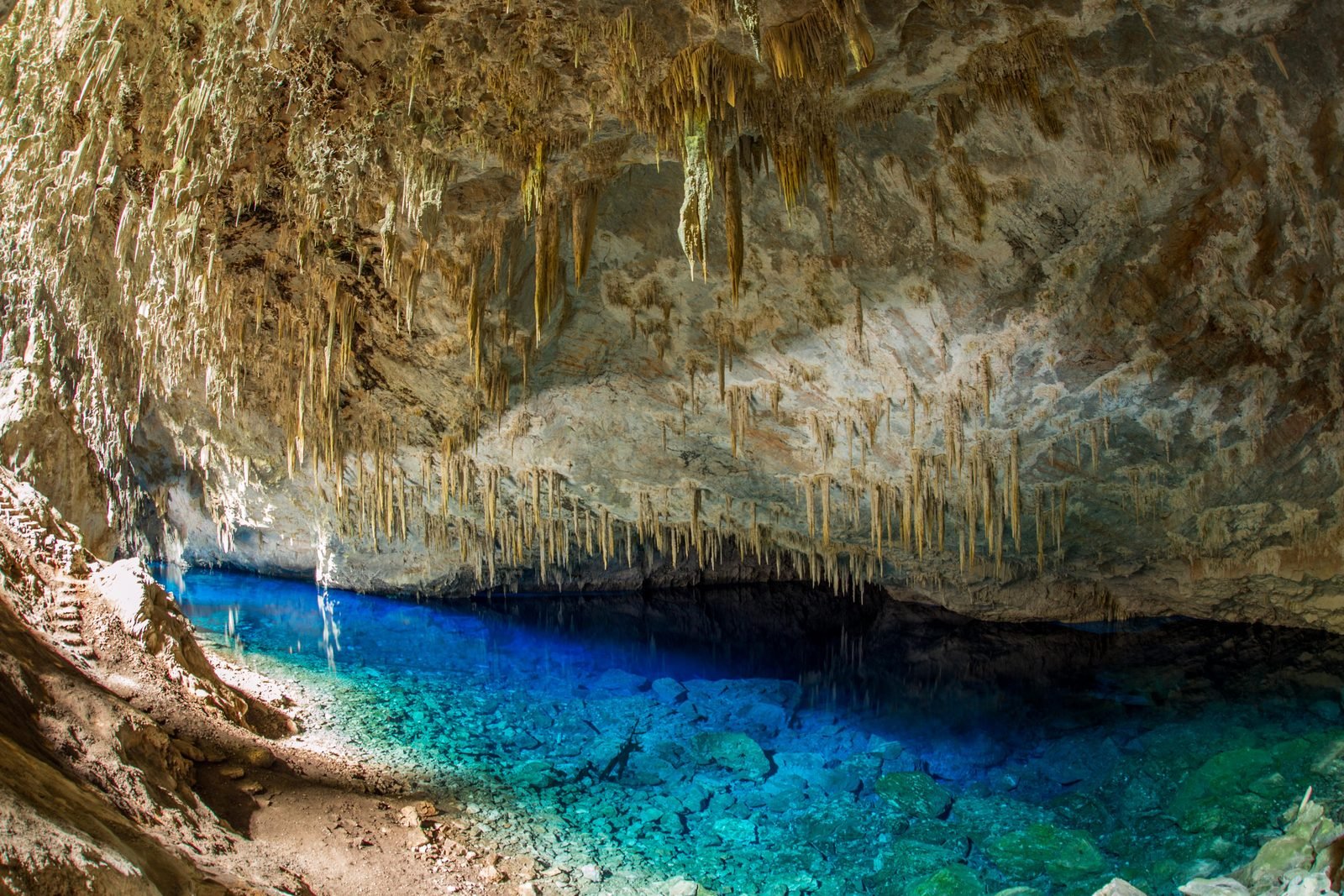
The Gruta do Lago Azul (Blue Lake Cave) opened the first big tourism chapter. The cave’s official website repeats the local tradition that a Terena Indigenous man found it in 1924; the geological site record published by SIGEP, Brazil’s commission for geological heritage sites, notes there is no documentary proof of that story and that locals already knew the cave around 1940. What is documented: the cave was listed by IPHAN, Brazil’s national heritage institute, in 1978, became a state Natural Monument by Decree 10,394 of June 11, 2001, and has hosted scientific expeditions. In 1990 researchers described Potiicoara brasiliensis, a tiny crustacean found only in Bodoquena caves. In 1992 a French-Brazilian diving expedition found Pleistocene mammal fossils at the bottom of the lake, including a giant ground sloth and the saber-toothed cat Smilodon populator. Research dives have reached 96 meters.
Geology explains the water. Bonito sits on carbonate rocks of the Corumbá Group, laid down at the bottom of a sea between 580 and 540 million years ago. Rainwater slowly dissolves the limestone, creating caves, sinkholes and springs, and the dissolved calcium carbonate helps suspended particles settle on the riverbed. That is why the water looks like glass, and it is the same process that, over millennia, opened the Macaw Sinkhole and the Anhumas Abyss.
Tourism scaled up in the 1980s and 1990s, and so did concerns about it. Bonito’s tour-guide association was founded in 1994. In 1995, Municipal Law 695 created the Municipal Tourism Council (Comtur), and its first act, Normative Resolution 09/1995, introduced the single voucher. The idea is credited to Antônio Carlos “Tó” Soares, owner of the Tapera restaurant, and it had two goals: track the tax owed on each tour and cap the number of visitors at each site. The attractions’ association (Atratur) and the agencies’ association (Abaetur) followed in 1996. The design has lasted, and the logic is still the same three decades later.
The Serra da Bodoquena itself gained federal protection on September 21, 2000, when a decree created the Serra da Bodoquena National Park. According to ICMBio, the federal parks agency, the park now covers 77,021.58 hectares across Bonito, Bodoquena, Jardim and Porto Murtinho. Most tours, however, take place on private ranches and reserves around it, many of them registered as RPPNs (private natural heritage reserves).
When to visit Bonito: clear water, rain, spawning season and cold snaps
Direct answer: for river snorkeling, the best window is April to October, the dry season, when rain is less likely to cloud the water. To see the sunbeam inside the Gruta do Lago Azul, go between December 15 and January 15 and book a morning slot. July (Brazilian school holidays) and New Year are the busiest and most expensive periods.
Bonito has two clear seasons. In the dry season, roughly April to October, rain is scarce and the rivers reach peak clarity; August and September are favorites among snorkelers. The wet season, November to March, brings more frequent and heavier rain. The rivers start out crystal clear at the springs, but a heavy storm in the hills washes mud into the riverbed and can cut visibility for a day or more. When that happens, agencies often reschedule or cancel snorkel tours on the same day, so keep some slack in your plan.
Summer has its rewards. Waterfalls carry more water, the forest is greener, and between December 15 and January 15, usually from 8 to 10 a.m. on clear days, sunlight enters the mouth of the Gruta do Lago Azul and lights up the lake. That is the postcard shot. Outside that window the cave is still striking, but the blue is darker.
The piracema is the fish spawning run, when many species swim upriver to breed. In Mato Grosso do Sul, the fishing ban for the season ran from November 5, 2025 to February 28, 2026, according to the state environmental agency, Imasul. It does not change the snorkeling rules, but local guides and agencies report that the big shoals are less concentrated at the snorkel spots during those months. If seeing large schools of fish is your priority, choose the dry season.
In winter, June to August, days are usually pleasant, but cold fronts can drop temperatures sharply at night and early in the morning, so pack a warm layer. Spring-fed rivers keep a stable temperature, but getting out into a cold wind is unpleasant; that is why snorkel sites provide wetsuits. In 2026, the high-season calendar used by the attractions includes all of January, Carnival, Holy Week, Corpus Christi, July 11 to August 2 and the long holiday weekends in September, October and November.
| Period | Weather | Best for |
|---|---|---|
| April to June | Dry, warm days, cooler nights | Clear water at low-season prices |
| July | Dry, cold nights, high season | Family holidays; book everything early |
| August and September | Dry and hot, lower waterfalls | Best visibility and lots of fish |
| October and November | Rains begin | Lower prices, some risk of cloudy rivers |
| December and January | Hot and rainy, high season | Sunbeam in the Blue Lake Cave and full waterfalls |
| February and March | Rainy | Quieter trips outside Carnival, with a flexible plan |
How to get to Bonito: flights, buses and driving
Direct answer: most international visitors fly into São Paulo (GRU) and connect. Direct flights to Bonito leave from Campinas (Azul), São Paulo-Congonhas (Gol) and São Paulo-Guarulhos (LATAM) on set weekdays. Otherwise, fly to Campo Grande and cover about 290 km by rental car, transfer or bus, a 4- to 5-hour trip.
Bonito Regional Airport (BYO) is about 13 km from town. In October 2026 it is served by three airlines. Azul flies from Campinas-Viracopos on Tuesdays, Thursdays and Sundays, a flight of about 1 hour 55 minutes. Gol flies from São Paulo-Congonhas on Tuesdays, Saturdays and Sundays. LATAM, which previously flew twice a week from São Paulo-Guarulhos, moved to Wednesdays, Fridays and Sundays from October 25, 2026. Guarulhos is Brazil’s main international hub, so the LATAM flight is the simplest connection for long-haul travelers; Congonhas and Viracopos are domestic airports, and transferring from Guarulhos to them takes time on the road. Schedules change by season, so check the airline’s website before you lock in dates. According to the city, the airport set a record in 2025 with 36,388 arriving passengers.
If the direct flights do not fit, the usual route is to fly into Campo Grande International Airport (CGR), which has connections to several Brazilian capitals. From there you have three options:
- Rental car: rental desks are at the airport. The usual route follows the BR-060 and MS-382 highways via Guia Lopes da Laguna; the alternative is the BR-262 via Miranda. Either way it is 290 to 300 km, about 4 hours of driving. A car helps a lot in Bonito, since nearly all tours are 7 to 50 km from the town center. Many foreign licenses can be used in Brazil for short stays; check the rules for your country and carry an International Driving Permit if in doubt.
- Bus: Viação Cruzeiro do Sul runs Campo Grande to Bonito from the main bus station at 8 a.m. and 2 p.m. (local time), stopping at Campo Grande airport about 20 minutes later. The ride takes about 4 hours 50 minutes, and the fare was around R$128 in October 2026.
- Transfer: many Bonito agencies offer shared or private transfers from Campo Grande airport. They cost more than the bus but match your flight time.
Watch the clock when connecting: Mato Grosso do Sul is on UTC-4, one hour behind São Paulo, and Brazil does not use daylight saving time. A popular add-on is the southern Pantanal wetlands: according to Bonito’s tourism office, the town is about 180 km from the Pantanal region, reached by road toward Miranda.
How Bonito’s voucher system works
Direct answer: every tour is bought from an accredited local agency, which issues a single voucher with your name, date and time slot. Each attraction has a daily visitor cap, a licensed guide is mandatory and the price is fixed, identical at every agency. No voucher, no entry.
In practice it works like this. You pick your tours, contact a Bonito agency (in person, by WhatsApp or online), and it checks each attraction’s availability for your dates. Once the place is confirmed, the agency issues the voucher, a numbered document that serves as ticket, tax receipt and the city’s control tool at the same time. On the day, you show up at the attraction at the time printed on the voucher and meet your guide. Arriving late can cost you the slot.
Rules that apply to almost every tour:
- Same price everywhere: the attraction sets the price and it does not change between agencies. Agencies compete on service, transport and itinerary planning, not on tour prices.
- Transport is extra: the voucher price does not include getting to the attraction. Without a car, you pay for shared or private transport, usually booked through the same agency.
- Limited places: the Anhumas Abyss, for example, takes very few people a day and sells out weeks ahead in high season. Snorkel trips also have caps.
- Mandatory guide: every group goes with a licensed guide. Most guides speak Portuguese; English- or Spanish-speaking guides exist but must be requested in advance.
- Low and high season: attractions publish two price tables. In 2026 high season covers January, long holiday weekends and the July school break.
- Environmental Conservation Fee (TCA): separate from the voucher, it costs R$15 per person per day with tours and is paid only at turistapornatureza.com.br. Children under 7, residents and people who work in the town are exempt. The fee includes visitor accident insurance provided by the city. Agency, guide and hotel associations are challenging the fee at the Mato Grosso do Sul state court, which reopened the case in September 2026, but the fee remains in force.
A few activities are more flexible, such as the Municipal Beach Park (Balneário Municipal), which is still sold by voucher but lets you spend the whole day and bring your own food. The general rule stands: plan and book ahead.
Top things to do in Bonito and 2026 prices
Direct answer: the most popular tours are the river snorkels at Rio da Prata, Rio Sucuri, Aquário Natural and Nascente Azul; the Gruta do Lago Azul cave; the Anhumas Abyss; the Macaw Sinkhole (Buraco das Araras); the Boca da Onça and Estância Mimosa waterfall trails; and the Municipal Beach Park. In 2026, prices run from R$70 (Municipal Beach Park, low season) to more than R$1,600 (diving in the Anhumas Abyss).
The figures below come from the 2026 tour price table published by the local agency Acqua Viagens (updated February 16, 2026), cross-checked with other Bonito agencies and official attraction websites in October 2026. Because the attractions set the prices, they are the same at any agency. The first figure is low season and the second is high season. Some tables are valid only until mid-year or December, so ask for the current price when you book. Prices are in Brazilian reais; check the current exchange rate with your bank before you travel.
Rio da Prata (Jardim)
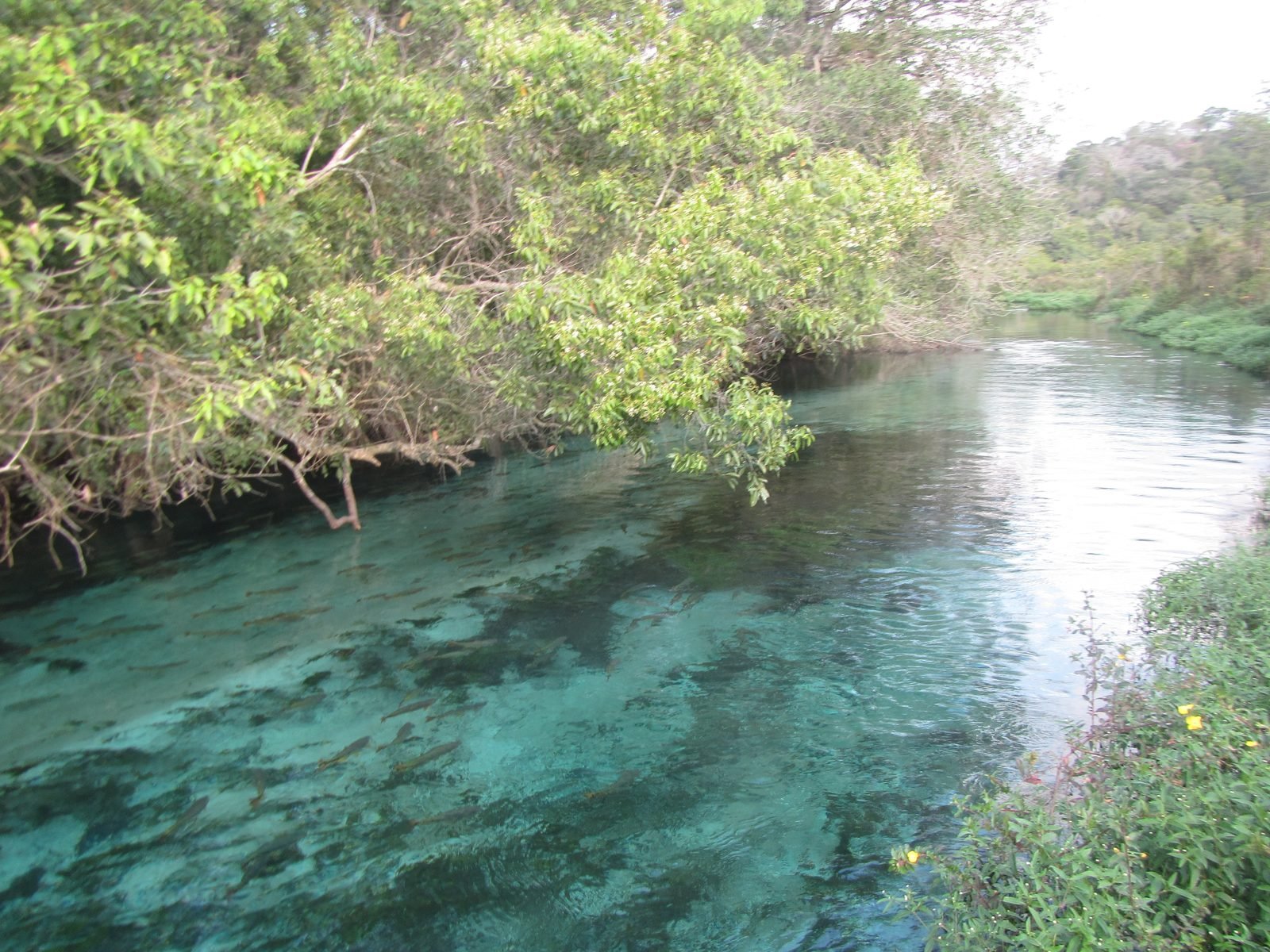
Recanto Ecológico Rio da Prata is in the neighboring municipality of Jardim, 50 km from Bonito via the MS-178 or the BR-267, opens every day of the year and has welcomed visitors since 1995. It is the region’s most famous snorkel trip. After a 600-meter forest trail inside the Fazenda Cabeceira do Prata private reserve, you get a mask, snorkel and wetsuit, slip into the spring of the Olho d’Água River and drift with the current for about 1.7 km to where it meets the Rio da Prata, then float another 600 meters. Along the way you swim over shoals of piraputanga, dourado, curimbatá and piau fish. The tour takes about 4 hours and ends with a Mato Grosso do Sul home-style lunch at the ranch. 2026 price: R$470 (low) and R$570 (high), with lower senior rates; minimum age 5.
Rio Sucuri
Rio Sucuri is about 19 km from the center, at Fazenda São Geraldo. The snorkel covers about 1,800 meters on a gentle current, with a support boat following the group, and the clarity impresses even people who have done other snorkels. The full tour lasts about 2.5 hours. There is also a boat-only trip for anyone who would rather stay dry. 2026 price: R$349 (low) and R$438 (high); boat only, R$161.
Aquário Natural (Baía Bonita Ecological Reserve)
Aquário Natural (“natural aquarium”) is in the Baía Bonita Ecological Reserve, 7 km from the center, making it the closest snorkel to town. The tour combines a trail and a float in spring water packed with fish, followed by a heated pool and restaurant. It suits travelers short on time and families with children. 2026 price: R$352 (low) and R$436 (high).
Nascente Azul
Nascente Azul is about 30 km from the center on the road to Bodoquena. The snorkel lasts about 2.5 hours, and the same voucher gives access to the site’s bathing area on the same day; the 450-meter zipline costs extra. It is one of the most complete options for families, mixing a snorkel with a day of leisure. 2026 price: snorkel R$374 (low) and R$462 (high); bathing area only, R$126 and R$139; buffet lunch, R$94.
Gruta do Lago Azul (Blue Lake Cave)
Brazil’s best-known cave is a Natural Monument managed by the city. The guided visit goes down about 300 steps to the edge of a deep blue lake whose known depth exceeds 90 meters. There is no swimming or recreational diving: it is a viewing visit of about 1 hour 20 minutes that calls for shoes with good grip and some stamina for the climb back. From December 15 to January 15, in the first hours of the morning, sunlight enters the opening and lights the lake. 2026 reference price: R$120 (low) and R$180 (high); confirm the current price with your agency.
Anhumas Abyss (Abismo Anhumas)
The Anhumas Abyss, 23 km from the center, is Bonito’s most expensive tour and one of the most sought after. You descend on a 72-meter electric-assisted rappel through a crack in the cave roof, two people at a time, into a cavern holding a lake about 80 meters deep. Options are contemplation, snorkeling, a discover-scuba dive to 8 meters with no certification needed, and dives to 18 meters for certified divers. The day before, visitors go through a check-in at the company office in town to try on wetsuits and sign safety forms. The operator reports more than 25 years without serious accidents. 2026 price: contemplation R$997; snorkeling R$1,598; discover-scuba dive R$1,699 (low) and R$1,898 (high). Daily places are very few, so book as soon as your dates are set.
Macaw Sinkhole (Buraco das Araras, Jardim)
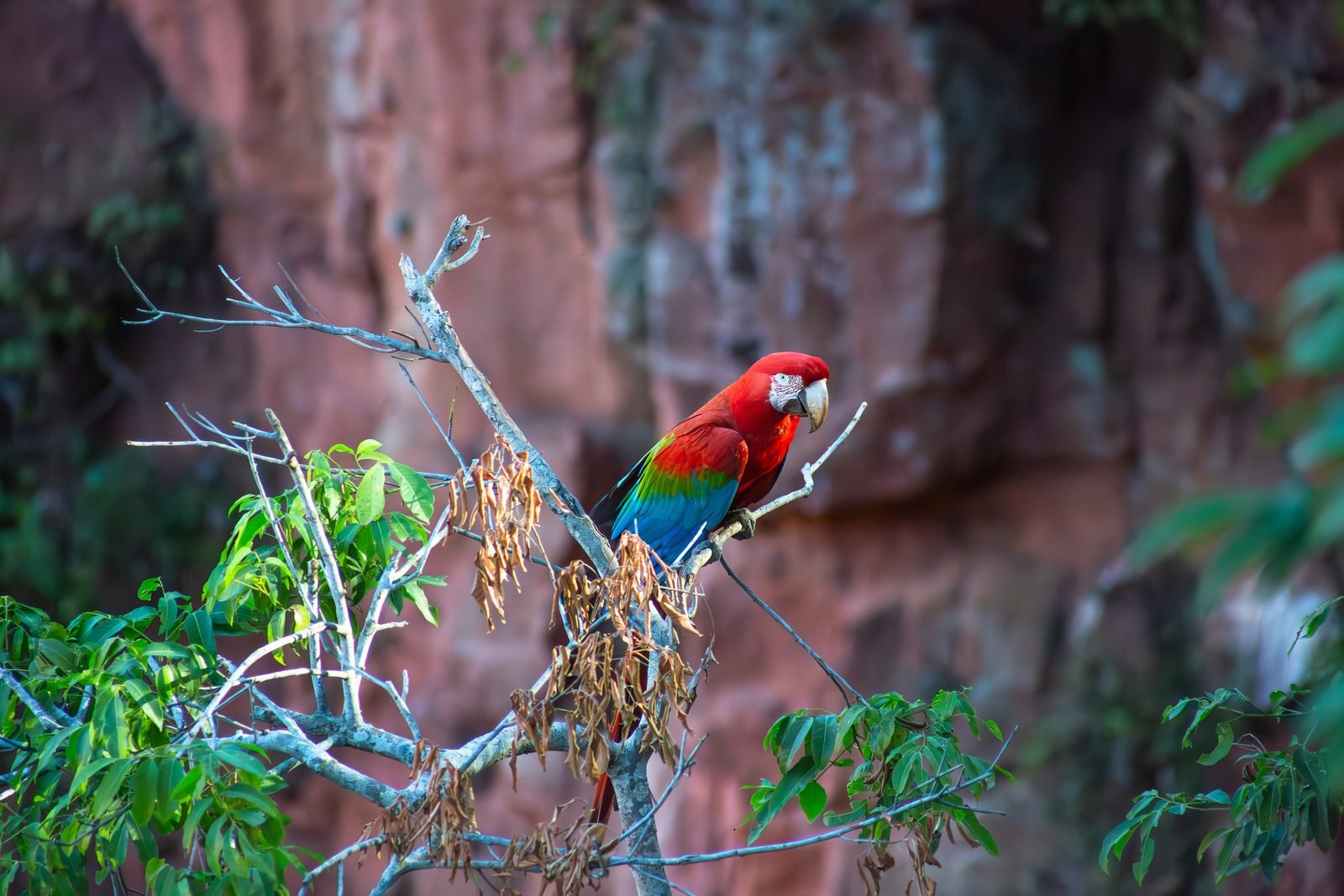
Buraco das Araras is a sinkhole, a crater formed by ground collapse, about 100 meters deep and 500 meters around, in the municipality of Jardim. It sits on a private reserve and is the best place in the region to watch red-and-green macaws flying and perching on the red sandstone walls. The official site lists 160 bird species. The visit is an easy trail walk to viewpoints on the rim. 2026 price: R$185 (adults), R$135 (children 6 to 12) and R$150 (seniors), with no seasonal difference.
Boca da Onça
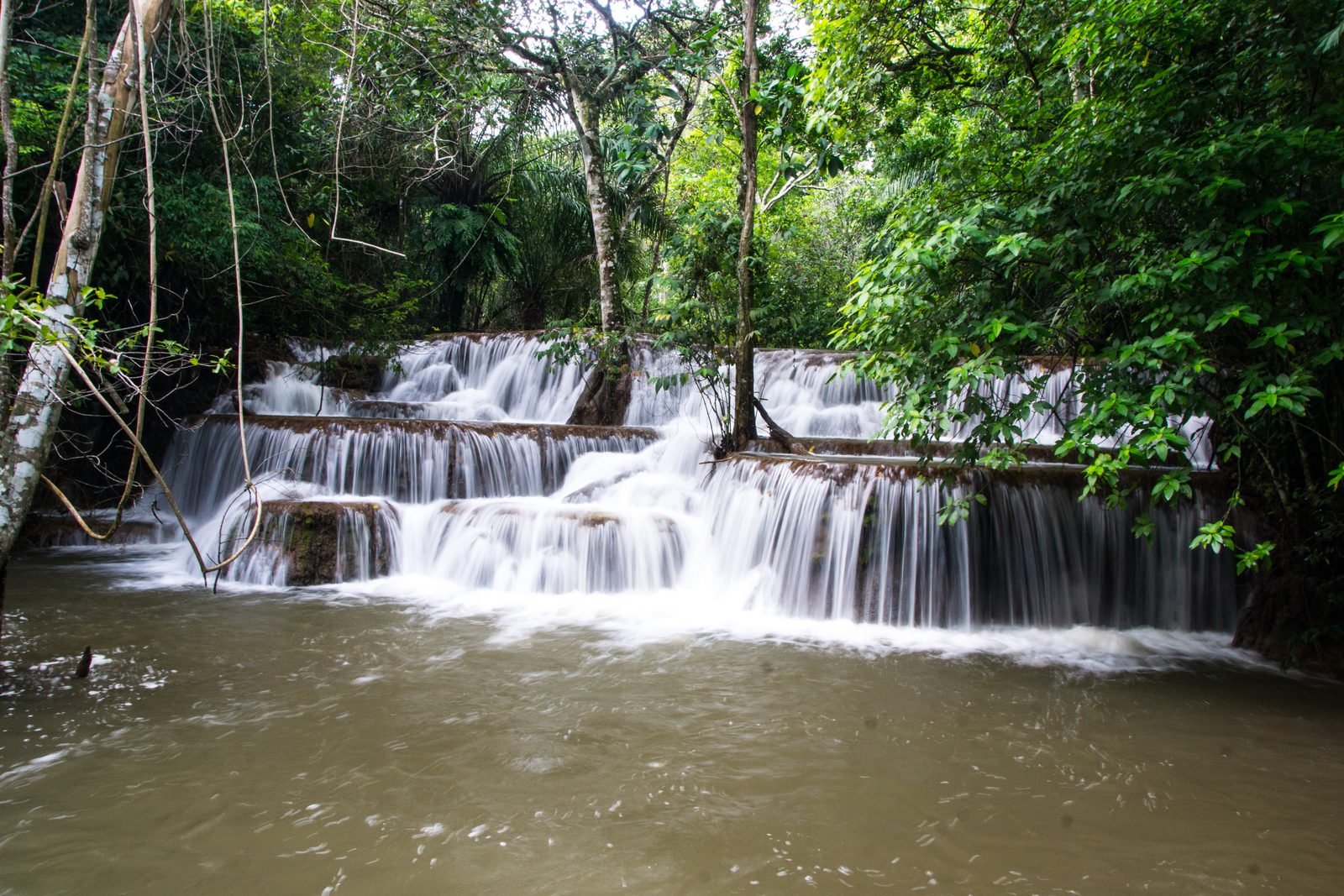
Boca da Onça Ecotour is the region’s longest waterfall trip. The property has 15 waterfalls and drops, 9 of them with swimming spots, including the 156-meter Boca da Onça falls, which the operator presents as the tallest in Mato Grosso do Sul. It also runs a 90-meter platform rappel in the Rio Salobra canyon, billed as Brazil’s biggest. The full trail requires reasonable fitness. 2026 price: Adventure Trail from R$555 (low); Discovery Trail R$665 (low) and R$775 (high); rappel R$800 (low) and R$905 (high).
Estância Mimosa
Estância Mimosa is a trail-and-waterfall trip with natural swimming pools, birdwatching and a regional lunch cooked on a wood-fired stove. It belongs to the same group as Rio da Prata and Lagoa Misteriosa, protects part of its land as a private reserve and has its adventure-safety management certified to the ISO 21101 standard. It is a good choice for waterfalls with less physical effort than Boca da Onça. 2026 price: R$340 (low) and R$410 (high).
Municipal Beach Park (Balneário Municipal)
The Balneário Municipal is 7 km from the center on the Rio Formoso and is Bonito’s cheapest and most relaxed outing. There are shallow and deeper sections, fish that swim right up to you, lawns and shade. You may bring your own food, and there are no group times: you arrive and stay the day. 2026 price: R$70 (low) and R$98 (high).
Rio Formoso: rafting, tubing and river parks
The Rio Formoso is the main river near town and the base for rafting and tubing (“boia-cross”) trips, with small rapids and drops. A raft trip on the Formoso costs R$190 (low) and R$220 (high); tubing at Parque Ecológico Rio Formoso costs R$198 and R$250, and at Hotel Cabanas, R$160. These are fun rather than contemplative trips and work well with teenagers.
Other tours worth asking about
- Lagoa Misteriosa: a flooded sinkhole with blue water, open only from April to September. R$270 (low) and R$298 (high).
- Rio Azul: about 91 km from the center, combining a trail to the spring, a short snorkel and a boat ride on the Rio Salobra. R$498 (low) and R$598 (high).
- Barra do Sucuri: a snorkel where the Sucuri meets the Formoso. R$269 (low) and R$348 (high).
- Gruta São Miguel: about 18 km from the center, a dry cave with formations, reached by a suspended walkway over the forest. R$108 (low) and R$143 (high).
- Parque das Cachoeiras: a trail past a chain of swimmable waterfalls. R$260 (low) and R$312 (high).
- Ceita Corê: about 36 km from the center on the MS-178, with a 4 km trail past six or seven waterfalls, a zipline and lunch. R$516 (low) and R$580 (high).
- Rio do Peixe: waterfalls and home-cooked lunch on a ranch. R$305 (low) and R$360 (high).
- Serra da Bodoquena trail: a hike in the plateau’s hills. R$340 (low) and R$440 (high).
- Projeto Jiboia: an evening talk about snakes, in town. R$80.
Day trips to Jardim and Bodoquena
Direct answer: Rio da Prata, the Macaw Sinkhole and Lagoa Misteriosa are in the municipality of Jardim; Boca da Onça and Nascente Azul are on the way to Bodoquena. Allow 30 to 60 minutes of driving from Bonito and book transport together with your voucher.
Many visitors arrive without realizing that some of the most famous tours are not in Bonito at all. Jardim, to the south, is home to Recanto Ecológico Rio da Prata, Lagoa Misteriosa and Buraco das Araras. Because they are close to each other, you can pair Rio da Prata in the morning with the Macaw Sinkhole in the late afternoon on the same day out. Heading north, the road from Bonito to Bodoquena leads to Nascente Azul, Ceita Corê (on the MS-178) and Boca da Onça, which lies toward the hills and the Rio Salobra canyon. The Serra da Bodoquena National Park spans Bonito, Bodoquena, Jardim and Porto Murtinho, but visits inside the park are still restricted; tours take place on private land around it.
If your plan includes two or more trips to Jardim or Bodoquena, consider renting a car. Shared agency transport is charged per person and, for Rio da Prata, cost about R$148 per person in 2026 according to local agencies, which adds up quickly for families.
What to eat in Bonito
Direct answer: Bonito’s food mixes river fish, Paraguayan heritage and ranch cooking. Try pacu and pintado (roasted, fried or stewed), sopa paraguaia, which is actually a savory cornbread, chipa cheese bread, iced tereré and dishes made with farm-raised caiman.
Mato Grosso do Sul borders Paraguay and Bolivia, and it shows on the plate. Sopa paraguaia (“Paraguayan soup”) is a trick name: it is a firm, savory cake of corn, cheese, onion and eggs, served as a side. Chipa is a cheese bread of Paraguayan origin, shaped like a horseshoe or a ball, sold at bakeries and served at pousada breakfasts. Tereré, yerba mate brewed with cold water and sipped from a horn or cup called a guampa, is almost a social ritual in the region; Paraguay’s tereré practices were added to UNESCO’s Intangible Cultural Heritage list in 2020. If your guide passes the cup around on a tour, take a sip and pass it on.
River fish are the stars. Pacu usually comes roasted with crispy ribs, and pintado, a large catfish, appears as fried strips, grilled or in mojica, a stew with cassava. Caiman meat (jacaré), mild in flavor, is served at some restaurants as strips, ceviche or breaded; it comes from licensed commercial farms, not from hunting. At Casa do João, a family restaurant open since 2007, the menu includes regional fish and caiman dishes. On full-day tours such as Rio da Prata and Estância Mimosa, the included lunch is home-style Mato Grosso do Sul food served from a wood-fired stove or buffet, with rice, beans, cassava, meats and ranch desserts; the dulce de leche at Rio da Prata has a following of its own.
Bonito’s center packs restaurants, ice-cream shops and bars along Rua Coronel Pilad Rebuá and around Praça da Liberdade, the town’s evening meeting point. Practical tip: tours start early and some are far away, so many people eat lunch at the attraction and save restaurants for dinner. Tipping is not mandatory in Brazil, but most restaurants add an optional 10% service charge to the bill.
How much does a trip to Bonito cost in 2026?
Direct answer: after flights and lodging, tours are the biggest expense. A 4-day plan with Rio da Prata, Rio Sucuri, Gruta do Lago Azul, the Macaw Sinkhole and the Municipal Beach Park costs about R$1,190 (low season) to R$1,470 (high season) per adult in vouchers alone, plus the conservation fee and transport to the sites.
| Item | 2026 price | Notes |
|---|---|---|
| Environmental Conservation Fee (TCA) | R$15 per person per tour day | Under-7s exempt |
| Rio da Prata | R$470 (low) and R$570 (high) | Lunch included; transport extra |
| Rio Sucuri | R$349 (low) and R$438 (high) | Boat only, R$161 |
| Aquário Natural | R$352 (low) and R$436 (high) | 7 km from the center |
| Nascente Azul (snorkel) | R$374 (low) and R$462 (high) | Includes the bathing area |
| Gruta do Lago Azul | R$120 (low) and R$180 (high) | Confirm the current price |
| Anhumas Abyss | R$997 (contemplation) to R$1,898 (discover dive, high) | Very limited places |
| Macaw Sinkhole | R$185 | Children 6 to 12, R$135 |
| Estância Mimosa | R$340 (low) and R$410 (high) | Wood-stove lunch |
| Boca da Onça (Discovery Trail) | R$665 (low) and R$775 (high) | 90 m rappel, R$800 and R$905 |
| Municipal Beach Park | R$70 (low) and R$98 (high) | Bring your own food |
| Bus Campo Grande to Bonito | about R$128 | About 4 h 50 min |
| Shared transport to Rio da Prata | about R$148 per person | Booked through the agency |
The example adds up low-season prices: Rio da Prata (R$470), Rio Sucuri (R$349), Gruta do Lago Azul (R$120), Macaw Sinkhole (R$185) and Municipal Beach Park (R$70) total R$1,194 per adult. In high season the same set comes to R$1,471. Tour prices come from the 2026 Acqua Viagens table and other local agencies, checked in October 2026; always ask how long a price table is valid, since some attractions adjust mid-year. To save money, travel in low season, rent a car if you are a group, and alternate expensive tours with the Municipal Beach Park and the Blue Lake Cave.
Bonito itineraries: 3, 4 and 5 days
Direct answer: with 3 days, do one snorkel, the Gruta do Lago Azul and the Macaw Sinkhole. With 4 days, add waterfalls at Estância Mimosa or Boca da Onça. With 5 days, add the Anhumas Abyss or a second snorkel and an easy day at the Municipal Beach Park.
The logic is to group tours by direction (Jardim to the south, Bodoquena to the north), schedule snorkels early in the trip in case rain forces a change, and never stack two long tours on the same day.
3-day itinerary
- Day 1: arrive, buy vouchers and pay the TCA. In the afternoon, Aquário Natural, 7 km from the center. Evening at Praça da Liberdade and dinner in town.
- Day 2: Rio da Prata in the morning, with lunch at the ranch, and the Macaw Sinkhole in the late afternoon, both in Jardim.
- Day 3: Gruta do Lago Azul early and the Municipal Beach Park until it is time to head to the airport.
4-day itinerary
- Day 1: arrive and spend the afternoon at the Municipal Beach Park or tubing on the Rio Formoso.
- Day 2: Rio da Prata and the Macaw Sinkhole.
- Day 3: Gruta do Lago Azul in the morning and Rio Sucuri in the afternoon.
- Day 4: Estância Mimosa, with a trail, waterfall swims and a wood-stove lunch.
5-day itinerary
- Day 1: arrive, do the Anhumas Abyss check-in at the operator’s office and walk around town.
- Day 2: Anhumas Abyss (it fills much of the day) and rest in the afternoon.
- Day 3: Rio da Prata and the Macaw Sinkhole.
- Day 4: Boca da Onça if you are fit, or Nascente Azul if you prefer snorkeling and downtime.
- Day 5: Gruta do Lago Azul plus Rio Sucuri or the Municipal Beach Park before your flight.
With young children, check each tour’s minimum age: at Rio da Prata it is 5, and some adventure activities require older kids. With more time, Bonito pairs well with a few days in the southern Pantanal.
Safety and sustainability in Bonito
Direct answer: on Bonito’s snorkels, avoid regular sunscreen and insect repellent (attractions ask for the bare minimum, ideally eco-friendly products), do not stand on the riverbed and do not feed the fish. Always follow your guide, use the gear provided and respect each site’s rules. Those rules are what keep the water clear.
The rules exist because these ecosystems are fragile. Sunscreen and repellent leave residues in the water that affect fish and plants. Recanto Ecológico Rio da Prata, for example, asks visitors to use as little sunscreen as possible, only on skin the wetsuit does not cover (face, neck and backs of the legs), preferably an eco-friendly formula, and to use repellent sparingly, ideally natural or citronella-based. Leggings under the short-legged wetsuit solve much of the problem at midday. Standing on the bottom stirs up sediment and destroys aquatic plants, so on snorkels you keep your body horizontal, legs still and arms by your sides. Feeding fish and wild animals is also forbidden.
On safety, tours run with licensed guides and gear supplied by the attraction, such as wetsuits, masks, snorkels and life vests, and several sites have adventure-tourism safety management certified to the ISO 21101 standard. Each activity has its own medical restrictions: tell your guide and the front desk about any health condition, and note that you cannot join tours after drinking alcohol. On trails, wear closed shoes with good grip and carry water and a light snack. The visitor insurance included with the TCA covers personal accidents during your stay, but it does not replace travel insurance for international visitors.
In town, Bonito is calm and its center is easy to explore on foot. At night, rural roads are poorly lit and animals cross them, so avoid long drives after dark.
Where to stay in Bonito
Direct answer: to walk to dinner at night, stay downtown near Rua Coronel Pilad Rebuá and Praça da Liberdade. For more nature, look at hotels on the Bonito–Três Morros road or the road to the Municipal Beach Park, a few kilometers from the center. Every link below goes to the property’s official website and was checked in October 2026; we do not use agency or booking-site links.
Bonito has lodging for every budget, from a hostel to a full resort. Most pousadas (small guesthouses) have their own or a partner tour agency, which makes it easy to buy vouchers at check-in. Rates vary a lot between low and high season, so check prices directly on the official website or via the WhatsApp number listed there.
Zagaia Eco Resort (resort, Bonito–Três Morros road)
Zagaia Eco Resort sits at km 0 of the Bonito–Três Morros road, just outside town, on large grounds with views of the Serra da Bodoquena. It is the most complete option for families who want resort facilities, with several pools, heated covered pools and hot tubs, a spa, a kids club and event rooms, plus an in-house tour agency to arrange your vouchers.
Wetiga Hotel (hotel, downtown)
Wetiga Hotel is at Rua Coronel Pilad Rebuá 679, Bonito’s main street, a few blocks from Praça da Liberdade. It has pools, a restaurant, an events center, an electric-vehicle charger and a tour agency on site. A good choice if you want comfort and to walk to dinner.
Marruá Hotel (hotel, Vila Donária)
Marruá Hotel is at Rua Joana Sorta 1173, close to the center, and has been running for more than 20 years. It has 120 rooms and a Pantanal-themed suite inspired by the culture of the region’s wetlands.
Arte da Natureza Hotel Bonito (hotel, Alvorada)
Arte da Natureza Hotel Bonito is at Rua Santana do Paraíso 1027, a short walk from the center. It has four pools, two of them heated, suites with private pools and a water park, and it claims the largest glass-sided pool in South America. It works well for couples and for families who want to relax at the hotel in the late afternoon.
Hotel Cabanas (leisure hotel, Municipal Beach Park road)
Hotel Cabanas is at km 6 of the road to the Municipal Beach Park, on the banks of the Formoso and Formosinho rivers. Guests stay in cabins and bungalows and have private river bathing spots, stand-up paddle, kayaks, a zipline and a heated pool. It suits travelers who want to spend part of the trip at the hotel itself.
Pousada Olho D’Água (guesthouse, Bonito–Três Morros road)
Pousada Olho D’Água is at km 1 of the Bonito–Três Morros road, about 3 km from the center, on a 40,000-square-meter property. It has 24 rooms and a quiet, rural feel, a few minutes’ drive from the restaurants.
Pousada Galeria Artes (guesthouse, downtown)
Pousada Galeria Artes is at Rua Luiz da Costa Leite 1053, downtown. It is pet friendly and completely smoke-free, with a pool with hydromassage and its own tour agency. Rooms sleep 1 to 6 guests, handy for families and groups of friends.
Pousada Remanso (guesthouse, downtown)
Pousada Remanso is on Bonito’s main street, close to restaurants and agencies. It has a pool with a waterfall and hydromassage and a breakfast with regional items. Practical if you plan to use shared tour transport and do everything else on foot.
Bonito HI Hostel e Pousada (hostel, Bairro Formoso)
Bonito HI Hostel e Pousada is at Rua Doutor Pires 850, about 1.5 km from the center, and has been open since 1997. It offers shared rooms, private suites, family options and a tiny house, plus a pool, breakfast and an on-site tour agency. The pick for budget and solo travelers who want to meet other people.
Video: Bonito by Visit Brasil
This official clip from Visit Brasil, the tourism brand of Brazil’s national tourism board Embratur, shows the Rio da Prata snorkel in about 30 seconds.
Frequently asked questions about Bonito
When is the best time to visit Bonito, Brazil?
April to October, the dry season, usually brings the clearest river water and fewer rain cancellations. August and September are favorites for snorkeling. From December 15 to January 15, on clear mornings, sunlight lights up the lake in the Gruta do Lago Azul, but that is the rainy season.
How many days do you need in Bonito?
Four or five days is ideal. In 3 days you can do one snorkel, the Gruta do Lago Azul and the Macaw Sinkhole. Five days leaves room for the Anhumas Abyss, a second snorkel and a waterfall trail without rushing.
Can you visit Bonito’s attractions without a tour agency?
In practice, no. Attractions only admit visitors with a single voucher issued by an accredited agency, with a set date and time and a mandatory guide. The price is the same at every agency, and you can book remotely by email, WhatsApp or the agency’s website.
How much does a trip to Bonito cost in 2026?
In tours alone, a 4-day plan with Rio da Prata, Rio Sucuri, Gruta do Lago Azul, the Macaw Sinkhole and the Municipal Beach Park costs about R$1,190 per adult in low season and R$1,470 in high season, based on 2026 price tables. Add the R$15-per-day conservation fee, transport, lodging and food.
How do you get to Bonito from São Paulo?
There are direct flights to Bonito Regional Airport from Campinas (Azul), São Paulo-Congonhas (Gol) and São Paulo-Guarulhos (LATAM) on set days of the week. Otherwise, fly to Campo Grande and continue about 290 km by car, transfer or Cruzeiro do Sul bus, a trip of about 4 hours 50 minutes.
Which is the best snorkeling tour in Bonito?
Rio da Prata, in Jardim, is the most famous, with about 2.3 km of floating and lunch included. Rio Sucuri, 19 km from the center, offers extremely clear water closer to town. Aquário Natural is the nearest and good for kids, and Nascente Azul combines a snorkel with a day at its bathing area.
Do you need to know how to swim to snorkel in Bonito?
You do not need to be a swimmer. The mandatory wetsuit already keeps you afloat, and Rio da Prata says it provides a life vest on request. You do need to get used to the mask and snorkel and hold the floating position, face down with legs still; anyone who cannot adapt is offered an alternative tour.
What is Bonito’s Environmental Conservation Fee?
It is a city fee of R$15 per person per day on which you do tours, charged since December 20, 2025 and paid only at turistapornatureza.com.br. Children under 7, residents and local workers are exempt, and the fee includes visitor accident insurance. The fee is being challenged in court but remains in force in October 2026.
When does the sunbeam light up the Blue Lake Cave?
Between December 15 and January 15, usually from 8 to 10 a.m. on clear days, sunlight enters the cave mouth and turns the lake bright blue. To catch it, book the first morning slot and check the weather forecast.
Can you wear sunscreen while snorkeling in Bonito?
Attractions ask for the bare minimum. Rio da Prata advises applying sunscreen only where the wetsuit does not cover, such as the face, neck and backs of the legs, preferably an eco-friendly formula, and using repellent sparingly. Leggings under the wetsuit help protect you from the sun.
Is Bonito worth visiting?
Direct answer: yes, especially if you love nature and want a well-organized trip. The clear water, caves and easy wildlife viewing are unique in Brazil, and the voucher system keeps tours controlled and guided. Tours are expensive, so budget carefully and book ahead.
Bonito is a very different trip from Brazil’s coast: the appeal is slipping into a river so clear it looks like an aquarium, descending to an underground lake, watching wild macaws up close and ending the day with tereré on the town square. It works for couples, families and solo travelers at any time of year, as long as you match your expectations to the season. To compare it with other nature trips on Explora Brasil, see our guides to Iguaçu Falls and Fernando de Noronha, which also caps visitor numbers and charges an environmental fee. For cities and beaches, read our guides to Rio de Janeiro, Salvador and Florianópolis; for a mountain-town break, the Gramado guide.
Sources
- Bonito Tourism Department (Sectur): turismo.bonito.ms.gov.br (beds, distances, single voucher, flights and TCA)
- IBGE Cidades: Bonito (MS) overview and history (2022 census population, area and town history)
- City of Bonito, Environmental Conservation Fee: turistapornatureza.com.br (fee, exemptions and visitor insurance)
- ICMBio: Serra da Bodoquena National Park (area and municipalities)
- Gruta do Lago Azul: grutadolagoazul.com.br (history, heritage listing and visits)
- Abismo Anhumas: abismoanhumas.com.br (rappel, options and prices through February 2027)
- Recanto Ecológico Rio da Prata: FAQ and preliminary information (route, gear, sunscreen and minimum age)
- Rio Sucuri: riosucuri.com.br (snorkel and boat trip)
- Aquário Natural: aquarionatural.com.br (distance and facilities)
- Buraco das Araras: buracodasararas.com.br (sinkhole size, birds and prices)
- Boca da Onça Ecotour: bocadaonca.com.br (waterfalls, rappel and prices)
- Estância Mimosa: estanciamimosa.com.br (trail, waterfalls and certification)
- Acqua Viagens: 2026 tour price table (low and high season prices, updated 02/16/2026)
- Imasul: imasul.ms.gov.br (fishing ban during the spawning season in Mato Grosso do Sul)
- UNESCO: Tereré on the Intangible Cultural Heritage list (2020 inscription)