Pipa is a beach village in the municipality of Tibau do Sul, on the southern coast of Rio Grande do Norte in Brazil’s Northeast, about 85 km from Natal and 95 km from Natal’s airport. The village sits on top of the cliffs, and below it runs a chain of pale-sand beaches with green water. This Pipa Brazil travel guide comes down to a few essentials: walk to Baía dos Golfinhos (Dolphin Bay) at low tide to swim near the Guiana dolphins, watch the sunset from the Chapadão cliffs above Praia do Amor, take the forest trails at the Santuário Ecológico, ride a boat on the Guaraíras Lagoon in the late afternoon and explore the neighboring beaches, from Madeiro down to Sibaúma. At night, everything happens on Avenida Baía dos Golfinhos, the main street, lined with restaurants, bars and shops.
We put this guide together in October 2026 and checked the facts against official and local sources: Tibau do Sul’s municipal laws 854/2024 and 876/2024 (which regulate boat trips and the environmental fee), IBGE (Brazil’s statistics institute), INMET (the national weather institute), the Palmares Cultural Foundation, ICMBio, reporting by g1 and Estadão, the local Guia de Pipa for bus times and the hotels’ own websites. It covers the village’s history and the rules that protect the dolphins, where to stay, when to go, how to get there from Natal, how the tides work, what to do on each beach, what things cost, two-to-four-day itineraries and ten places to stay, each linked to its official site. Where we could not find a reliable source, we say so.
Quick facts: Pipa (Tibau do Sul, Rio Grande do Norte)
- Where it is: on the southern coast of Rio Grande do Norte state, in the municipality of Tibau do Sul (102.7 km² and 16,929 people in the 2022 census; IBGE estimates 18,302 for 2026). Pipa is a district, not a town of its own.
- Why go: colorful cliffs, one beach after another, Guiana dolphins that come close to the sand at Dolphin Bay, a lively village after dark and the Guaraíras Lagoon next door.
- Golden rule: the tide decides. Dolphin Bay and the walks between several beaches only work at low tide. Check the tide table before heading out and never sit right under the cliffs.
- Best time to go: September to February, when it rarely rains. The rainy season runs from March to July and peaks in June (almost 350 mm on average in Natal). Peak season: December to February, Carnival and July.
- Getting there: Natal airport is about 95 km away (1.5 to 2 hours by car or transfer). Viação Riograndense buses leave Natal’s bus station several times a day, taking about 2 hours.
- What it costs: the speedboat trip to Dolphin Bay runs about R$ 70 per person plus the municipal environmental fee of R$ 10 (children up to 9 are exempt; seniors and students pay half). The Santuário Ecológico charges about R$ 30 per person. A private airport transfer starts at R$ 250.50 per car.
- How many days: three days for the village, the beaches and the lagoon; four or five to add Barra do Cunhaú, Baía Formosa or a day trip to João Pessoa.
- Pack: trail sandals, sunscreen, a hat, cash and a Brazilian payment app or card for beach shacks, and the tide table saved on your phone.
History of Pipa and Tibau do Sul
Direct answer: Tibau do Sul grew out of 17th-century Indigenous mission villages, became a district in 1911 and only became a municipality in 1963. Pipa was a fishing village for centuries. Tourism began in the 1970s, when surfers discovered its waves and cliffs, and today it is one of the best-known destinations in Brazil’s Northeast.
In the early 17th century, the land of today’s municipality belonged to the area of the Aldeia Antônia and later to the mission village of São João Batista de Guaraíras, which lasted until 1760, according to the history compiled on Wikipedia from IBGE and city hall records. That year the mission became a town attached to Arez. The Potiguara people who lived on this coast traded brazilwood with French smugglers and later dealt with the Dutch before the Portuguese took firm control. The name Tibau comes from an Indigenous language and is usually translated as “between two waters,” because the town sits between the Guaraíras Lagoon and the Atlantic.
From fishing village to municipality
Life in Tibau revolved around fishing, the lagoon and small farms. A school opened in 1873, and the settlement became a district of Goianinha in 1911. In the 1920s, heavy rain caused the Guaraíras Lagoon to burst its banks, and the flood destroyed houses and plots, so residents moved the village to higher ground, where it still stands. In 1953 the district became a vila (a small town) named Tibau, and a state law of 1958 renamed it Tibau do Sul (“southern Tibau”) to avoid confusion with the Tibau near Mossoró, on the state’s northern coast. It split from Goianinha and became a municipality under state law 2,803 of April 3, 1963, and April 3 is still celebrated as its anniversary.
Where the name Pipa comes from
The most common explanation goes back to Portuguese sailors. From the sea, they supposedly saw a rock shaped like a pipa, a wine barrel, and began using the name as a landmark. No document proves the story, but guides, locals and Wikipedia all repeat it.
The surfers arrive
Until the 1970s, Pipa was a fishing village with no paved road, no electricity in many homes and hardly any visitors. The first to arrive in numbers were surfers from Natal and other states, drawn by the waves at Praia do Amor and Praia do Centro. Backpackers followed, then foreigners who bought land and opened guesthouses, and from the 1990s organized tourism. The RN-003 road, which links the BR-101 highway at Goianinha with Tibau do Sul and Pipa, made the trip from Natal much easier.
Pipa today
The village grew along Avenida Baía dos Golfinhos, which is packed with restaurants, bars, shops, ice-cream parlors and tour agencies. Many fishermen’s houses became guesthouses, and plenty of foreigners live and work here, which explains the international menus and the number of languages you hear on the street. The calendar includes the Pipa Food Festival, usually in early October, FLIPIPA, a literary festival held since 2009, and the feast of St Anthony, the municipality’s patron saint, a local holiday on June 13. Tibau do Sul, the municipal seat, remains quieter, focused on the lagoon and fishing.
Protected areas: dolphins, turtles and Atlantic Forest
Direct answer: the Guiana dolphins of Dolphin Bay and Madeiro live inside a municipal reserve, REFAUTS (Tibau do Sul Coastal Wildlife Reserve). The beaches have been a sea-turtle protection area since 1996, and the Guaraíras Lagoon is part of the Bonfim-Guaraíra state environmental protection area. That is why there are limits on boats, set hours for trips and an environmental fee.
Pipa has unusual nature for such a busy village. On a single walk you can see cliffs, patches of Atlantic Forest, mangroves, reefs and dolphins. That mix depends on a few legal protections, and knowing them makes the rules feel less like red tape.
REFAUTS and the Guiana dolphins
The Guiana dolphin (Sotalia guianensis), called boto-cinza in Portuguese, is a small gray dolphin that lives in coastal waters and estuaries of the Atlantic, from Central America to southern Brazil. In Pipa, it frequents the coves of Madeiro and Dolphin Bay, where it comes close to the breaking waves, especially at low tide. To protect the animals, Tibau do Sul created the Tibau do Sul Coastal Wildlife Reserve, REFAUTS, by municipal decree in 2006. In 2018, Municipal Law 616 re-created the reserve on a firmer legal footing, covering the stretch of sea and the coves used by dolphins and turtles.
Sea turtles
Resolution 10 of CONAMA, Brazil’s national environment council, dated October 24, 1996, recognizes the Pipa beach area as a sea-turtle protection zone. Turtles are often seen near the rocks and reefs, and the boat to Dolphin Bay sometimes crosses paths with them. Stay away from nests, do not use strong flashlights on the beach at night and never feed any animal.
Bonfim-Guaraíra and Mata da Pipa
The Guaraíras Lagoon, which meets the sea at Tibau do Sul, lies within the Bonfim-Guaraíra Environmental Protection Area, created by the state government on March 22, 1999. It covers about 42,000 hectares across six municipalities, protecting lagoons, dunes, mangroves and Atlantic Forest. In 2006 the state also created Mata da Pipa State Park, an area of Atlantic Forest near the village. The cliffs, for their part, are fragile sedimentary formations: erosion is natural and is sped up by spring tides (the highest tides of the month) and by building on top.
What this means for you
In practice, four things. First, boat trips can only be run by licensed boats, within hours set by law, and with a daily limit on trips. Second, there is an Environmental Preservation Fee of R$ 10 per passenger per trip, collected when you board. Third, swimming with dolphins does not mean touching, chasing or feeding them: any contact should come from them, and keeping your distance is your job. Fourth, a cliff is not a place for shade. Sit well away from the base, especially after rain and at high tide.
Where to stay in Pipa: village center, Chapadão, Madeiro or Tibau do Sul
Direct answer: stay in the village center, near Avenida Baía dos Golfinhos, if you want to walk everywhere and enjoy the nightlife. Pick the Chapadão and Praia do Amor area for views and sunsets while staying close to the center. Madeiro and the road to Tibau do Sul have hotels with more nature and quiet, and Sibaúma and Tibau do Sul suit travelers who want peace and have a car.
Pipa is small, but it has steep streets, narrow sidewalks and little parking. So where you stay shapes the trip. Stay in the center and you can leave the car parked and walk everywhere. Stay farther out and you will depend on a car, taxi, moto-taxi or transfer at night.
The center and Avenida Baía dos Golfinhos
This is the heart of Pipa. The avenue runs down toward the sea and holds most of the restaurants, bars, small grocery stores, pharmacies and tour agencies. Small guesthouses and hotels at different prices fill the side streets, and Praia do Centro is a few minutes’ walk away. The price of convenience is noise: on holidays and in high season, music goes on late. Ask for a room at the back if you are a light sleeper.
Chapadão and Praia do Amor
South of the center, Rua Praia do Amor leads to guesthouses overlooking the Chapadão cliffs and Praia do Amor, the surfers’ favorite beach. It is the best area if you want to watch the sunset without leaving your hotel while staying 10 to 15 minutes’ walk from the center. Some places have stairs straight down to the beach.
Dolphin Bay and Madeiro
At the entrance to the village, the avenue runs above Dolphin Bay, and a few hotels sit on the clifftop overlooking the cove. Farther along, on the road to Tibau do Sul, are the Madeiro hotels, some set in large areas of forest. They are great for pools, nature and silence, but getting to the center at night means a car or taxi.
Tibau do Sul and the lagoon
The municipal seat is about 9 km from Pipa, where the Guaraíras Lagoon meets the sea. There are guesthouses and chalets with lagoon views, perfect for sunsets and for travelers who like calm. Nightlife is much quieter, and almost everything requires a car.
Sibaúma and the south
South of Pipa, past Praia do Amor, Minas and Cancela, lies Sibaúma, a quilombo community (founded by descendants of enslaved Africans) set among dunes and wide beaches. There are upscale places to stay and secluded houses. It is a choice for travelers seeking privacy who do not mind relying on a car for everything.
Weather and the best time to visit Pipa
Direct answer: the best time to visit Pipa is September to February, with sun almost every day and little rain. October and November are the driest months. The rainy season runs from March to July, peaking between April and July. Temperatures barely change: highs between 28 °C and 31 °C (82–88 °F) all year.
Pipa has no official weather station with a long data record, so we use INMET’s 1991–2020 climate normals for Natal, about 85 km away, as a reference. The pattern along Rio Grande do Norte’s southern coast is the same, but Pipa can have slightly different days because of the forest and the cliffs.
| Month | Average low | Average high | Average rainfall |
|---|---|---|---|
| January | 24.4 °C | 30.4 °C | 80.7 mm |
| February | 24.6 °C | 30.7 °C | 99.8 mm |
| March | 24.2 °C | 30.7 °C | 200.8 mm |
| April | 23.7 °C | 30.3 °C | 240.5 mm |
| May | 23.1 °C | 29.8 °C | 221.8 mm |
| June | 21.9 °C | 28.8 °C | 348.8 mm |
| July | 21.0 °C | 28.4 °C | 254.0 mm |
| August | 21.2 °C | 28.6 °C | 118.7 mm |
| September | 22.2 °C | 29.0 °C | 54.0 mm |
| October | 23.5 °C | 29.7 °C | 20.6 mm |
| November | 24.2 °C | 30.0 °C | 22.5 mm |
| December | 24.7 °C | 30.4 °C | 29.0 mm |
Source: INMET (Brazil’s National Institute of Meteorology), 1991–2020 climate normals, Natal station (used as a reference for Pipa).
High and low season
High season runs from Christmas to Carnival, with another peak in July during Brazilian school holidays, even though it is a rainy month. On those dates lodging prices go up, the restaurants on the avenue fill up and you need to book tours ahead. New Year’s Eve and Carnival sell out guesthouses months in advance.
September, October and November offer the best balance: little rain, good sea conditions, a lively village without crowds and lower prices than in summer. March and August can also be good, with passing showers. From April to July it rains often, but rarely all day. It is a cheaper season if you don’t mind swapping an afternoon at the beach for a stroll around the village.
Wind, waves and the sea
The trade wind blows from the sea almost all year and is stronger in the second half of the year, which draws kitesurfers to the region. Waves are most consistent at Praia do Amor and Praia do Centro, where the surf schools are. For calm swimming, conditions are best at low tide, when rocks and reefs hold back part of the swell.
How to get to Pipa
Direct answer: most people fly into Natal International Airport, in São Gonçalo do Amarante, and drive or take a transfer about 95 km to Pipa (1.5 to 2 hours). From Natal itself, Viação Riograndense buses leave the main bus station several times a day. João Pessoa (about 140 km) and Recife (about 260 km) are alternative airports.
From Natal airport
Governador Aluízio Alves International Airport sits in São Gonçalo do Amarante, northwest of Natal. From there to Pipa is about 95 km, skirting Natal to reach the BR-101 highway and following it to Goianinha, where the RN-003 road heads down to the coast. OpenStreetMap’s route planner estimates about 1.5 hours without traffic, but allow 1.5 to 2 hours, especially in the late afternoon or if there is roadwork on the BR-101.
Your options are a rental car, a private or shared transfer, a taxi or a ride-hailing app. Luck Receptivo, one of the region’s largest tour operators, was selling the private airport–Pipa transfer in October 2026 from R$ 250.50 per vehicle (minimum two adults) until December 18, 2026, and R$ 310 between December 18 and January 31, 2027. Many guesthouses can also recommend trusted drivers.
From Natal
From Ponta Negra, Natal’s hotel district, Pipa is about 82 km away, also via the BR-101 and RN-003, in a little over an hour. Many people visit Pipa as a day trip from Natal, but the village deserves at least two nights. See also our Natal travel guide.
By bus
Viação Riograndense runs the Natal–Pipa route from Natal’s bus station. The trip takes about 2 hours and the fare was R$ 28.50, plus a R$ 3 boarding fee at the station, according to the local Guia de Pipa, updated October 11, 2026. Listed departures from Natal to Pipa were 6:00, 7:10, 8:00, 9:15, 11:00, 12:00, 13:00, 14:10, 15:00, 15:50, 17:00 and 18:10. Informal shared transport also runs for about R$ 28. Schedules change, so check at the station or with the company before you travel.
A third option is to go to Goianinha, on the BR-101, and take the local cooperative’s vans (COOPIPA), which run to Pipa on demand, with waits of 15 to 45 minutes.
From João Pessoa and Recife
From João Pessoa International Airport to Pipa is about 140 km, a little over 2 hours by car, all on the BR-101. From Recife airport it is about 260 km, close to 4 hours. That makes sense if you find a cheaper flight or plan a coastal road trip combining Pipa with Paraíba and Pernambuco. Luck Receptivo also sells a day trip from Pipa to João Pessoa, from R$ 220 per person (October 2026).
Getting around Pipa
Direct answer: within the village, on foot. Distances are short, but there are steep streets and narrow sidewalks. For Madeiro, Tibau do Sul, Sibaúma and the more distant beaches, use a car, taxi, moto-taxi, buggy or an organized tour. Parking in the center is hard in high season.
Avenida Baía dos Golfinhos is Pipa’s backbone. It enters the village from Madeiro, runs above Dolphin Bay and drops down to the center. Almost everything a visitor needs is on it or a few steps away. Praia do Centro lies at the end of the streets that run down from the avenue, and Praia do Amor and the Chapadão are 10 to 15 minutes’ walk to the south.
Car
A car helps a lot if you are staying in Madeiro, Tibau do Sul or Sibaúma, or if you want to explore Barra do Cunhaú and Baía Formosa on your own. In the center, a car gets in the way: streets are narrow, there is traffic at night and parking is scarce. Choose lodging with parking.
Taxis, moto-taxis and apps
There are taxi stands and plenty of moto-taxis, handy for climbing hills or getting to Madeiro at night. Ride-hailing apps work, but availability varies, especially for the return from more remote spots. Agree on the fare before getting into a taxi.
Buggies, jeeps and quad bikes
Buggy and jeep tours are the classic way to see the beaches to the south and north, such as Sibaúma, Cacimbinhas and Tibau do Sul. In October 2026, Luck Receptivo advertised a jeep tour in Pipa from R$ 128 and a “complete Pipa tour” from R$ 127 per person. Choose licensed buggy drivers and avoid driving on the sand unless you understand the tides.
Tides, boat trips and the environmental fee
Direct answer: in Pipa, low tide opens up walking access to Dolphin Bay and the passages between beaches, and it is when the dolphins come closest. Boat trips follow Municipal Law 854/2024: they run from 9:00 to 16:00, have a minimum price of R$ 70 per passenger and pay the Environmental Preservation Fee (TPA) of R$ 10 per passenger per trip, set by Law 876/2024, with exemption for children up to 9 and half price for seniors and students.
How to read a tide table
A tide table shows each day’s high and low tide times and the water height. The lower the low-tide number, the more sand is exposed. For Pipa, local sites use the port of Natal as the reference. Check the Brazilian Navy’s tide tables or those published by local operators, such as Pipando and Pipa.com.br, before planning each day.
The lowest low tides happen around the full and new moon (spring tides). On those days low water is lower, great for walking between beaches, but high tide is higher too. It is exactly during these tides that the water pounds the base of the cliffs, and the risk of collapse increases.
Law 854/2024
Municipal Law 854 of May 15, 2024, organizes boat tours in Tibau do Sul. Key points:
- trips run from 9:00 to 16:00, with 8:30 to 16:30 possible by authorization;
- the minimum price is R$ 70 per passenger, adjusted yearly for inflation (IPCA);
- the law created a municipal tourism fee of R$ 6 per passenger, later replaced by the R$ 10 TPA (see below);
- each boat may make at most six trips a day in the dolphin reserve and six on the Guaraíras Lagoon;
- the law provides for 15 licensed boats at Praia do Centro in Pipa and 16 on the lagoon;
- catamarans carrying more than 20 passengers need special authorization, with a cap of 240 passengers a day.
In December 2024, Municipal Law 876 merged the fees created by Laws 727/2021, 789/2022 and 854/2024 under the name Environmental Preservation Fee (Taxa de Preservação Ambiental, TPA) and set it at R$ 10 per passenger per trip on boats, open-back “pau de arara” trucks and quad bikes (charged to the driver, for quad bikes), and R$ 3 per passenger on the little tourist “trains”. The fee only applies from age 10. People aged 60 or over and students with a valid ID pay half. That is the amount operators were charging in October 2026, paid when boarding. Bring cash or use Pix (Brazil’s instant payment system).
Dolphins: how to behave
The Guiana dolphins are neither trained nor fed. They show up because the cove is rich in fish and sheltered. Do not touch them, chase them, swim toward them or try to grab a fin. Stay still and let them approach. On boats, the expected practice is to slow down and switch off the engine or put it in neutral near the animals. Avoid any boatman who speeds up over the dolphins; you can report them to city hall.
Things to do in Pipa: beaches, dolphins, trails and the lagoon
Direct answer: the essentials are Dolphin Bay at low tide, sunset at the Chapadão, the trails of the Santuário Ecológico, the boat trip from Praia do Centro, Praia do Madeiro, late afternoon on the Guaraíras Lagoon in Tibau do Sul and a buggy or jeep ride to Sibaúma and Cacimbinhas. At night, have dinner and stroll along Avenida Baía dos Golfinhos.
Pipa’s coast, in the broad sense, runs from the town of Tibau do Sul down to Sibaúma, with about eleven beaches: Tibau do Sul, Cacimbinhas, Giz, Madeiro, Baía dos Golfinhos, Centro, Amor, Minas, Cancela, Sibaúma and Malembá. Many are separated by headlands and only connect along the sand at low tide. Below are the highlights in the order most visitors do them.
Dolphin Bay (Baía dos Golfinhos)
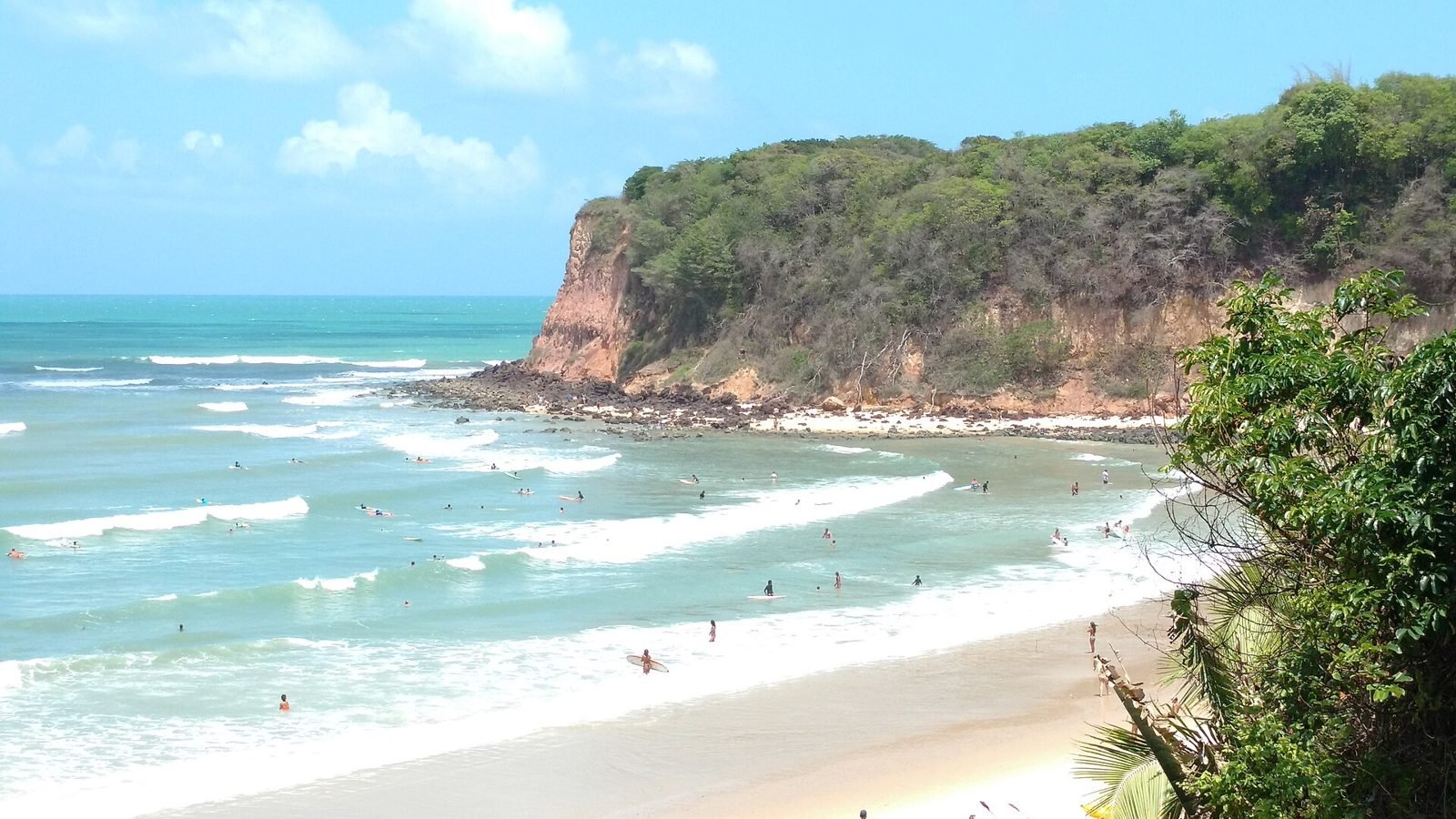
This is Pipa’s most famous beach: a cove of golden sand below a tall, forest-topped cliff, where Guiana dolphins appear near the breaking waves. There is no road access. Along the sand, you start at Praia do Centro and walk about 10 minutes to the left as you face the sea (north), going around the rocks. The other route is via Praia do Madeiro, down a staircase of about 160 steps and then right along the sand.
Both routes only work at low tide. Local operators recommend arriving about 3 hours before low water and heading back before the tide rises, because the water closes the passage at the foot of the cliff. Leave it too late and you will be stuck on a narrow strip of sand or have to wait for hours. If you don’t want to depend on the tide, you can see the cove by speedboat (see below).
The dolphins can turn up at any time, but you are more likely to see them in the morning and at low tide. Enter the water slowly, stay still and watch. Do not try to touch the animals.
Cliff safety
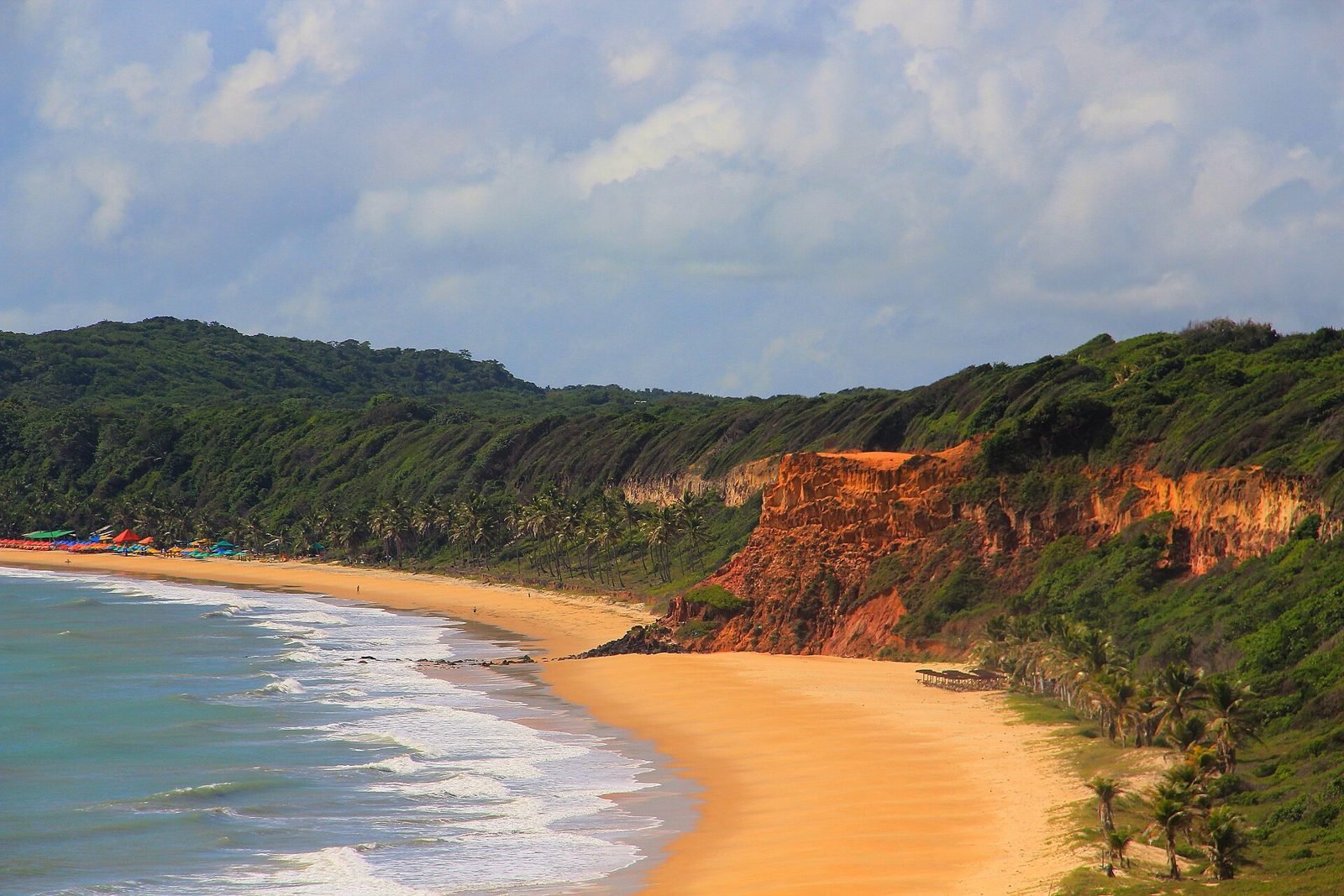
On November 17, 2020, part of a cliff collapsed at Dolphin Bay, killing a couple and their seven-month-old son who were resting on the sand near its base, according to g1 and Estadão. Brazil’s Federal Public Prosecutor’s Office opened an investigation, and Idema, the state environmental agency, warned that spring tides accelerate cliff erosion. The lesson is simple: do not sit, lay out a towel or set up an umbrella against the cliff. Always stay in the middle of the beach or near the water.
Speedboat trip to Dolphin Bay
Boats leave from Praia do Centro on a 45-to-60-minute trip that, according to Pipando’s description, goes from Praia do Centro to Dolphin Bay and Praia do Madeiro, with a swim stop, a chance to watch the dolphins and views of Praia do Amor and Cacimbinhas along the way. In October 2026, Pipando was selling the trip for R$ 70 per person, plus the R$ 10 Environmental Preservation Fee paid when boarding. The sea is usually calmer in the morning. Under municipal law, trips only run between 9:00 and 16:00.
Chapadão and Praia do Amor
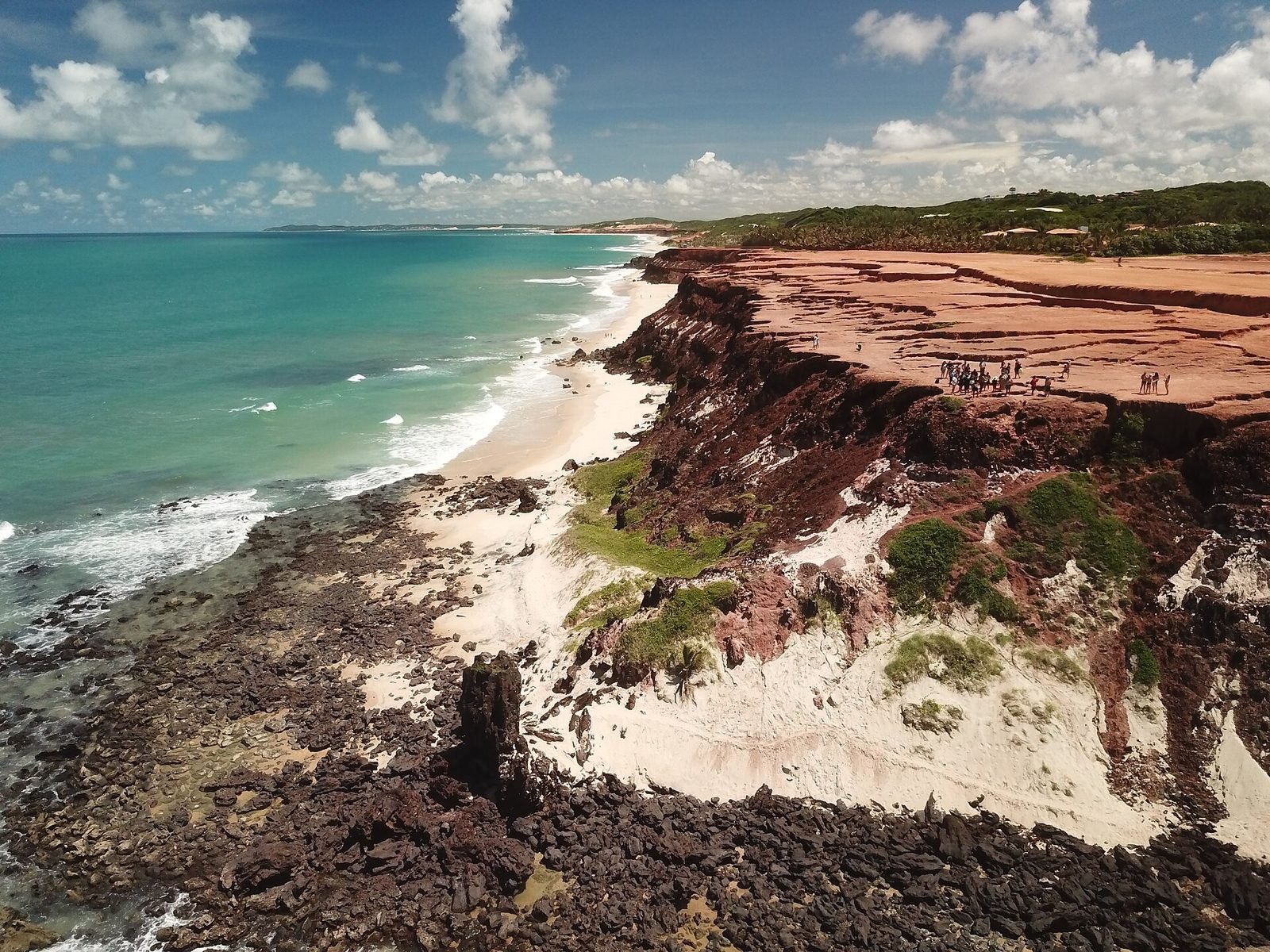
The Chapadão is a plateau of reddish cliffs, up to about 40 meters high, between Praia do Centro and Praia do Amor. From the top, you see the whole of Praia do Amor, the rocks and the open sea. It is the classic place to watch the sunset in Pipa, and in the late afternoon people gather here from every guesthouse. It is a 10-to-15-minute walk from the center.
Praia do Amor (“Love Beach”) gets its name because, seen from above, the shape of the beach and rocks resembles a heart, especially at low tide. It is the surfers’ beach, with consistent waves and surf schools. Access is by stairs from Rua Praia do Amor or along the sand from Praia do Centro at low tide.
Santuário Ecológico de Pipa
The Santuário Ecológico de Pipa is a private area of Atlantic Forest of about 90 hectares on the road to Madeiro, about 1.5 km from the center. It has around twelve short trails, 150 to 600 meters long, and viewpoints over the sea, including the Mirante dos Golfinhos (dolphin lookout) and the Mirante das Tartarugas (turtle lookout), from which you can sometimes spot the animals. According to information published by local guides and operators in 2026, admission is about R$ 30 per person, children aged 6 to 11 pay half, and it opens daily from 7:00 to 17:00. We could not find an official website for the Santuário, so confirm prices at the ticket office.
Go early in the morning, when it is cooler and the animals are more active. Wear sneakers or sport sandals, and bring water and insect repellent.
Praia do Centro
This is the village beach, where the streets from the avenue end. It has beach shacks, board rentals, surf schools and the boat departure point. At low tide, pools form between the rocks and you can walk to Dolphin Bay or Praia do Amor. At high tide, the sand narrows and the action concentrates around the beach shacks.
Praia do Madeiro
At the entrance to Pipa, about 5 km from the center by road, Madeiro is a wide, calm cove ringed by forested cliffs and coconut palms. It is good for families, beginner surfers and dolphin watching, since the dolphins also frequent this cove, one of the core areas of the REFAUTS reserve. You walk down a staircase from the road. From here, at low tide, you can continue to Dolphin Bay.
Cacimbinhas and Giz
Between Madeiro and Tibau do Sul lie Cacimbinhas and Praia do Giz, emptier beaches with cliffs and dunes. From the top of the Cacimbinhas cliffs you can see the string of beaches all the way to Madeiro. It makes a good stop on a buggy or car tour for photos. The sea can have currents, and there are not always beach shacks.
The Guaraíras Lagoon and Tibau do Sul
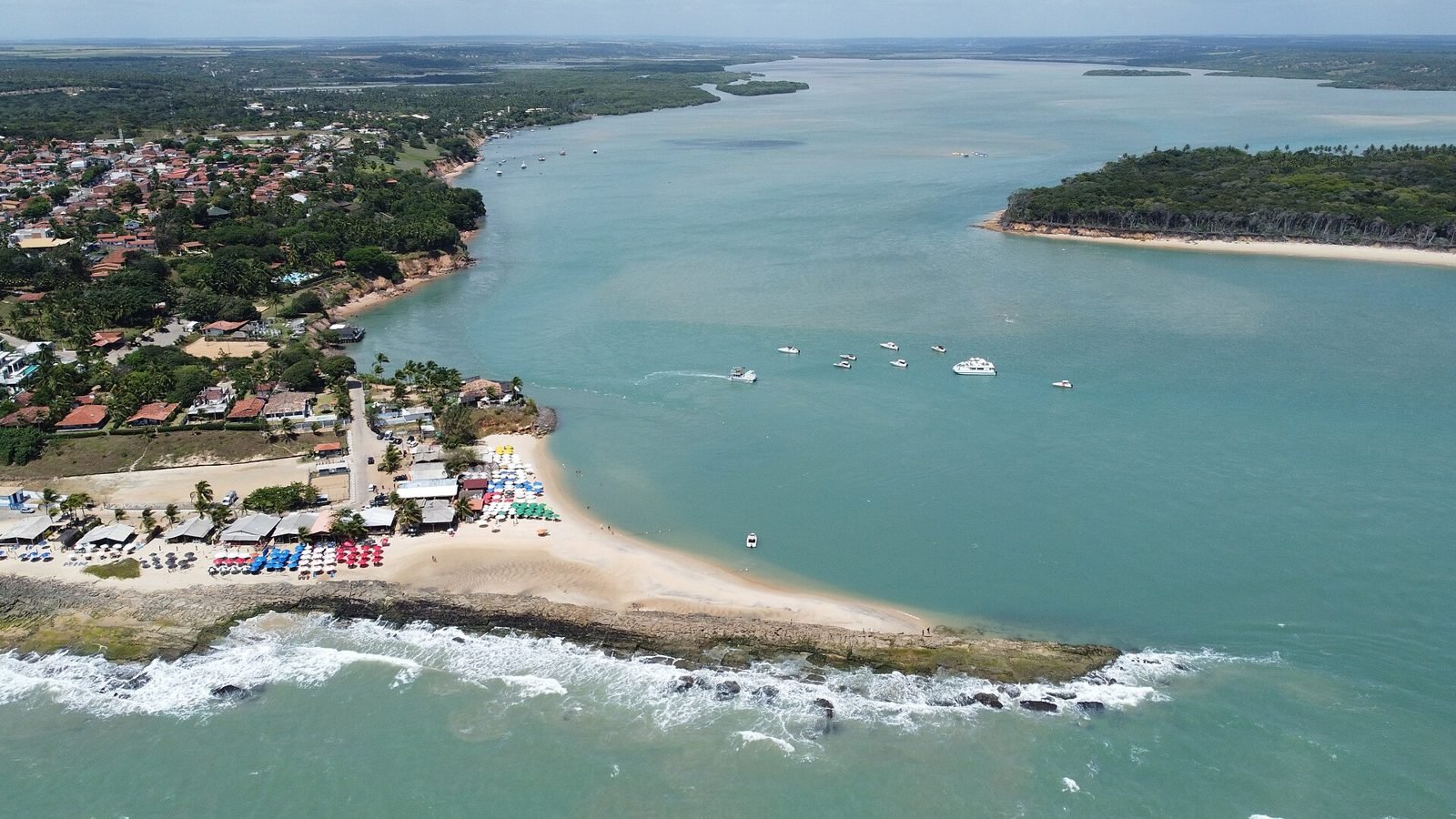
The Guaraíras Lagoon meets the sea at the tip of Tibau do Sul town, about 9 km from Pipa. The landscape of lagoon, mangroves, boats and cliffs changes color at the end of the day, and the sunset seen from the lagoon is one of the most beautiful on the Rio Grande do Norte coast. The bars and restaurants on the lagoon shore fill up at that hour.
There are sunset boat trips on the lagoon and through the mangroves. In October 2026, Luck Receptivo advertised the trip from R$ 143 per person. As this is part of the Bonfim-Guaraíra protected area, boats follow the same municipal limits, with no more than six trips a day per boat.
Minas, Cancela and Sibaúma
South of Praia do Amor, the beaches of Minas and Cancela are wide and almost undeveloped, reached by trail, buggy or along the sand at low tide. Farther on lies Sibaúma, a quilombo community certified by the Palmares Cultural Foundation in 2005, with dunes, coconut groves and wide beaches. Take it slowly, respect the community and spend money at local businesses. The sea along parts of these beaches is rough and there are no lifeguards, so only go in where locals are swimming.
Surfing, kitesurfing and other sports
Praia do Amor and Praia do Centro have surf schools offering beginner lessons and board rentals. The steady wind in the second half of the year attracts kitesurfers, more on the lagoon and open beaches than in the center. The calm waters of the Guaraíras Lagoon are also popular for paddle sports such as stand-up paddleboarding, which agencies and guesthouses can usually arrange.
The village at night
For its size, Pipa has one of the liveliest nightlife scenes on the Northeast coast. Avenida Baía dos Golfinhos fills with people strolling, restaurants with tables on the street, bars, craft shops and ice-cream parlors. Many restaurants only open in the late afternoon. There is a craft fair, running since 2005, and in high season there are parties at bars and clubs. FLIPIPA, the literary festival created in 2009, and the Pipa Food Festival, usually in early October, are the best-known events on the calendar.
Where to eat in Pipa
Direct answer: most restaurants are on Avenida Baía dos Golfinhos and the streets off it, serving Northeastern Brazilian food, seafood, pizza, Italian, Japanese and chef-driven cooking. Many only open in the late afternoon. For lunch on the beach, use the beach shacks at Praia do Centro, Madeiro and Tibau do Sul, on the lagoon shore.
Pipa has far more restaurants than its size would suggest, partly because of the foreigners who settled here from the 1980s and 1990s on. On the same street you will find a tapioca stand, seafood places, Argentine, Italian and Japanese cooking and chef-run bistros. The Pipa Food Festival, usually in early October, is a good showcase of the local scene.
Flavors of Rio Grande do Norte
From the local menu, try shrimp (Rio Grande do Norte is a major producer, with farms around the Guaraíras Lagoon), fresh fish grilled or in moqueca (a coconut-milk stew), carne de sol (salt-cured beef) with cassava and clarified “bottle butter,” tapioca crepes, cuscuz (steamed corn cake) and regional fruit juices such as cajá, cashew fruit, acerola and mangaba. Ginga com tapioca, a fried-fish snack typical of Natal, also shows up in bars around here. See more in our Natal travel guide.
Tips for eating well and spending less
- Have lunch early at the beach shacks, before the rush, and check the price of each dish before ordering.
- At night, walk the avenue and compare menus, which are usually posted at the door.
- In high season, book a table at the most popular restaurants, especially for New Year’s Eve and Carnival.
- The village’s small grocery stores and bakeries are handy for breakfast if you are renting a house or apartment.
- Ask whether the service charge is included: in tourist spots it usually comes on the bill (typically 10%).
At sunset
The late afternoon sets the plan: the Chapadão, from where you walk down to dinner in the center, or Tibau do Sul, with bars and restaurants on the shore of the Guaraíras Lagoon. In that case, arrange your ride back before you go.
How much a trip to Pipa costs
Direct answer: besides flights and lodging, the main expenses are the airport transfer (from R$ 250.50 per car through an agency), the speedboat trip to Dolphin Bay (about R$ 70 per person, plus the R$ 10 municipal fee), the Santuário Ecológico (about R$ 30 per person), the sunset boat on the Guaraíras Lagoon (from R$ 143) and buggy or jeep tours (from R$ 127 to R$ 128 per person).
The figures below come from official sources or sales pages checked in October 2026. They are references, not guaranteed prices. Restaurant and hotel prices are not included because they vary by date and have no official source.
| Item | Reference price | Source |
|---|---|---|
| Natal–Pipa bus (Viação Riograndense) | R$ 28.50, plus R$ 3 boarding fee at the bus station | Guia de Pipa, updated 10/11/2026 |
| Private transfer, Natal airport–Pipa | from R$ 250.50 per vehicle (until 12/18/2026); R$ 310 from 12/18/2026 to 01/31/2027 | Luck Receptivo, Oct 2026 |
| Speedboat to Dolphin Bay (45–60 min) | R$ 70 per person | Pipando, Oct 2026 |
| Legal minimum price for boat trips | R$ 70 per passenger (adjusted for inflation) | Municipal Law 854/2024 |
| Environmental Preservation Fee (TPA), per passenger per trip | R$ 10 (boat, pau de arara truck, quad bike); R$ 3 on the tourist train; free up to age 9; 50% for 60+ and students | Municipal Law 876/2024 |
| Santuário Ecológico de Pipa | R$ 30 per person; half price ages 6 to 11 | Pipa Local Trips and Descubre Pipa, 2026 (no official website) |
| Sunset boat on the Guaraíras Lagoon | from R$ 143 | Luck Receptivo, Oct 2026 |
| Jeep tour in Pipa | from R$ 128 | Luck Receptivo, Oct 2026 |
| Complete Pipa tour | from R$ 127 | Luck Receptivo, Oct 2026 |
| Pipa to Barra do Cunhaú tour | from R$ 242 | Luck Receptivo, Oct 2026 |
| Pipa to João Pessoa tour | from R$ 220 | Luck Receptivo, Oct 2026 |
| Preserve Pipa room tax | R$ 4 per room per night, voluntary | Preserve Pipa (ASHTEP and Pipa Convention & Visitors Bureau) |
The Preserve Pipa contribution
Member hotels charge a voluntary “room tax” of R$ 4 per night per room, regardless of the number of guests, for Preserve Pipa, an initiative of the Tibau do Sul and Pipa Hotel Association (ASHTEP) and the Pipa Convention & Visitors Bureau. According to the program’s website, the money has funded contributions to the Santuário Ecológico, Projeto Tamar (Brazil’s sea-turtle project) and a group dedicated to marine mammals, as well as trash bins on the main avenue. Since it is a donation, you can decline it, but it is an easy way to help the destination.
How to save money
Travel between August and November or in March, avoiding Brazilian holidays. Take the bus if you are already in Natal and don’t need a car. Walk to Dolphin Bay at the right tide instead of paying for the boat. Eat lunch at the beach shacks and dinner away from the main avenue. Splitting a rental car among four people usually costs less than separate transfers and tours.
Pipa itinerary: 2, 3 or 4 days
Direct answer: in two days, do Dolphin Bay, Praia do Amor, the Chapadão and the village. In three, add the Santuário Ecológico, Madeiro and sunset on the Guaraíras Lagoon. In four, add Sibaúma and Cacimbinhas by buggy or a trip to Barra do Cunhaú and Baía Formosa.
Pipa in 2 days
- Day 1: arrive, check in and have lunch. In the afternoon, Praia do Centro and a walk to Praia do Amor. Sunset at the Chapadão and dinner on Avenida Baía dos Golfinhos.
- Day 2: walk to Dolphin Bay at low tide (leave early, following the tide table). Lunch in the center. In the afternoon, the speedboat trip if the tide didn’t let you see the dolphins, or rest at your guesthouse.
Pipa in 3 days
- Days 1 and 2 as above.
- Day 3: the Santuário Ecológico early in the morning, a swim at Praia do Madeiro and, late in the afternoon, a boat trip or sunset on the shore of the Guaraíras Lagoon in Tibau do Sul.
Pipa in 4 days
- Days 1 to 3 as above.
- Day 4: a buggy or jeep tour along the southern beaches to Sibaúma, stopping at Minas and Cancela, or along the northern beaches, with Cacimbinhas and Giz. Another option is Barra do Cunhaú and Baía Formosa, about an hour’s drive away.
Itinerary tips
Build your itinerary around the tide table, not the other way round. The day with the lowest tide is the one for Dolphin Bay and beach-to-beach walks. Days with a high tide in the morning are good for the Santuário, the hotel pool or the lagoon. If you are visiting from Natal, spend at least one night in the village: the best of Pipa happens in the late afternoon and evening.
Safety in Pipa
Direct answer: the main risks in Pipa are natural: cliff collapses, a rising tide that traps visitors between rocks, currents on beaches without lifeguards and strong sun. In the village, take the same precautions as in any tourist spot, especially with your phone and wallet at night and at parties.
At sea and by the cliffs
- Never stay at the base of a cliff, not even for shade. The 2020 accident at Dolphin Bay happened to people sitting next to the cliff.
- Respect the tide. Leave Dolphin Bay and the passages between beaches before the water rises.
- On open beaches such as Minas, Cancela and Sibaúma, only swim where the water is calm and locals are in the sea.
- Do not climb up or down cliffs away from paths and stairs, and keep away from the edge of the Chapadão, especially at night.
Sun and heat
Rio Grande do Norte’s sun is strong all year, even with wind and clouds. Wear sunscreen, a hat and a UV shirt, drink plenty of water and avoid the hottest midday hours on trails and on beaches without shade.
In the village and on the road
Carry a closed bag at night, don’t leave belongings unattended on the sand and arrange transport back from Tibau do Sul or Madeiro late at night. On the road, avoid driving at night on unlit stretches and respect the speed limits on the RN-003, which passes through small villages.
Useful numbers
- SAMU (ambulance): 192
- Military Police: 190
- Fire Department: 193
- Federal Highway Police (BR-101): 191
Places near Pipa
Direct answer: Pipa pairs well with Natal (about 85 km), Tibau do Sul and the Guaraíras Lagoon (9 km), Barra do Cunhaú (about 56 km by road), Baía Formosa (about 62 km), the Pirangi cashew tree (about 68 km) and João Pessoa, in Paraíba (its airport is about 140 km away).
- Natal: the state capital has Ponta Negra beach, the Morro do Careca dune, the Genipabu dunes and the Forte dos Reis Magos fortress. See our complete Natal guide.
- Barra do Cunhaú: a beach in the municipality of Canguaretama, to the south, where a river meets the sea. The town is linked to the Martyrs of Cunhaú, Catholics killed in 1645 and canonized in 2017.
- Baía Formosa: a fishing village at the state’s southern tip. It is home to RPPN Mata Estrela, a 2,039.93-hectare private reserve registered with ICMBio, described as the largest remnant of Atlantic Forest in Rio Grande do Norte and the largest area of this biome on dunes in Brazil.
- The Pirangi cashew tree and Natal’s southern coast: on the way between Natal and Pipa, with the famous giant cashew tree and beaches such as Tabatinga.
- Other Northeast destinations: to continue your trip, see our guides to Recife, Porto de Galinhas, Maragogi, Maceió, Fortaleza, Jericoacoara and Fernando de Noronha (in 2026, direct flights to the island leave from Recife and São Paulo-Guarulhos; the Natal–Noronha route was suspended in 2025). For a comparison of three Brazilian beach towns, read Búzios, Jericoacoara and Pipa: Brazil’s under-the-radar beaches.
Where to stay in Pipa: 10 places with official websites
Direct answer: to stay in the center, within walking distance of everything, look at Pousada Toca da Coruja and Hotel Pipa Atlântico. For views of the Chapadão and Praia do Amor, Sombra e Água Fresca, Hotel da Pipa, Paua Hotel Boutique and Xamã. At the village entrance, above Dolphin Bay, Sun Bay Hotel. For nature and quiet, Hotel Ponta do Madeiro, Tibau Lagoa in Tibau do Sul and Kilombo Villas in Sibaúma. The links go to each property’s official website and were checked on October 28, 2026. There are no affiliate links. The amenities mentioned are those listed on each website, and the photos in this guide are not of these properties.
A tip before you book: ask how far it is on foot to Avenida Baía dos Golfinhos and whether there is parking. In Pipa, location changes your trip more than the hotel’s category, and hauling a suitcase uphill late at night is no fun.
Pousada Toca da Coruja (boutique guesthouse, center)
Pousada Toca da Coruja is at Avenida Baía dos Golfinhos 464, in the village center, and is a member of the Roteiros de Charme association of boutique hotels. According to its official website, it has luxury bungalows of about 130 m² built on stilts in the middle of the garden, and special apartments of 60 m². It is one of Pipa’s most traditional guesthouses, for travelers who want to walk everywhere while staying in a forest setting. Phone numbers listed on the website: +55 (84) 3246-2226 and +55 (84) 3246-2225.
Sombra e Água Fresca (hotel, resort and spa, Praia do Amor)
Sombra e Água Fresca is at Rua Praia do Amor 1000, facing the Chapadão. According to its official website, it has three units: the hotel, with 28 rooms and two panoramic pools overlooking the Chapadão and Praia do Amor; the resort, with 10 houses; and the Spa Floresta. It is a good choice if you want the sunset view without leaving the hotel. Listed phone numbers: +55 (84) 3246-2258 and +55 (84) 3246-2376.
Hotel da Pipa (hotel, Praia do Amor)
Hotel da Pipa is at Rua Praia do Amor 50, at the start of the street that leads to the Chapadão. Its official website says it is the only hotel with exclusive access to Praia do Amor and highlights its pool deck over the sea. It is a few minutes’ walk from the center. Listed contacts: +55 (84) 99115-5355 and +55 (84) 98132-8284.
Paua Hotel Boutique (boutique hotel, Chapadão)
Paua Hotel Boutique is at Avenida Baía dos Golfinhos 1747, in the Chapadão area. According to its official website, guests stay in bungalows, with garden-view and sea-view options, and the hotel has its own restaurant. It suits couples who want privacy close to the center.
Hotel Pipa Atlântico (hotel, center)
Hotel Pipa Atlântico is at Avenida Baía dos Golfinhos 578, in the center. According to its official website, it has 97 units on a 13,000 m² plot and offers accessible rooms, which is rare in a hilly village. Good for families and groups who want full hotel facilities within walking distance of the nightlife. Listed phone: +55 (84) 3246-2565.
Sun Bay Hotel (hotel, Dolphin Bay)
Sun Bay Hotel is at Avenida Baía dos Golfinhos 125, at the entrance to Pipa, on the clifftop above Dolphin Bay. According to its official website, it has four pools, 3,000 m² of gardens, more than ten room categories, accessible facilities and a day-use option from 10:00 to 18:00. It is a longer walk from the center, offset by the view. Listed phone numbers: +55 (84) 2018-3611 and +55 (84) 3087-1602.
Xamã Senses (guesthouse, near Praia do Amor)
Xamã is at Rua dos Cajueiros 45. According to its official website, it has a heated saltwater pool and is about 5 minutes from Praia do Amor. It is a smaller guesthouse, for travelers who want a homely feel between the center and the Chapadão. Listed phone: +55 (84) 4042-0943.
Hotel Ponta do Madeiro (hotel, Madeiro)
Hotel Ponta do Madeiro sits on the Madeiro clifftop, on the road into Pipa (Avenida Antônio Florêncio 2695). According to its official website, it lies within 1.5 million m² of native vegetation, has five room categories and offers transfers. It is for travelers who want nature, a lookout over the dolphins’ cove and silence, and don’t mind relying on a car or taxi to reach the village. Listed phone numbers: +55 (84) 98802-3597 and +55 (84) 98870-4041.
Kilombo Villas (luxury hotel, Sibaúma)
Kilombo Villas is at Rua das Tartarugas 1, on Sibaúma beach, south of Pipa. Its official website describes it as a five-star luxury hotel with 10 private villas, its own restaurant (Kibo) and breakfast served in your villa or by the sea. A choice for honeymooners and travelers who want seclusion, with a car.
Tibau Lagoa (chalets, Tibau do Sul)
Tibau Lagoa is in Tibau do Sul, near the Guaraíras Lagoon. According to its official website, it offers detached chalets with garden or lagoon views and a 24-hour reception, close to the beaches of Tibau do Sul, Giz and Cacimbinhas, 10 minutes from Praia do Madeiro and 15 minutes from Pipa’s center. A good base if you want lagoon sunsets and prices outside the center.
Video: the Sea Trail in Pipa
The video below was published by Visit Brasil, the channel of Embratur, Brazil’s official tourism promotion agency. It is 30 seconds of footage of Pipa, from the cliffs to the sea, from the Sea Trail series.
Pipa FAQ
What is there to do in Pipa, Brazil?
The highlights are Dolphin Bay at low tide, sunset at the Chapadão cliffs, the trails of the Santuário Ecológico, a speedboat ride along the beaches, Praia do Madeiro, late afternoon on the Guaraíras Lagoon in Tibau do Sul and a buggy or jeep ride to Sibaúma. At night, everything happens on Avenida Baía dos Golfinhos.
How many days do you need in Pipa?
Three days are enough for the village, Dolphin Bay, the Chapadão, the Santuário and the lagoon. With four or five, you can add Sibaúma, Barra do Cunhaú, Baía Formosa or João Pessoa. A day trip from Natal is possible, but you miss the late afternoon and evening, which are the best of Pipa.
When is the best time to visit Pipa?
From September to February, when it rarely rains. October and November are the driest months, with about 20 mm of rain on average in Natal. March to July is the rainy season, peaking in June. High season runs from December to Carnival, plus July.
How do you get to Dolphin Bay in Pipa?
On foot, only at low tide: start at Praia do Centro and walk about 10 minutes north along the sand, or take the staircase of about 160 steps down to Praia do Madeiro and continue along the sand. Arrive about 3 hours before low water and head back before the tide rises. You can also see the cove by speedboat from Praia do Centro.
Can you swim with dolphins in Pipa?
The Guiana dolphins often approach swimmers at Dolphin Bay and Madeiro, especially at low tide. But touching, chasing or feeding them is prohibited, since they live in the REFAUTS municipal reserve. Stay still and let them come to you.
How much is a boat trip in Pipa?
The 45-to-60-minute speedboat trip to Dolphin Bay cost R$ 70 per person in October 2026, which is also the minimum price set by Municipal Law 854/2024. Add the Environmental Preservation Fee of R$ 10 per passenger, free up to age 9 and half price for seniors and students. The sunset boat on the Guaraíras Lagoon started at R$ 143.
How much does the Santuário Ecológico de Pipa cost?
According to local guides and operators, in 2026 admission was about R$ 30 per person, with half price for children aged 6 to 11, and the park opened daily from 7:00 to 17:00. It covers about 90 hectares of Atlantic Forest with about 12 short trails. The Santuário has no official website, so confirm at the ticket office.
How do you get from Natal to Pipa?
By car or transfer, it is about 82 km from Ponta Negra and 95 km from the airport, via the BR-101 and RN-003, in 1 hour 20 minutes to 2 hours. By bus, Viação Riograndense leaves Natal’s bus station several times a day, with fares of R$ 28.50 and a trip of about 2 hours. A private airport transfer starts at R$ 250.50 per car.
Are the cliffs in Pipa dangerous?
The cliffs are fragile and can collapse, as happened at Dolphin Bay in 2020, when a family died. Do not sit at their base, do not use them for shade and avoid the strip next to the cliff during the highest tides. On top, keep away from the edge.
Is Pipa good for kids?
Yes, with some care. Praia do Madeiro has calmer water, the Santuário has short trails and boat trips are quick. Watch out for the village’s steep streets, rough sea on open beaches and the cliffs. The Environmental Preservation Fee only applies from age 10.
Is Pipa worth visiting?
Yes, especially if you like nature with nightlife close at hand. Few places in Brazil combine dolphins that come close to the beach, colorful cliffs, Atlantic Forest, a lagoon with spectacular sunsets and a village with restaurants serving many cuisines, just over an hour from a state capital. The trade-off is the crowds in high season and a few precautions you cannot forget: tides, cliffs and respect for the animals. If you are going to Natal, set aside at least two or three nights for Pipa. If you plan to keep traveling around the Northeast, read our guides to Natal, Recife, Maragogi, Fortaleza, Salvador and the Lençóis Maranhenses.
Sources
- Tibau do Sul City Council: Municipal Law 854/2024 (boat tours, in Portuguese)
- Tibau do Sul City Council: Municipal Law 876/2024 (Environmental Preservation Fee, in Portuguese)
- Tibau do Sul City Council: Municipal Law 616/2018 (REFAUTS, in Portuguese)
- IBGE Cidades: Tibau do Sul
- INMET: climate normals
- Brazilian Navy: tide tables (CHM)
- g1 RN: cliff collapse in Pipa (2020, in Portuguese)
- Estadão: federal prosecutors investigate the cliff accident (in Portuguese)
- Observatório Terras Quilombolas: Sibaúma
- ICMBio SIMRPPN: RPPN Mata Estrela
- Guia de Pipa: Natal–Pipa buses
- Pipando: how to get to Dolphin Bay
- Luck Receptivo: Pipa tours and transfers (reference prices)
- Pipa Local Trips: Santuário Ecológico de Pipa
- Descubre Pipa: Santuário Ecológico (hours and half-price tickets)
- Preserve Pipa: room tax and projects
- Wikipedia: Tibau do Sul (history and IBGE data)
- OpenStreetMap and OSRM: driving distances and times